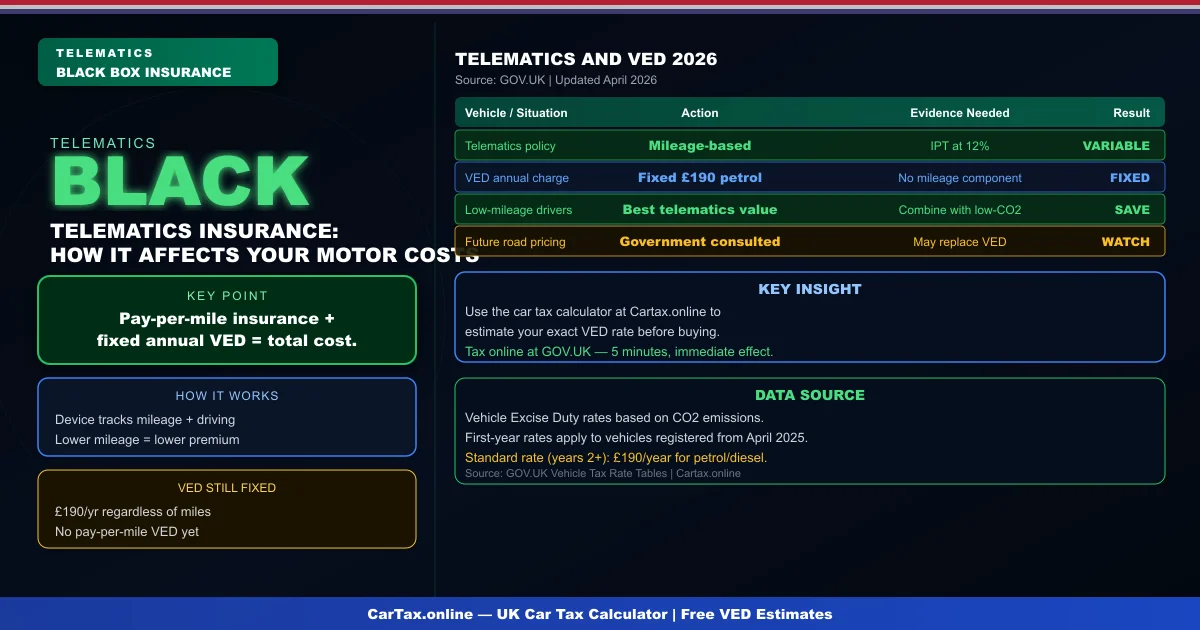
Telematics insurance — also called black box or usage-based insurance — tracks your driving behaviour and mileage. While it does not directly affect road tax, understanding the relationship between mileage-based insurance and fixed annual costs like VED helps you calculate your true cost of motoring.
How Telematics Insurance Works
Telematics policies use a small device plugged into your car's OBD port or a smartphone app to record driving behaviour: speed, acceleration, braking, cornering and mileage. Insurers use this data to calculate your premium — safer drivers and lower-mileage drivers typically pay less. Some telematics policies offer a PAYD (Pay As You Drive) model where your premium is directly tied to miles driven, while others offer discounted fixed premiums based on driving score.
VAT and Telematics Insurance
Insurance premiums are subject to Insurance Premium Tax (IPT) at the standard rate of 12%, not VAT. This means the VAT treatment of telematics insurance is the same as any other insurance — there is no VAT to reclaim on the premium. However, the cost of the telematics device itself — if rented rather than owned — may include VAT that businesses can reclaim under standard input tax rules if the vehicle is used for business.
Annual VED vs Pay-Per-Mile: Cost Comparison
Telematics insurance introduces a variable cost element — mileage — alongside the fixed cost of road tax. For low-mileage drivers, a combination of low-mileage telematics insurance and standard annual VED may be cheaper than a standard insurance policy with no mileage cap. However, VED is a flat annual charge regardless of mileage — you pay the same £190 whether you drive 1,000 or 20,000 miles. There is currently no pay-per-mile road tax option for cars in the UK, though this is under government consideration. Related: Car Tax and Telematics Insurance UK 2026 | Car Tax Telematics Insurance UK 2026 | Car Tax Telematics Insurance UK 2026 | Car Tax and Telematics UK 2026.
New Drivers and Telematics
Telematics insurance is particularly popular among young and new drivers, who face very high standard insurance premiums. A telematics policy can significantly reduce insurance costs for new drivers who are careful and low-mileage. For this group, VED is based on the vehicle's CO2 — the same as any driver. The vehicle type matters more than driving experience for road tax. A new driver in a low-CO2 car pays exactly the same VED as an experienced driver in the same car.
Future: Pay-Per-Mile Road Tax Proposals
The government has consulted on replacing or supplementing VED with a road pricing mechanism based on miles driven. This would be a significant change — potentially replacing the fixed annual VED charge with a variable cost based on actual road use. Such a system could complement or replace current telematics insurance by using similar technology to track mileage for tax purposes. Watch for further government announcements on road pricing in future budget statements.
Official Resources: GOV.UK Check Vehicle Tax | GOV.UK Vehicle Tax | DVLA Online | MOT Check
Frequently Asked Questions
Q: How much is car tax (VED) in the UK 2026?
Car tax rates in the UK depend on your vehicle's CO2 emissions and list price. Standard rates start from £190 per year for petrol and diesel cars, with zero-rated VED for EVs. First-year rates vary from £0 to £2,605 depending on emissions. Additional premiums apply for vehicles over £40,000.
Q: How do I check if my car is taxed online?
You can check your vehicle's tax status for free on the Gov.uk website at gov.uk/check-vehicle-tax. You'll need your vehicle's registration number (number plate). You can also check via the Motor Insurance Database to verify road tax and insurance status simultaneously.
Q: Can I get a refund on car tax if I sell my vehicle?
Yes — if you sell or scrap your vehicle, you can claim a refund on any full months of remaining road tax. Contact DVLA with the V11 reminder letter or apply online at gov.uk. Refunds are usually processed within 4-6 weeks.
Q: Is road tax refund available when transferring ownership?
No — road tax does not transfer with the vehicle. When you sell your car, the tax is automatically cancelled and any remaining months are refunded to you by DVLA. The new owner must tax the vehicle immediately. As a buyer, always verify the vehicle's tax status before purchasing.
Q: What is the luxury car tax threshold in the UK 2026?
The additional rate for vehicles over £40,000 (list price) adds £410 per year to standard VED rates for years 2-6 of registration. This surcharge brings the annual cost for high-emission vehicles over £40,000 to around £600-690 per year. Pure EVs under £40,000 pay zero VED.