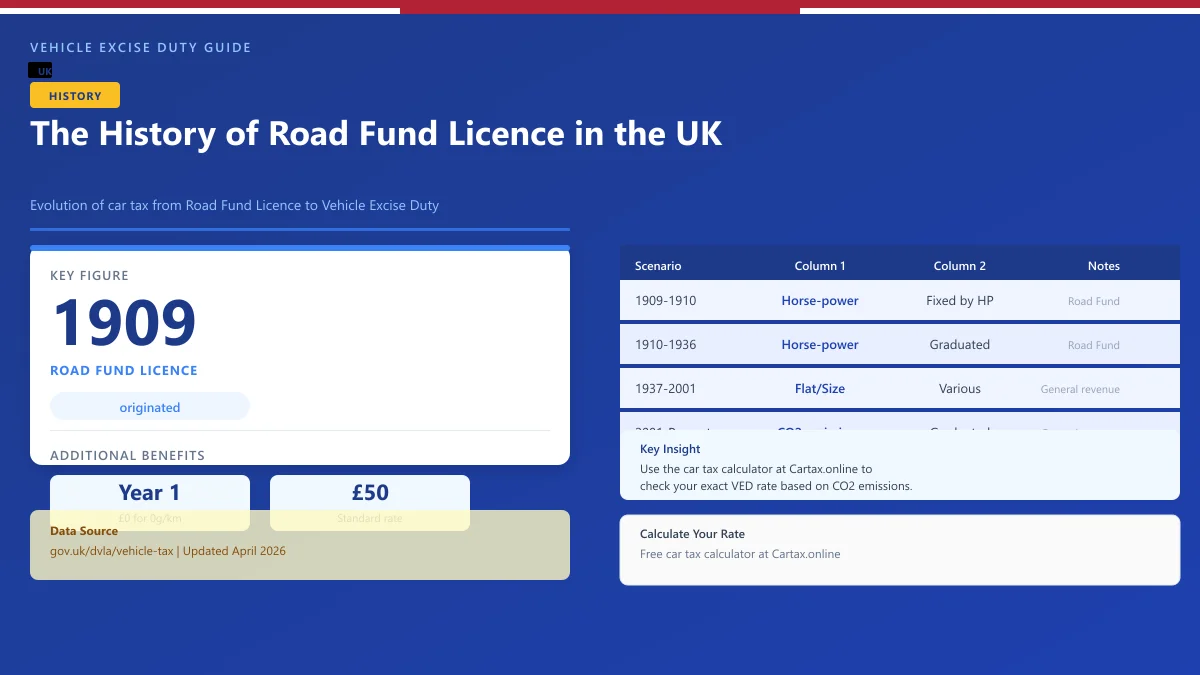
April 13, 2026 in United Kingdom — The history of road tax in the UK stretches back over a century, from the first Road Fund Licence in 1909 to today's graduated CO2-based Vehicle Excise Duty. Understanding how car tax has evolved helps put today's rates in context.
Origins of the Road Fund Licence (1909-1910)
The Road Fund Licence was introduced in 1909 under the Finance (1909-1910) Act, with the first licences issued in 1910. Revenue from vehicle taxation was specifically designated to fund road building and maintenance — this ring-fenced arrangement gave car tax a purpose and justified the levy to motorists. The original licence fee was based on horse-power, calculated from cylinder bore and number of cylinders.
By 1912, over 100,000 licences had been issued, and the Road Fund had accumulated significant balances dedicated to road improvements. The history of road fund licence in the UK began as a pragmatic solution to fund the growing motor car infrastructure.
History of Road Fund Licence: Key Periods
- 1909-1910: Horse-power rating — Fixed by HP band — Revenue to Road Fund (ring-fenced)
- 1910-1936: Horse-power rating — Graduated by HP — Revenue to Road Fund (ring-fenced)
- 1937-1946: Flat rate — Single annual fee — Revenue to general taxation
- 1947-1956: Flat rate — Single annual fee — Revenue to general taxation
- 1956-2001: Engine size (cubic capacity bands) — Graduated — Revenue to general taxation
- 2001-Present: CO2 emissions — Graduated CO2 bands — Revenue to general taxation
The Golden Era of Ring-Fenced Road Tax (1910-1936)
Between 1910 and 1936, all vehicle excise revenue went directly into the Road Fund and was spent exclusively on roads. The fund financed major projects including trunk roads, bridges, and the emerging classified road network. Related: Road Fund Licence History UK | Car Tax History UK 2026 | Car Tax History UK 2026 | Car Road Tax UK 2026.
In 1921, the total road fund revenue was £12.7 million — a substantial sum at the time. By the mid-1930s, the fund had built thousands of miles of new roads. However, the increasing costs of road maintenance and the growth in motor traffic meant the fund was consistently overspent against its income.
Integration into General Revenue (1937-Present)
In 1937, the Road Fund was merged into the Consolidated Fund, and vehicle excise revenue became general taxation. The original ring-fenced purpose was abandoned in favour of broader fiscal flexibility. Motorists argued that since they were still paying road tax, the money should continue to be spent on roads — this debate has persisted to the present day.
The shift meant that car tax history UK became indistinguishable from other forms of taxation. Critics have long argued that this breaks the original social contract — drivers pay road tax but the money is spent on general services with no guaranteed road investment.
The Modern CO2-Based System (2001-Present)
The 2001 reform marked the most significant change in car tax history UK — replacing a system based on engine size with one based on environmental impact. This created the progressive VED structure we know today, where zero-emission vehicles pay nothing while the highest-emission vehicles pay £2,605 per year.
The graduated CO2-based system aligns car tax with environmental policy — those who produce more emissions pay more. The March 2025 changes further extended this logic by introducing the first-year graduated rates for brand new vehicles.
Future of Road Tax in the UK
The long-term future of car tax is uncertain. With the 2030 ZEV target approaching and the growing proportion of zero-emission vehicles on UK roads, the government faces declining VED revenues. Projections suggest that by 2035, VED income could fall by 40%.
Road User Charging is being discussed as a replacement mechanism — a per-mile charge that replaces the fixed annual VED with a variable charge based on actual road usage. Several European countries have already introduced such systems.
Conclusion
The history of road fund licence in the UK shows a journey from ring-fenced road funding to general taxation, then to the modern CO2-based graduated system. The next chapter may be road user charging. For today's VED rates, use our car tax calculator. Read more at GOV.UK VED rate tables.
Frequently Asked Questions
Q: How much is car tax (VED) in the UK 2026?
Car tax rates in the UK depend on your vehicle's CO2 emissions and list price. Standard rates start from £190 per year for petrol and diesel cars, with zero-rated VED for EVs. First-year rates vary from £0 to £2,605 depending on emissions. Additional premiums apply for vehicles over £40,000.
Q: How do I check if my car is taxed online?
You can check your vehicle's tax status for free on the Gov.uk website at gov.uk/check-vehicle-tax. You'll need your vehicle's registration number (number plate). You can also check via the Motor Insurance Database to verify road tax and insurance status simultaneously.
Q: Can I get a refund on car tax if I sell my vehicle?
Yes — if you sell or scrap your vehicle, you can claim a refund on any full months of remaining road tax. Contact DVLA with the V11 reminder letter or apply online at gov.uk. Refunds are usually processed within 4-6 weeks.
Q: Is road tax refund available when transferring ownership?
No — road tax does not transfer with the vehicle. When you sell your car, the tax is automatically cancelled and any remaining months are refunded to you by DVLA. The new owner must tax the vehicle immediately. As a buyer, always verify the vehicle's tax status before purchasing.
Q: What is the luxury car tax threshold in the UK 2026?
The additional rate for vehicles over £40,000 (list price) adds £410 per year to standard VED rates for years 2-6 of registration. This surcharge brings the annual cost for high-emission vehicles over £40,000 to around £600-690 per year. Pure EVs under £40,000 pay zero VED.