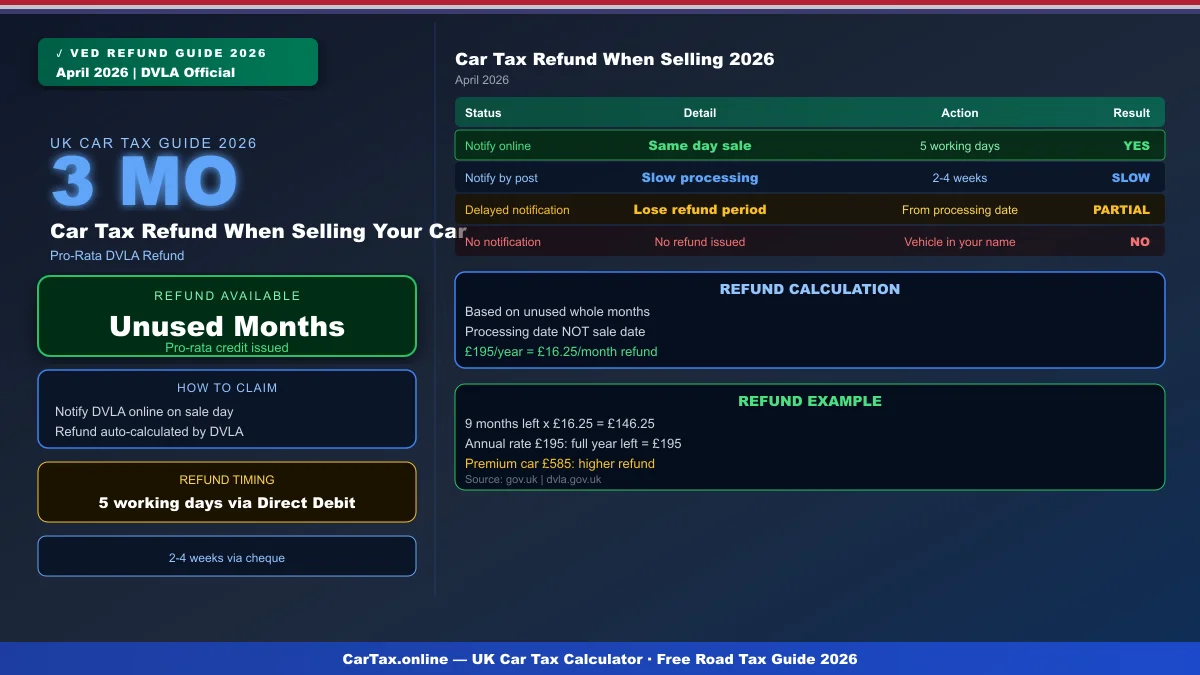
April 12, 2026 in United Kingdom — When you sell a vehicle, any unexpired road tax period is refundable. The DVLA calculates the refund as a pro-rata credit based on unused whole months remaining in the tax period. This means if you sell your car with three months of tax left, you are entitled to a refund of those three months. Understanding how the refund works prevents both sellers and buyers from losing money unnecessarily.
How the DVLA Car Tax Refund Works
Road tax in the UK is paid in advance for a 12-month period. When a vehicle is sold and the seller notifies the DVLA of the change of keeper, the DVLA automatically calculates any refund due and issues it to the previous keeper.
The refund calculation:
- Based on unused whole months remaining in the tax period
- Calculated from the date the DVLA processes the notification, not the sale date
- Issued via the original payment method (bank account for Direct Debit, cheque for card payment)
- Typically received within 5 working days for Direct Debit, longer for cheques
Notifying the DVLA — The Critical Step
The refund only triggers when the DVLA processes a change of keeper notification. The two ways to notify:
Online (Fastest — Recommended)
Use GOV.UK sell your vehicle and enter the 11-digit V5C reference number plus the new keeper's details. The DVLA processes this immediately, and the refund is issued within 5 working days.
By Post
Fill in section 9 of the V5C (or the green slip) and post it to the DVLA. Processing takes up to 4 weeks, delaying the refund. The seller should keep the yellow copy as proof of submission.
The key point: the refund is calculated from the processing date, not the sale date. If you notify the DVLA three weeks after selling, the refund only covers the unused period from that processing date — you lose those three weeks.
What the Seller Gets — Refund Examples
| Months Left on Tax | Annual Tax Rate | Monthly Refund | Example Refund |
|---|---|---|---|
| 12 months | £195/year | £16.25/month | £195.00 (full year remaining) |
| 9 months | £195/year | £16.25/month | £146.25 |
| 6 months | £195/year | £16.25/month | £97.50 |
| 3 months | £195/year | £16.25/month | £48.75 |
| 1 month | £195/year | £16.25/month | £16.25 |
For vehicles in higher CO2 bands, the refund is proportionally higher. A vehicle paying £680/year in VED (band 166-175g/km) gets a refund of £56.67 per unused month.
Seller vs Buyer — Who Should Tax the Car?
The answer is clear: the seller should notify the DVLA immediately on the day of sale, and the buyer should tax the vehicle immediately upon purchase. Both actions can be taken on the same day.
The buyer needs the green slip (new keeper notification) from the seller to tax the vehicle immediately. The green slip has a 21-digit reference number that works for online taxing even before the full V5C arrives by post.
If the seller hasn't notified DVLA yet when the buyer tries to tax, the buyer can still tax using the green slip. The DVLA system accepts the new keeper details and processes the transfer.
What Happens If You Don't Notify the DVLA?
Until the DVLA processes the change of keeper notification, the vehicle remains registered in the seller's name. This has consequences:
- The seller is liable for any fines, toll charges, or penalties incurred by the vehicle
- The seller continues to be the registered keeper for DVLA purposes
- The unexpired tax refund is not issued until notification is processed
- If the vehicle is involved in an incident, the registered keeper may be implicated
The DVLA recommends notifying within 14 days of selling or transferring the vehicle. If more than 14 days pass and the new keeper has not taxed the vehicle, the DVLA may assume the seller has not notified and follow up.
Premium Supplement Refund — Vehicles Over £40,000
For vehicles paying the premium supplement (£390/year in addition to the standard rate), the refund calculation is different. The premium supplement applies for years 2-6. If sold partway through year 2-6, the refund for the premium supplement portion is also calculated pro-rata.
Example: A vehicle paying £585/year (£195 standard + £390 supplement) sold with 6 months remaining in year 3 gets a refund of £195 for the supplement portion plus £97.50 for the standard rate portion = £292.50 total.
Frequently Asked Questions
Can I keep the tax on my car when I sell it?
No. Road tax is attached to the vehicle registration, not the keeper. When a vehicle changes keeper, the tax does not transfer with it — the seller receives a refund for unused months, and the buyer must tax the vehicle independently.
What if I sell a car that's already untaxed?
If you sell a vehicle showing as untaxed on the DVLA system, either the tax expired recently or there was a Direct Debit failure. You cannot claim a refund for unused tax since there is no unused period. The buyer must tax immediately. Check with the DVLA to confirm the status before the sale.
Does the buyer get any tax credit from my purchase?
No. The refund goes to the seller because they paid for the full tax period. The buyer starts a fresh 12-month tax period from the date they tax the vehicle. There is no partial credit or transfer of unused tax to the buyer.
How long does the road tax refund take?
For Direct Debit payments, the refund is issued within 5 working days of the DVLA processing your notification. For credit/debit card payments, a cheque is issued which may take 2-4 weeks to arrive. Online notification is always faster than postal.
Can I tax the car and then sell it to get a full refund?
No. The DVLA only refunds unused whole months from the date the change of keeper notification is processed. Taxing for a full year and then immediately selling results in an 11-month refund — the month the notification was processed is not refunded.
Conclusion
When selling your car, notify the DVLA on the same day to maximise your road tax refund. The refund covers unused whole months from the processing date, paid via your original payment method within 5 working days for Direct Debit. The buyer should tax the vehicle immediately using the green slip before driving.
Use our UK car tax calculator to estimate your annual road tax costs and budget for the pro-rata refund when selling.