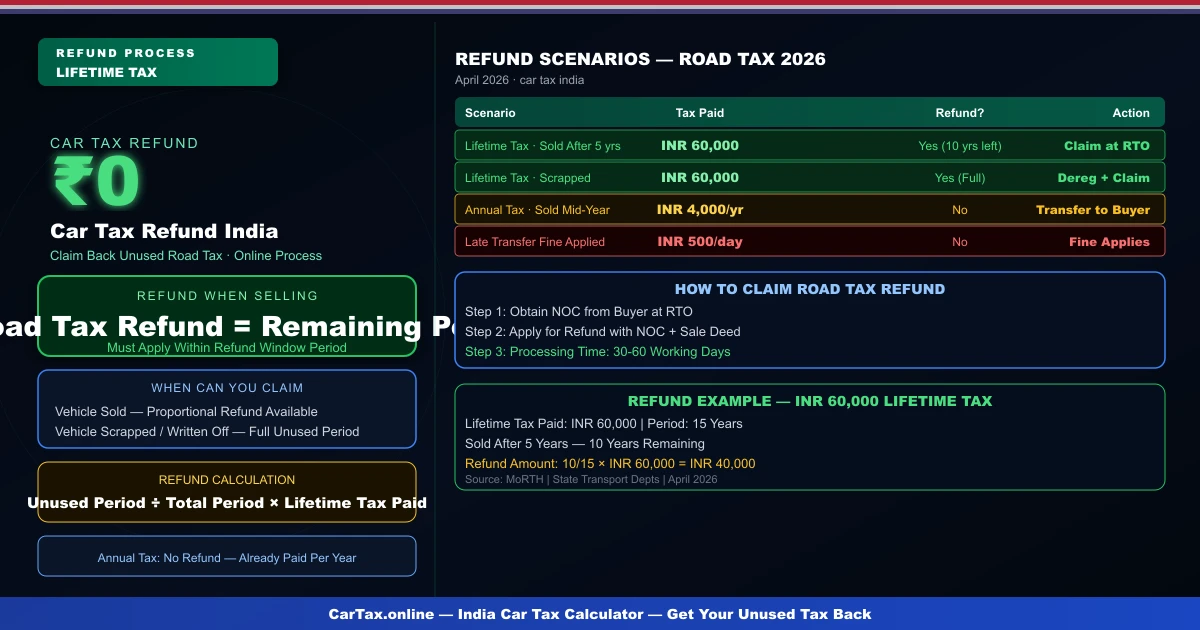
Car tax refund in India for 2026 follows the established framework under each state's motor vehicle taxation rules, allowing vehicle owners to recover unused road tax when selling, permanently deregistering, or transferring their vehicle. Despite the process being well-established, many vehicle owners remain unaware of their refund eligibility, leaving money unclaimed.
As of April 18, 2026, road tax refund claims must be filed at the original RTO where the tax was paid, and only the registered owner can claim the refund. The refund amount is calculated based on the unused remaining period of the road tax already paid, making early sale of a vehicle more financially advantageous than keeping it.
When Are You Eligible for a Road Tax Refund?
You are eligible for a road tax refund when you sell your vehicle, permanently deregister the vehicle, or transfer registration to another state. The refund covers the unused portion of the road tax period already paid. If you paid lifetime road tax or annual road tax and sell the vehicle partway through the period, the unexpired portion is refundable.
The refund is not automatic and must be actively claimed by the registered owner. Many sellers overlook this and simply factor any residual tax value into the sale price negotiations. However, the refund belongs to the seller, not the buyer, and requires separate application to the RTO after the sale is complete.
How to Claim Road Tax Refund in India
To claim a road tax refund, visit the original RTO where the road tax was paid with the original tax receipt, sale deed, NOC if applicable, RC book, and a written application form. The application should state the date of sale, the reason for refund, and the period of unused tax being claimed. The RTO will verify the details and process the refund after deducting any applicable processing fees.
Processing times vary significantly by state. Maharashtra, Karnataka, and Gujarat have online refund request portals that process claims within 30 to 60 days. Other states may take up to 6 months for manual processing. Some states require the vehicle to be physically present for inspection before approving the refund, which can be impractical for vehicles already sold to a new owner in another state.
Road Tax Refund for Private Car Sales
When selling a car privately within the same state, the refund is calculated from the date of sale to the end of the paid tax period. For annual tax payers, this typically means refund for the remaining months of the year. For lifetime tax payers, the refund is proportional to the remaining years of the vehicle's expected useful life as defined by state norms.
Private sellers should ideally claim the refund before or immediately after the ownership transfer is completed in the RTO records. Once the new owner's name appears on the RC, the original owner loses the ability to claim the refund. Sellers should ensure they receive the Form 28 signed by the buyer as evidence of transfer to support their refund claim.
Road Tax Refund for Inter-State Transfers
When transferring a vehicle to another state, the original owner must first obtain an NOC from the origin state's RTO, which involves clearing all pending tax dues. The road tax refund for inter-state transfers is claimed by the original owner from the origin state's RTO after the NOC is issued. The refund is not transferred to the new owner or the destination state.
The timeline for inter-state refund claims can be extended because the NOC process itself takes 4 to 6 weeks, and the refund claim can only be filed after the NOC is issued. Sellers should maintain copies of all submitted documents and follow up with the RTO periodically to ensure timely processing of their refund claim.
State-wise Road Tax Refund Variations
Road tax refund rules and processing times vary by state. States like Maharashtra and Karnataka process refunds within 30 to 60 days through their online systems. Delhi has specific refund request forms that must be submitted in person. Some smaller states may require extensive documentation and take longer to process claims.
For detailed state-specific guidance, use our India car tax calculator which includes information on road tax refund procedures across major Indian states. Always retain original tax receipts and payment confirmations as these are essential for processing any refund claim.
Frequently Asked Questions
How do I claim a car tax refund in India?
To claim a car tax refund, visit the original RTO where the road tax was paid with the original tax receipt, sale deed, NOC if applicable, RC book, and a written application. The refund is calculated for the unused remaining period of the tax paid. Processing times vary by state from 30 days to 6 months.
When am I eligible for a road tax refund?
You are eligible for a road tax refund when you sell your vehicle, permanently deregister the vehicle, or transfer it to another state. The refund covers the unused portion of the road tax period already paid. If you paid annual tax, the refund is calculated from the date of sale to the end of the paid period.
Can I get a road tax refund if I sell my car privately?
Yes, private sellers are entitled to road tax refunds for the unused portion of their paid tax. The refund is claimed by the registered owner at the original RTO, not the buyer. The seller should factor this into the sale price negotiations since the buyer will need to pay fresh road tax in their own name.
How long does a car tax refund take in India?
Car tax refund processing times vary significantly by state. States like Maharashtra, Karnataka, and Gujarat process refunds within 30 to 60 days through online portals. Other states may take up to 6 months for manual processing. Some states require physical visit to the RTO while others accept online applications.
Is road tax refund automatic when I sell my car?
No, road tax refund is not automatic. You must actively apply for it at the original RTO with supporting documents including the sale deed, original tax receipt, and RC book. If you do not apply, the unused tax credit remains unclaimed and you lose the money. There is typically no time limit to claim, but it is advisable to apply promptly after sale.
Official Resources: Parivahan Portal | Vahan Road Tax | India GST Portal | FAME-III Scheme
Frequently Asked Questions
Q: What is the current road tax rate for cars in India 2026?
Road tax rates in India vary by state and vehicle category. For new cars, GST is charged at 5% for EVs, 18% for hybrids under 1,200cc, and up to 28% for petrol/diesel SUVs. State road tax is charged separately and varies from Rs3,000-15,000 annually depending on the state's slab system. Check your specific state's RTO website for current rates.
Q: How do I calculate my car road tax online in India?
You can calculate your car road tax using online calculators available on state RTO portals and CarTax.online. The calculation considers your vehicle's ex-showroom price, fuel type, engine capacity, and state of registration. Road tax is payable annually or for the vehicle's lifetime depending on your state's rules.
Q: Is GST included in the road tax for new cars in India?
No — GST and road tax are separate charges. GST is a central tax charged by the vehicle manufacturer at the time of purchase. State road tax is a separate annual or one-time charge levied by your state's transport department. Both apply at the time of first registration, and annual road tax continues for subsequent years.
Q: Do electric vehicles get tax benefits in India 2026?
Yes — electric vehicles in India qualify for a reduced GST rate of 5% (down from 28% for petrol cars). Under FAME-III subsidies, EVs may also qualify for additional state-level incentives, reduced road tax, and free registration in many states. The exact benefits vary by state.
Q: What happens if I don't pay my car road tax on time?
If you don't pay road tax, your vehicle's registration can be flagged in the Vahan database, preventing renewal of fitness certificates and creating legal liability during police checks. Penalties range from Rs200-500 per day of default in most states. Road tax is a legal requirement under the Motor Vehicles Act.