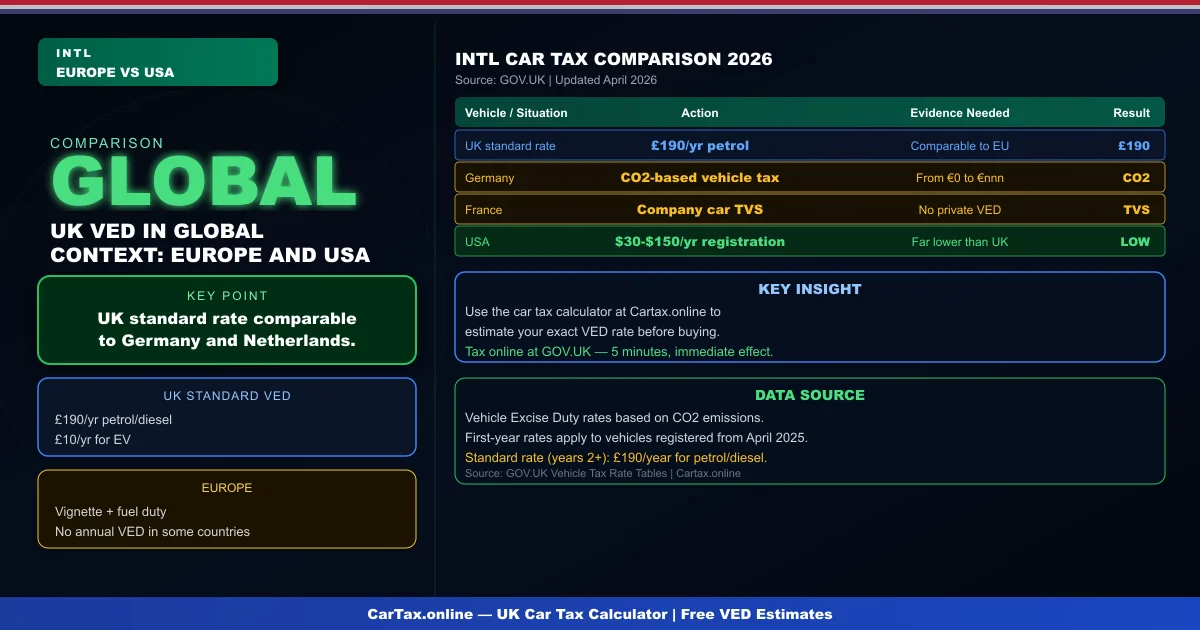
Road tax systems vary significantly between countries. Understanding how the UK's Vehicle Excise Duty compares to systems in Europe and the US helps put your annual VED bill in international context.
UK VED vs European Vignette Systems
Many European countries use a vignette system — a road charge payable for using specific roads or motorways — rather than an annual vehicle tax. Germany charges based on CO2 for cars registered since 2021, with older cars paying a flat rate. Austria, Switzerland and Czech Republic use vignette stickers for motorway use. France uses a péage (toll) system on major roads. The UK is unusual in having a comprehensive annual vehicle tax system that is separate from road use charges.
France: Taxe Spéciale sur Certains Véhicules Routiers
France has progressively shifted towards CO2-based vehicle taxation, particularly for company cars through the TVS (taxe sur les véhicules de société). Company car drivers in France pay a significant annual charge based on CO2 — which is more directly tied to environmental impact than the UK's flat standard rate. However, France does not have a separate annual VED equivalent for private vehicles, relying instead on tolls and fuel taxes.
Germany: Vehicle Tax
Germany taxes vehicles based on CO2 and engine size for older cars. Since 2021, new cars are taxed purely on CO2 under WLTP measurement, with rates ranging from €0 for zero-emission vehicles to hundreds of euros per year for high-CO2 cars. Germany also has a truck road user levy (Maut) for heavy goods vehicles. The German system is more directly CO2-linked than the UK's first-year banding approach. Related: Car Tax Rates Comparison UK 2026 | Car Tax Cost Comparison UK 2026 | Car Tax vs Motorcycle Tax UK 2026 | Car Tax vs Motorcycle Tax UK 2026.
USA: Registration Fees
In the United States, vehicle registration fees — the equivalent of road tax — are set at the state level and are typically far lower than UK VED. Annual registration fees range from $30 to $150 per year depending on the state and vehicle value. Some states charge property tax on vehicles in addition to registration fees. The US has no equivalent of CO2-based vehicle tax for passenger cars — the system is simpler and lower-cost, though fuel taxes (federal and state gas tax) fund road maintenance.
Netherlands: Motor Vehicle Tax (MRB)
The Netherlands taxes vehicles through the Motorrijtuigenbelasting (MRB), a yearly tax based on vehicle weight, fuel type and emissions. Electric vehicles are fully exempt. The system is similar to the UK's in structure but often results in lower annual costs for standard petrol cars. Dutch fuel prices are among the highest in Europe, which effectively functions as a usage-based charge supplementing the annual MRB.
Where the UK Stands
The UK's standard annual VED rate of £190 is broadly comparable to Germany and the Netherlands for standard petrol cars. The UK's first-year rate can be significantly higher than most European equivalents for high-CO2 cars. However, the UK does not have a motorway vignette charge — roads are funded through general taxation and fuel duty. The total motoring tax burden in the UK — including fuel duty — is among the highest in Europe per litre of petrol.
Official Resources: GOV.UK Check Vehicle Tax | GOV.UK Vehicle Tax | DVLA Online | MOT Check
Frequently Asked Questions
Q: How much is car tax (VED) in the UK 2026?
Car tax rates in the UK depend on your vehicle's CO2 emissions and list price. Standard rates start from £190 per year for petrol and diesel cars, with zero-rated VED for EVs. First-year rates vary from £0 to £2,605 depending on emissions. Additional premiums apply for vehicles over £40,000.
Q: How do I check if my car is taxed online?
You can check your vehicle's tax status for free on the Gov.uk website at gov.uk/check-vehicle-tax. You'll need your vehicle's registration number (number plate). You can also check via the Motor Insurance Database to verify road tax and insurance status simultaneously.
Q: Can I get a refund on car tax if I sell my vehicle?
Yes — if you sell or scrap your vehicle, you can claim a refund on any full months of remaining road tax. Contact DVLA with the V11 reminder letter or apply online at gov.uk. Refunds are usually processed within 4-6 weeks.
Q: Is road tax refund available when transferring ownership?
No — road tax does not transfer with the vehicle. When you sell your car, the tax is automatically cancelled and any remaining months are refunded to you by DVLA. The new owner must tax the vehicle immediately. As a buyer, always verify the vehicle's tax status before purchasing.
Q: What is the luxury car tax threshold in the UK 2026?
The additional rate for vehicles over £40,000 (list price) adds £410 per year to standard VED rates for years 2-6 of registration. This surcharge brings the annual cost for high-emission vehicles over £40,000 to around £600-690 per year. Pure EVs under £40,000 pay zero VED.