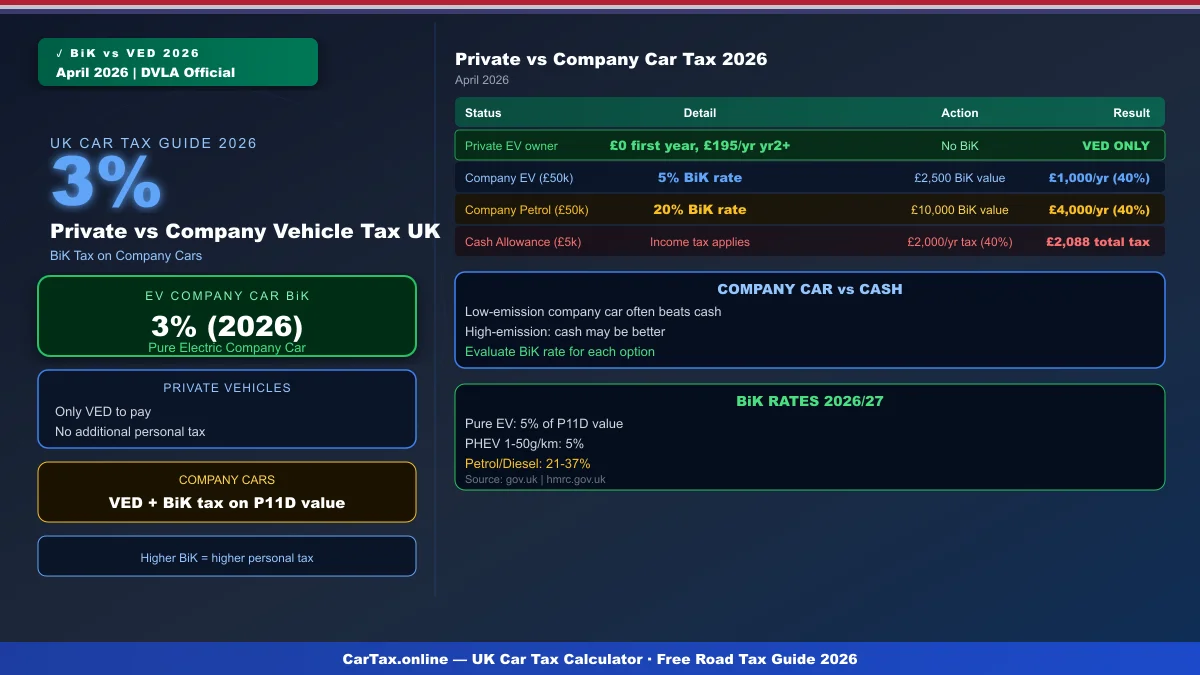
April 13, 2026 in United Kingdom — The tax treatment of a vehicle differs significantly depending on whether it is owned privately or provided by your employer as a company car. Company car drivers pay Benefit in Kind (BiK) tax based on the vehicle's list price and CO2 emissions, while private owners pay only Vehicle Excise Duty (VED). Understanding the difference helps you evaluate job offers that include company car schemes and choose the most tax-efficient vehicle arrangement for your situation.
Private Vehicle Road Tax
For privately owned vehicles, road tax is straightforward — you pay VED based on the vehicle's CO2 emissions. The standard post-April 2017 rates are:
- First year: CO2-based rate from £0 (pure EV) to £2,605 (255g/km+)
- Years 2+: £195/year for all post-2017 vehicles
- Premium supplement: £390/year if list price exceeds £40,000 (years 2-6)
Private owners pay road tax from their own pocket, but there is no additional tax liability related to personal use of the vehicle.
Company Car Benefit in Kind (BiK) Tax
When your employer provides a vehicle for personal use, you pay Benefit in Kind (BiK) tax on the value of that benefit. BiK is calculated as a percentage of the vehicle's list price (P11D value), which typically equals the recommended retail price including VAT but excluding first-year registration fees and road tax.
The BiK percentage is determined by the vehicle's CO2 emissions:
| Vehicle Type | BiK Rate (2025/26) | BiK Rate (2026/27) |
|---|---|---|
| Pure Electric (0g/km) | 3% | 5% |
| Plug-in Hybrid (1-50g/km) | 3% | 5% |
| Plug-in Hybrid (51-75g/km) | 4% | 6% |
| Petrol/Diesel (130g/km) | 20% | 21% |
| Petrol/Diesel (165g/km) | 28% | 29% |
| Petrol/Diesel (190g/km+) | 37% | 37% |
BiK tax is paid through your PAYE code — your employer deducts it from your salary each month. The rate is applied to your marginal income tax band (20%, 40%, or 45%).
Company Car vs Cash Allowance — The Real Cost
Many employers offer a choice between a company car and a cash allowance. The decision is not just about convenience — the tax implications are significant:
Company Car Example
A £50,000 plug-in hybrid company car with CO2 of 50g/km:
- BiK rate: 3% (2025/26)
- P11D value: £50,000
- BiK amount: £1,500 per year
- BiK tax (40% taxpayer): £600/year
- Employer NI saving: Employer pays 13.8% Class 1A NI on £1,500 = £207/year
Cash Allowance Example
Same employee taking a £5,000 cash allowance instead:
- Added to salary: £5,000/year
- Income tax (40%): £2,000/year
- National Insurance (2% above £12,570): £88.60/year
- Total tax cost: £2,088/year on £5,000
In this example, the company car saves the employee £1,488/year in tax compared to taking the cash allowance, even accounting for BiK tax. However, this analysis changes dramatically for high-emission vehicles where BiK rates reach 37%.
Road Tax for Company Cars
The registered keeper of a company car is typically the employer. Road tax is paid by the employer as a business expense and is generally not reclaimable as a deduction for the employee. However, the employer can claim the VAT back on road tax for qualifying business vehicles.
The employee's road tax position for a company car:
- VDED is paid by the employer
- The P11D value of the vehicle includes the first-year VED
- The employee does not pay VED directly — it is factored into BiK through the P11D value
Fleet Managers and Vehicle Tax
Fleet managers responsible for multiple company vehicles need to track:
- Annual VED for all vehicles (paid centrally)
- BiK declarations for all drivers (P11D season)
- Company car tax codes (updated annually based on updated P11D values)
- Vehicles approaching 3 years old (need MOT reminders)
- Vehicles approaching 40 years old (historic vehicle exemption potential)
Frequently Asked Questions
Is a company car worth more than a cash allowance?
It depends on the BiK rate. For pure electric vehicles with a 3% BiK rate, a company car is almost always worth significantly more than a cash allowance because the tax on the benefit is low. For high-emission vehicles with 37% BiK rates, the cash allowance may be more tax-efficient.
Who pays road tax on a company car?
The employer is the registered keeper and pays road tax as a business expense. The employee's BiK is calculated on the P11D value, which includes the first-year VED but not the ongoing annual road tax (since this is a business expense for the employer).
Can I claim road tax as a business expense if I'm self-employed?
Yes. If you are self-employed and use a vehicle for business purposes, you can claim road tax as a deductible expense through your self-assessment tax return. However, you can only claim the proportion of road tax that relates to business use — private use proportion is not deductible.
Do company car BiK rates change every year?
Yes. The government sets BiK rates annually, and they tend to increase each year as incentives for low-emission vehicles are gradually reduced. Pure electric vehicles started at 0% BiK and are now at 3% in 2025/26, rising to 5% in 2026/27, 7% in 2027/28, and likely 10%+ after that.
Conclusion
Private vehicles are taxed only through VED. Company cars add BiK tax on the vehicle's value. Pure electric company cars remain highly tax-efficient in 2026 at 5% BiK. Evaluate job offers that include company car schemes by comparing BiK rates for each vehicle option against cash alternatives. Use our UK car tax calculator for standard VED estimates.
Official Resources: GOV.UK Check Vehicle Tax | GOV.UK Vehicle Tax | DVLA Online