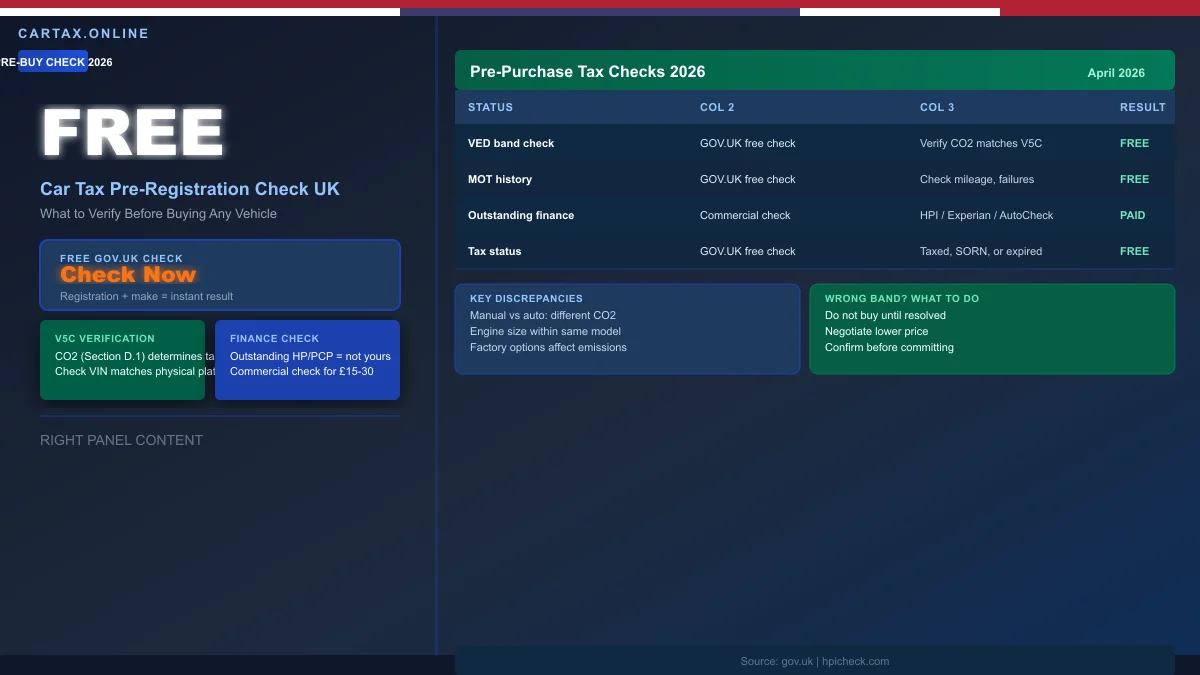
April 13, 2026 in United Kingdom — Before buying a vehicle, verifying its tax and registration details is one of the most important steps in the purchase process. A pre-registration check protects you from overpaying, buying an incorrectly classed vehicle, or inheriting someone else's tax problems. This guide covers exactly what to verify before committing to any purchase.
Why Pre-Registration Checks Matter
The vehicle's VED band determines how much road tax you will pay for the entire time you own it — there is no way to reduce a vehicle's tax band after purchase. If a seller claims a vehicle is in a lower CO2 band than it actually is, you could be paying hundreds of pounds more per year in road tax than expected. A quick check before purchase costs nothing and protects against costly mistakes.
The Essential Pre-Purchase Tax Checks
1. VED Band and CO2 Emissions
Use the GOV.UK free vehicle tax check to verify the registered CO2 emissions and VED band. Enter the registration number and make — the service returns the vehicle's VED band, current tax status, and expiry date. Compare this to what the seller has told you. If the band does not match, question the discrepancy before proceeding.
2. MOT Status Check
Use the GOV.UK MOT status check to verify current MOT status and view the full test history. The MOT history shows previous failures, advisories, and mileage readings — all of which help assess the vehicle's condition and detect potential mileage fraud. Related: Car Tax Pre-Registration Check UK 2026 | Car Tax Check UK | Car Tax MOT Check UK | Check Car Tax DVLA UK.
3. V5C (Logbook) Verification
The V5C is the primary proof of ownership and registration. When buying from a private seller, ensure:
- The V5C shows you as the new keeper section (green slip — V5C/2) if the seller has started the process
- The 'new keeper' details match your name and address
- The V5C is not stamped with a 'write-off' marker (insurance total loss)
- The vehicle's VIN/chassis number on the V5C matches the physical plate on the vehicle
4. Tax Status and Outstanding Liabilities
Even though road tax does not transfer to the buyer, an untaxed vehicle with expired MOT creates immediate costs for you. Check that the vehicle is currently taxed or that you understand exactly what you need to do immediately upon taking ownership. If it is SORN'd, arrange transport — you cannot legally drive it on the road.
5. Registered Keeper vs Owner
The registered keeper on the V5C may not be the legal owner if there is outstanding finance. A vehicle with unresolved HP or PCP is technically owned by the finance company — you cannot legally own it until the finance is settled. Use a commercial history check (HPI, Experian) to verify no outstanding finance.
What the V5C Tells You About Road Tax
The V5C contains key tax-relevant information in these sections:
- Section A: Vehicle registration number
- Section B: Vehicle identity number (VIN)
- Section D.1: CO2 emissions (in g/km) — determines your VED band
- Section D.2: Fuel type
- Section G: Type approval number (relates to vehicle class and applicable rules)
Checking CO2 Emissions: Common Discrepancies
CO2 emissions on the V5C can sometimes differ from what the seller claims. Common discrepancies include:
- Manual vs automatic transmission: Same model can have different CO2 depending on gearbox — always verify the exact vehicle
- Engine variant within same model: A 1.4L and 2.0L version of the same car have different emissions
- Factory options: Larger wheels, sport packages, or performance options can affect emissions
- Pre- vs post-facelift models: Same model name can have different CO2 before and after a mid-life update
Pre-Registration Date and VED Band Implications
The vehicle's first registration date determines which VED regime applies:
- Registered before April 1, 2017: Subject to lower annual rates (Band A £130/year for up to 100g/km)
- Registered April 1, 2017 onwards: Standard first-year rate plus higher annual rates from year 2
- Registered April 1, 2025 onwards: EVs pay first-year rate (previously £0 flat), then £195/year from year 2
Commercial Pre-Registration Checks
For vehicles above £5,000, a paid commercial check (HPI, Experian, AutoCheck — typically £15-30) provides:
- Outstanding finance check
- Insurance write-off check
- Stolen vehicle check
- Export check
- Mileage verification
- Scrapped vehicle check
What to Do If the Check Reveals Problems
- Wrong VED band: Do not buy until seller resolves — or negotiate a lower price to compensate
- Untaxed with expired MOT: Negotiate that seller resolves MOT before sale or reduce your offer by the expected cost
- Outstanding finance: Walk away — the finance company owns the vehicle
- Mileage discrepancy: Walk away — mileage fraud is a serious indicator of broader dishonesty
- Write-off marker: Ensure you understand the category and its implications for future insurance and resale
Conclusion
Always run the free GOV.UK vehicle tax and MOT checks before buying any vehicle. Verify CO2 emissions on the V5C match the registered VED band, confirm MOT status, and check for outstanding finance using a commercial report for vehicles over £5,000. The V5C's CO2 figure (Section D.1) determines your annual road tax cost — confirm it before committing. Use check vehicle tax and check MOT status before any purchase.