Car Tax Percentage in India — Understanding the Total Tax Burden
Car tax percentage in India in 2026 is a combination of two separate tax components: Goods and Services Tax (GST) levied by the central government and state road tax levied by the registering state. Unlike some countries where a single vehicle tax applies, India charges both taxes sequentially, making the total tax burden on a car significantly higher than the headline GST rate suggests. For a buyer purchasing a new car, understanding the combined tax percentage is essential for accurate cost planning.
GST is charged on the ex-showroom price of the vehicle and ranges from 5% for electric vehicles to 28% for petrol/diesel cars and SUVs. Road tax is charged by the state RTO on the on-road price (ex-showroom plus GST) and varies widely by state — from around 2% in some smaller states to over 20% in states like Maharashtra and West Bengal for high-value vehicles. The combined effect can push total taxes to nearly half the vehicle's ex-showroom price for luxury SUVs in high-tax states.
GST Rates for Cars in India 2026
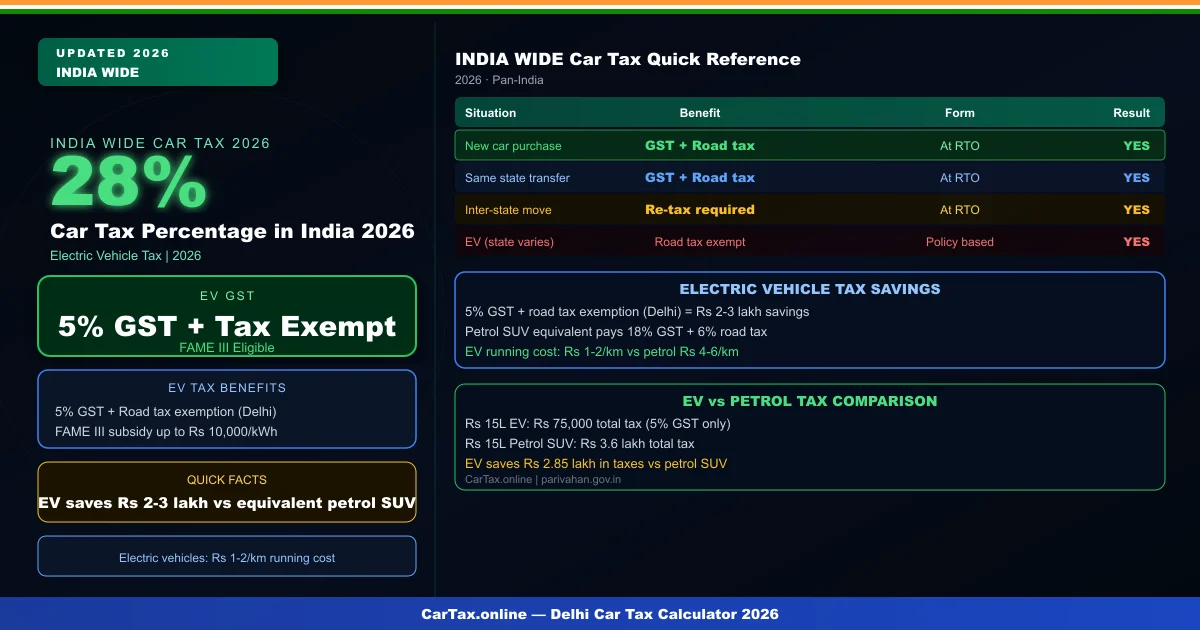
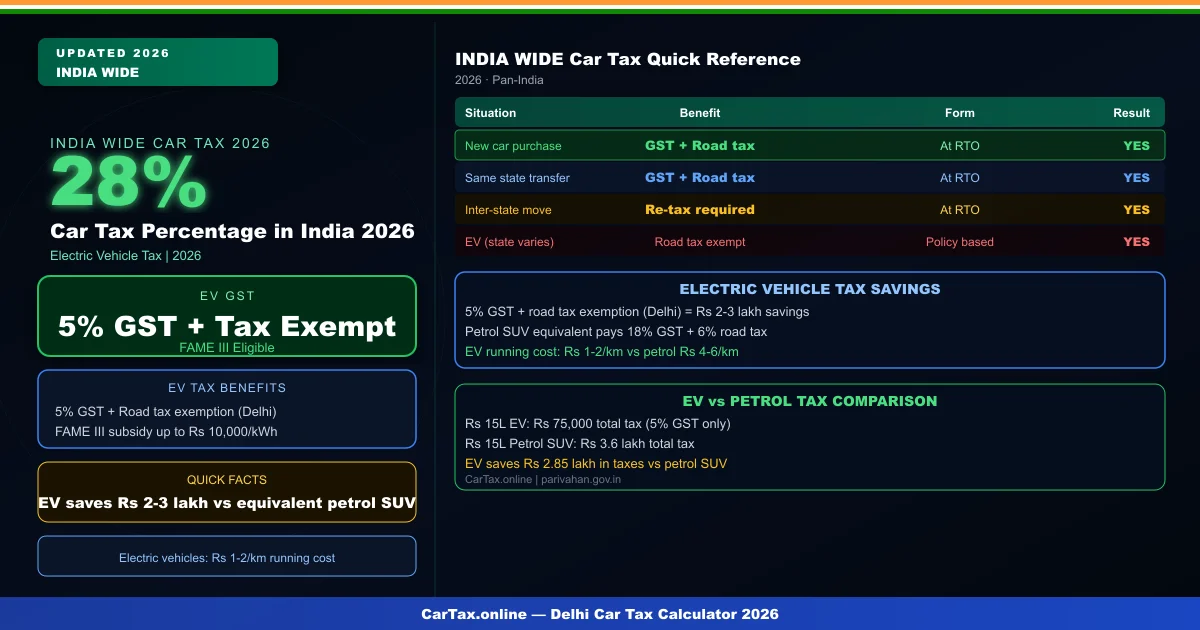
GST on cars in India is governed by the GST Council's rate schedule. Electric vehicles with an ex-showroom price below INR 15 lakh attract GST at 5%, making EVs the most GST-efficient vehicle category. This 5% rate is a significant reduction from the standard 28% applicable to most petrol and diesel cars, and the policy is designed to accelerate India's transition to electric mobility.
Hybrid vehicles with engine capacity below 1,200cc attract GST at 18%, positioned between the EV rate and the standard car rate. Petrol and diesel cars generally attract GST at 28%, regardless of engine size or body type. Sports utility vehicles and large sedans above 2 litres engine capacity are also categorised at 28% GST, with some models above INR 1 crore attracting an additional cess on top of the 28%.
The GST rate is applied to the ex-showroom price before road tax. This means a INR 10 lakh car at 28% GST carries INR 2.8 lakh in GST, making the GST-inclusive price INR 12.8 lakh before road tax. Road tax is then calculated on the INR 12.8 lakh amount (or the state's specific base), not the original ex-showroom price, compounding the tax burden.
State Road Tax Rates — Major States Compared
State road tax is where the variation becomes significant. Each state in India sets its own road tax rates for vehicle registration, and these rates can vary by a factor of three to four across states for equivalent vehicles. Delhi charges road tax at 8% for new private cars (with additional surcharges for higher value vehicles up to around 12%), while Maharashtra charges up to 20% for large SUVs. Karnataka charges road tax on a slab system starting around 13% for most passenger vehicles.
The road tax calculation basis also varies by state. Some states calculate road tax as a percentage of the vehicle's ex-showroom price, while others use the on-road price (ex-showroom plus GST) as the base. States using the on-road price as base effectively tax the GST component as well, significantly increasing the total tax burden compared to states that use the ex-showroom price alone.
For the top 10 major states in April 2026: Delhi levies 8-12% road tax on ex-showroom price; Maharashtra levies 13-20% on ex-showroom price for SUVs; Karnataka levies 13-18% on ex-showroom price on a slab basis; Gujarat levies around 4.5-6% on ex-showroom price; Tamil Nadu levies around 7-12% on ex-showroom price; West Bengal levies around 11-15% on ex-showroom price; Rajasthan levies around 5-8% on ex-showroom price; Uttar Pradesh levies around 6-9% on ex-showroom price; Punjab levies around 6-10% on ex-showroom price; and Telangana levies around 8-12% on ex-showroom price.
Combined Tax Percentage — Total Cost of Ownership
The combined tax percentage on a car in India can be calculated by adding GST and road tax as a proportion of the ex-showroom price. For an electric car at INR 10 lakh ex-showroom, GST at 5% adds INR 50,000, and road tax at 4% adds approximately INR 42,000, for a total tax of INR 92,000 or 9.2% of ex-showroom. For a petrol SUV at INR 20 lakh ex-showroom in Maharashtra, GST at 28% adds INR 5.6 lakh, and road tax at 15% on INR 25.6 lakh adds approximately INR 3.84 lakh, for a total tax of INR 9.44 lakh or 47.2% of ex-showroom.
This stark contrast between EV tax efficiency (9.2%) and luxury SUV tax burden (47.2%) explains why the government's EV incentive policy has such a significant impact on purchase decisions. The tax savings on an EV compared to an equivalent petrol SUV in a high-road-tax state like Maharashtra can exceed INR 5 lakh on a INR 20 lakh vehicle, making EVs not just environmentally preferable but financially compelling.
State-wise Car Tax Percentage Table
For a standard INR 10 lakh petrol sedan (1.5L engine) with GST at 28% in April 2026: Delhi total tax approximately 36-40% of ex-showroom (8% road tax on ex-showroom); Maharashtra total tax approximately 41-48% (15% road tax on ex-showroom); Karnataka total tax approximately 41-46% (13% road tax on ex-showroom); Gujarat total tax approximately 33-35% (5% road tax on ex-showroom); Tamil Nadu total tax approximately 35-40% (7% road tax on ex-showroom); West Bengal total tax approximately 39-43% (11% road tax on ex-showroom); Rajasthan total tax approximately 33-36% (5% road tax on ex-showroom); Uttar Pradesh total tax approximately 34-37% (6% road tax on ex-showroom).
Frequently Asked Questions
What is the total GST percentage on cars in India in 2026?
GST rates on cars in India in 2026 range from 5% for electric vehicles (EVs) with ex-showroom price below INR 15 lakh, to 18% for hybrid vehicles with engine capacity below 1,200cc, to 28% for standard petrol and diesel cars and SUVs. Some luxury vehicles above INR 1 crore may attract additional cess on top of the 28% GST rate under the GST Council's compensatory cess provisions.
Which Indian state has the highest road tax for cars?
Maharashtra has among the highest road tax rates for cars in India, particularly for SUVs and high-value vehicles where rates can reach 15-20% of the ex-showroom price. West Bengal also has high road tax rates, with slabs reaching 11-15% for passenger vehicles. For a INR 20 lakh SUV in Maharashtra, road tax alone can exceed INR 3 lakh, making state choice a significant factor in total purchase cost. Delhi has relatively moderate road tax rates at 8-12% for most private cars.
What is the combined tax percentage on a new car in India 2026?
The combined tax percentage on a new car in India ranges from approximately 7-11% for electric vehicles (5% GST + 2-6% road tax) to approximately 32-48% for petrol/diesel SUVs depending on the state. A standard INR 10 lakh petrol sedan in Delhi carries approximately 36% total tax (28% GST + 8% road tax), while the same car in Maharashtra carries approximately 41-43% total tax (28% GST + 13-15% road tax). States that calculate road tax on the on-road price rather than ex-showroom price compound the tax further.
Do electric vehicles get a lower tax percentage than petrol cars?
Yes. Electric vehicles attract GST at just 5% compared to 28% for petrol/diesel cars, and many states offer additional road tax exemptions or reductions for EVs. This makes the combined tax on an EV significantly lower than an equivalent petrol vehicle — often 5-10% total tax versus 30-45% for petrol cars. For a INR 15 lakh EV versus a INR 15 lakh petrol SUV, the tax savings can exceed INR 5 lakh on the purchase price alone, before factoring in lower running costs for EVs.
Is GST included in the road tax calculation base in India?
This varies by state. Some states calculate road tax as a percentage of the ex-showroom price alone, while others include GST in the tax base, effectively taxing the GST component as well. States that use the on-road price (ex-showroom + GST) as the base for road tax calculation impose a higher total tax burden than states using ex-showroom price alone. When comparing total costs across states, it is important to confirm which calculation basis your state uses by checking the current RTO schedule.