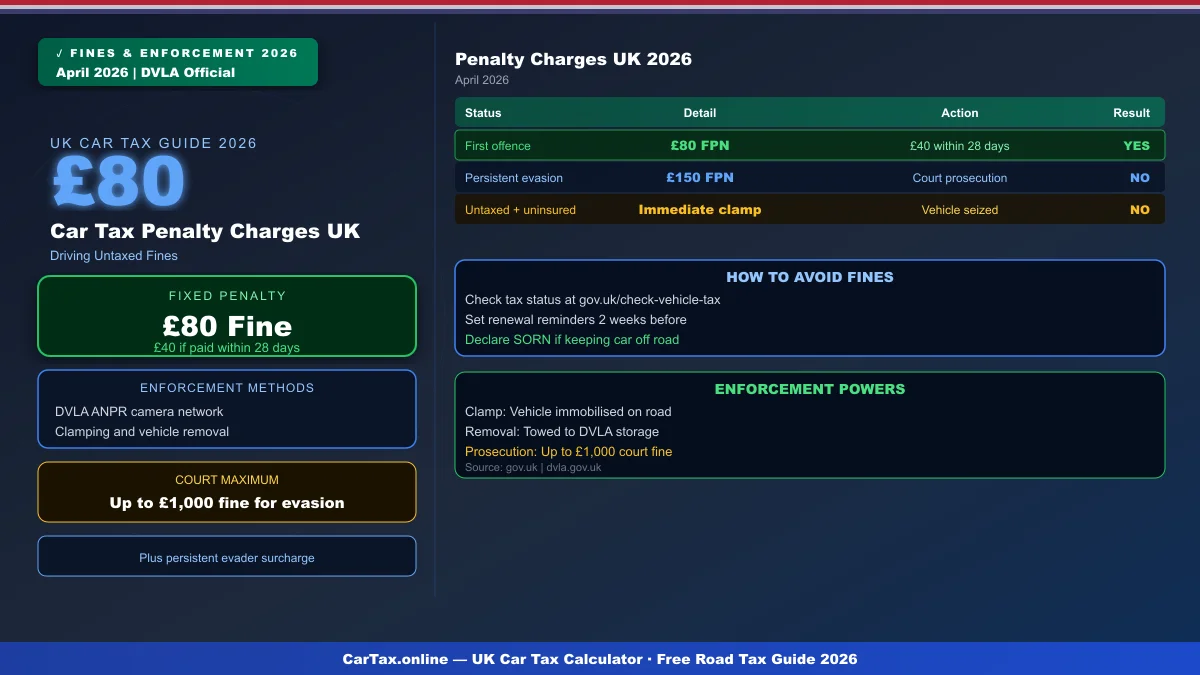
April 13, 2026 in United Kingdom — Driving a vehicle without road tax is one of the most common traffic offences in the UK, with the DVLA's Vehicle Monitoring and Enforcement system catching thousands of untaxed vehicles every year. The penalty for driving an untaxed vehicle starts at £80 and can reach £1,000 for persistent evaders. This guide covers every penalty scenario, how enforcement works, and how to avoid charges.
The £80 Fixed Penalty Notice for Untaxed Vehicles
If a vehicle is found on a public road without road tax, the DVLA issues a Fixed Penalty Notice (FPN) of £80 to the registered keeper. This is not a court conviction — it's an out-of-court settlement under the Vehicle Excise and Registration Act 1994.
The penalty notice is sent to the registered keeper's address as shown on the V5C. Even if you sold the vehicle and forgot to notify the DVLA, the notice goes to your address until the change of keeper is processed.
The £80 penalty is reduced to £40 if paid within 28 days. If unpaid after 28 days, the DVLA refers the case for prosecution, where a court can impose a fine of up to £1,000 plus costs.
DVLA Automatic Number Plate Recognition (ANPR) Enforcement
The DVLA uses a network of ANPR cameras across the UK to identify untaxed vehicles. These cameras read number plates and cross-reference them against the vehicle licensing database in real-time. Vehicles showing as untaxed are flagged for enforcement action.
ANPR is deployed at:
- Roadside camera installations on major routes
- Static enforcement sites at ports and borders
- Mobile camera vans operated by DVLA enforcement officers
- Vehicle testing stations and DVLA offices
The system also flags vehicles with expired MOT certificates, as vehicles over 3 years old must have a valid MoT to be legally roadworthy.
Continuous Insurance Enforcement (CIE) — Insurance Checks
The DVLA's Continuous Insurance Enforcement programme cross-checks vehicles against Motor Insurance Bureau records. Vehicles without valid insurance are automatically flagged. A vehicle that is untaxed AND uninsured is subject to immediate clamping or removal by DVLA enforcement officers.
Under CIE, if a vehicle's insurance lapses, the DVLA is notified and the vehicle shows as uninsured even before the tax status changes. This triggers immediate enforcement action.
What Happens When DVLA Enforcement Finds Your Vehicle
When DVLA enforcement officers find an untaxed vehicle on a public road, they have powers to:
| Enforcement Power | Details |
|---|---|
| Clamp the vehicle | Immobilisation device fitted — cannot be moved |
| Remove to storage facility | Vehicle towed if on public land |
| Issue Fixed Penalty Notice | £80 fine (reduced to £40 within 28 days) |
| Prosecute in court | Fine up to £1,000 if FPN is unpaid |
| Persistent evader surcharge | Additional £70 if vehicle has 2+ previous offences |
Declaring a SORN — Avoiding Penalties
If you want to keep a vehicle off the road without paying road tax, you must declare a Statutory Off Road Notification (SORN). Without a SORN, the vehicle is treated as taxable and any period without tax results in a penalty.
A SORN is free and can be declared:
- Online at GOV.UK declare SORN
- By post using form V11
Important SORN rules:
- The vehicle cannot be driven or parked on a public road
- A SORN must be renewed each year unless the vehicle is scrapped, sold, or permanently exported
- If you take the vehicle off the SORN for any reason, you must tax it immediately
- A SORN declared during a tax period is valid for the remaining period only
Persistent Evasion Surcharge
Vehicles with two or more previous vehicle excise duty evasion offences within the past 2 years are treated as persistent evaders. The Fixed Penalty Notice is increased to £150 (£75 within 28 days), and the DVLA prioritises these cases for prosecution.
Persistent evaders face court action where maximum fines of £1,000 per offence apply, plus vehicle seizure and possible disqualification from driving for the most serious cases.
Disputing a Penalty Notice
You can dispute a Fixed Penalty Notice if you believe the vehicle was incorrectly identified or if you had a valid reason for being untaxed:
- The vehicle was taxed — check your bank statement for the DVLA payment
- The vehicle was recently sold — provide evidence of the sale and DVLA notification
- The vehicle was on private land, not a public road — provide the landowner's declaration
- The vehicle was being transported to a place of tax or MoT — specific exceptions apply
Dispute through the GOV.UK penalty disputes service or by writing to DVLA Personal Tax Account, Swansea, SA99 1AR.
Frequently Asked Questions
Can I appeal a £80 road tax penalty?
Yes. If you believe the penalty was issued incorrectly — for example, if you had taxed the vehicle but the payment failed — you can dispute it through GOV.UK or by writing to the DVLA. You must provide evidence of payment or notification.
My car is on my driveway — do I need to tax it?
Yes, if your driveway is a public road or accessible from a public road. Your vehicle must be either taxed or have a valid SORN. A driveway within private property not adjacent to a public road may be exempt, but if it's visible or accessible from a public road, the DVLA enforcement can act.
What if I tax my vehicle after receiving a penalty notice?
Paying the road tax after receiving a penalty notice does not automatically cancel the fine. You must also pay the £80 penalty or dispute it. Contact the DVLA to explain if you have since taxed the vehicle and ask for the penalty to be cancelled — in some circumstances, particularly first offences where the vehicle was taxed promptly, they may withdraw the notice.
Can the DVLA clamp my car for being untaxed?
Yes. DVLA enforcement officers can clamp or remove any vehicle found on a public road without valid road tax. Clamping is the most common enforcement action, and the vehicle cannot be moved until the tax is paid and the release fee (if any) is settled.
Conclusion
Avoid the £80 penalty by always keeping your vehicle taxed or declaring a SORN. Use the free GOV.UK vehicle check to verify your status. Set calendar reminders before renewal dates. Use our UK car tax calculator to budget for annual road tax costs.
Frequently Asked Questions
Q: How much is car tax (VED) in the UK 2026?
Car tax rates in the UK depend on your vehicle's CO2 emissions and list price. Standard rates start from £190 per year for petrol and diesel cars, with zero-rated VED for EVs. First-year rates vary from £0 to £2,605 depending on emissions. Additional premiums apply for vehicles over £40,000.
Q: How do I check if my car is taxed online?
You can check your vehicle's tax status for free on the Gov.uk website at gov.uk/check-vehicle-tax. You'll need your vehicle's registration number (number plate). You can also check via the Motor Insurance Database to verify road tax and insurance status simultaneously.
Q: Can I get a refund on car tax if I sell my vehicle?
Yes — if you sell or scrap your vehicle, you can claim a refund on any full months of remaining road tax. Contact DVLA with the V11 reminder letter or apply online at gov.uk. Refunds are usually processed within 4-6 weeks.
Q: Is road tax refund available when transferring ownership?
No — road tax does not transfer with the vehicle. When you sell your car, the tax is automatically cancelled and any remaining months are refunded to you by DVLA. The new owner must tax the vehicle immediately. As a buyer, always verify the vehicle's tax status before purchasing.
Q: What is the luxury car tax threshold in the UK 2026?
The additional rate for vehicles over £40,000 (list price) adds £410 per year to standard VED rates for years 2-6 of registration. This surcharge brings the annual cost for high-emission vehicles over £40,000 to around £600-690 per year. Pure EVs under £40,000 pay zero VED.