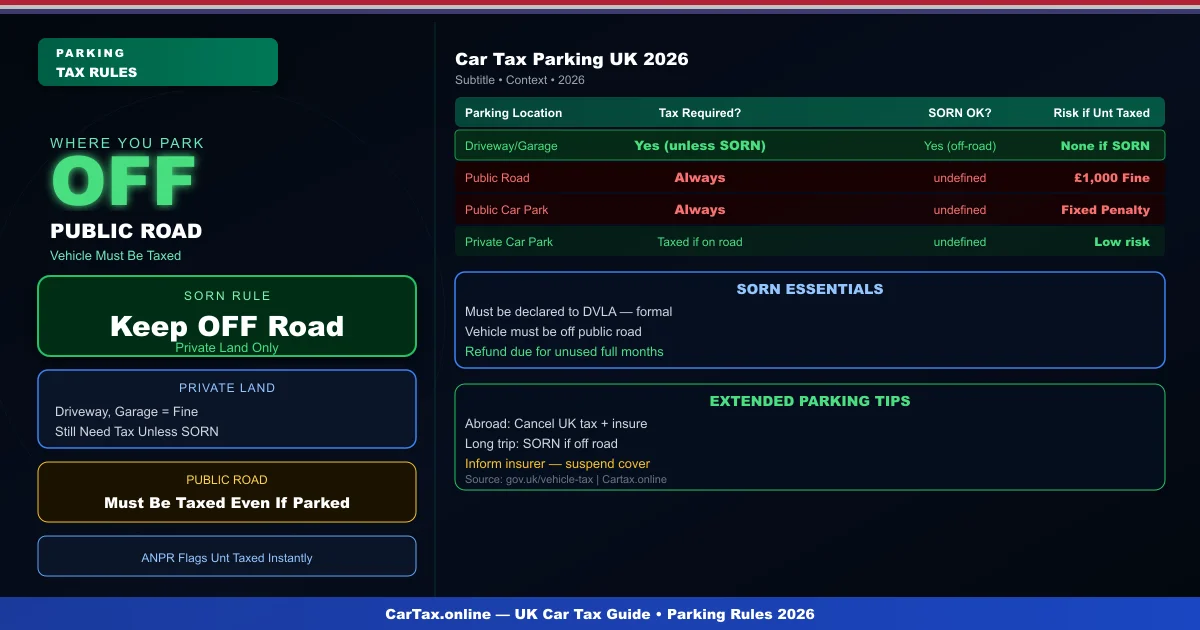
Where you park your vehicle has implications for road tax. Understanding the difference between private land, public road parking, and formal SORN declaration helps you stay compliant and avoid unexpected fines.
Parking on Private Land
Parking on private land — such as a driveway, garage, or private car park — does not exempt a vehicle from road tax. Road tax applies to all registered vehicles on the road network, regardless of where they are parked when not in use. Only formal SORN declaration removes the road tax obligation. A car parked on a private driveway must still be taxed unless a SORN is in place.
Parking on a Public Road
Parking on a public road without valid road tax is an offence. Even if the vehicle is parked and not being driven, it must be taxed. DVLA and the police can identify untaxed vehicles on public roads using ANPR cameras. An untaxed vehicle on a public road — even if stationary — will be flagged and the registered keeper will receive a fixed penalty notice. The only exception is a vehicle with a valid SORN, which must be kept off the public road.
SORN and Parking
Declaring a SORN means the vehicle must be kept off the public road. This is non-negotiable — a SORN does not allow you to park on public roads. If a SORNed vehicle is found on a public road, the keeper is liable for the offence of keeping an untaxed vehicle. A SORNed vehicle must be kept on private land — a garage, driveway, or private car park. If you do not have private parking, a SORN may not be practical. Related: Car Tax and Parking UK 2026 | Cancel Car Tax UK 2026 | SORN Declaration UK 2026 | Cancel Car Tax UK 2026.
Car Parks and Road Tax
A car parked in a public car park — even a multi-storey — is still on public land. The car park may have security and be private property, but it is not private land in the sense that matters for road tax. An untaxed vehicle in a public car park is as liable to a fixed penalty as one on a street. Some car parks have automatic number plate recognition systems that cross-reference with DVLA — operators may remove untaxed vehicles from their car parks.
Rental Cars and Parking
Rental vehicles must be parked legally, which includes ensuring the vehicle is taxed. The rental company is responsible for road tax on their fleet. However, if a rental vehicle is parked on a public road for an extended period — such as during a holiday — the rental company may be charged for extended road tax or may recover the cost from the customer. Check the rental agreement for parking obligations.
Tax Implications for Long-Term Parking
If you are planning to leave a vehicle unused for an extended period — such as during an extended trip abroad — road tax obligations depend on your plans. If the vehicle will be kept on public roads, it must remain taxed. If the vehicle will be kept off the road on private land, declare a SORN. If the vehicle will be abroad, you can cancel the UK road tax and re-tax when you return. Inform your insurance company as well — policies can often be suspended or reduced during extended periods of non-use.
Official Resources: GOV.UK Check Vehicle Tax | GOV.UK Vehicle Tax | DVLA Online | MOT Check
Frequently Asked Questions
Q: How much is car tax (VED) in the UK 2026?
Car tax rates in the UK depend on your vehicle's CO2 emissions and list price. Standard rates start from £190 per year for petrol and diesel cars, with zero-rated VED for EVs. First-year rates vary from £0 to £2,605 depending on emissions. Additional premiums apply for vehicles over £40,000.
Q: How do I check if my car is taxed online?
You can check your vehicle's tax status for free on the Gov.uk website at gov.uk/check-vehicle-tax. You'll need your vehicle's registration number (number plate). You can also check via the Motor Insurance Database to verify road tax and insurance status simultaneously.
Q: Can I get a refund on car tax if I sell my vehicle?
Yes — if you sell or scrap your vehicle, you can claim a refund on any full months of remaining road tax. Contact DVLA with the V11 reminder letter or apply online at gov.uk. Refunds are usually processed within 4-6 weeks.
Q: Is road tax refund available when transferring ownership?
No — road tax does not transfer with the vehicle. When you sell your car, the tax is automatically cancelled and any remaining months are refunded to you by DVLA. The new owner must tax the vehicle immediately. As a buyer, always verify the vehicle's tax status before purchasing.
Q: What is the luxury car tax threshold in the UK 2026?
The additional rate for vehicles over £40,000 (list price) adds £410 per year to standard VED rates for years 2-6 of registration. This surcharge brings the annual cost for high-emission vehicles over £40,000 to around £600-690 per year. Pure EVs under £40,000 pay zero VED.