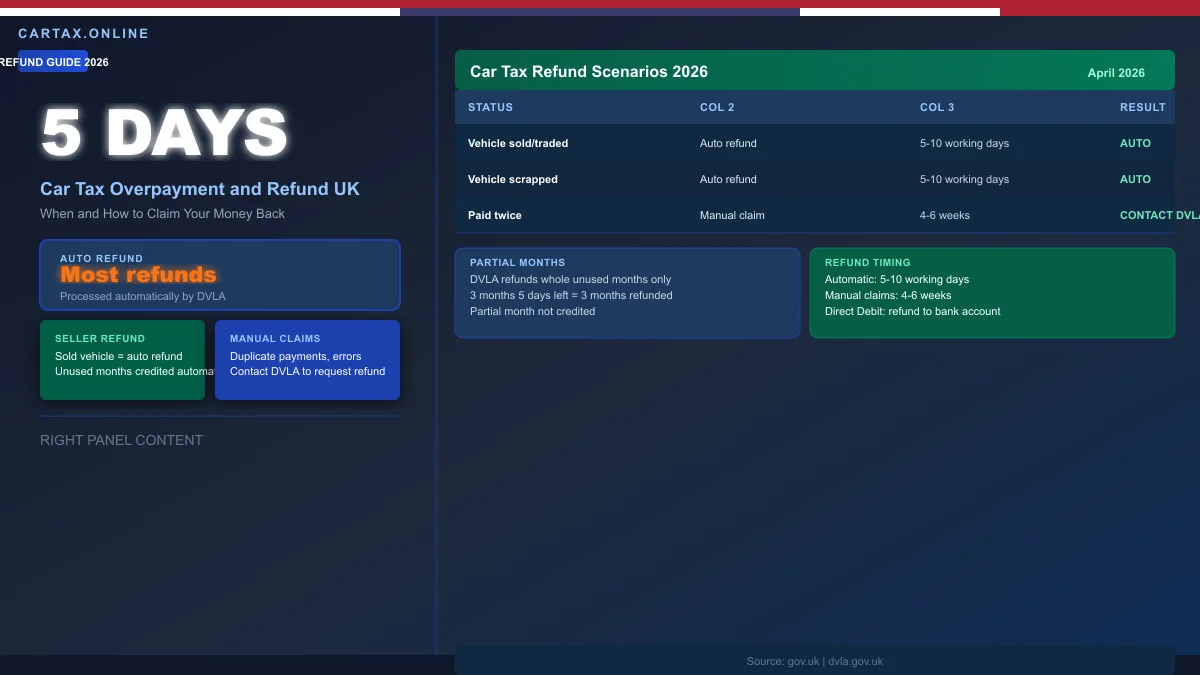
April 13, 2026 in United Kingdom — Paying too much road tax happens more often than most drivers realise. Whether you sold a car, paid twice, or were charged incorrectly, knowing how road tax refunds work can save you money. This guide explains when and how to claim a car tax refund in the UK for 2026.
Automatic Refunds: When the DVLA Refunds Without Asking
Most road tax refunds are processed automatically by the DVLA without you needing to claim them. These automatic refunds occur in the following situations:
- Selling or transferring a vehicle: The DVLA refunds unused whole months from the date of notification
- Vehicle scrapped: Notifying the DVLA of scrapping triggers an automatic refund of unused months
- Vehicle stolen: If reported to police and confirmed stolen, the DVLA refunds unused tax
- Vehicle exported: Notifying the DVLA of export triggers a proportional refund
How Long Do Automatic Refunds Take?
Automatic refunds from the DVLA typically take 5–10 working days to appear on your bank statement. The credit goes to the card or bank account that was originally used to pay the road tax. If your account has changed since you paid, contact the DVLA directly to update your refund destination.
Manual Refund Claims: When You Need to Act
Some situations require you to actively claim a refund rather than waiting for an automatic process: Related: Car Tax Overpayment and Refund UK 2026 | Car Tax Refund When Selling Your Car UK 2026 | Car Tax Refund When Selling Your Car UK 2026 | Car Tax Refund UK 2026.
Paid Twice for the Same Vehicle
If you accidentally made two payments for the same vehicle's road tax (e.g., paid online and then also paid at the post office), contact the DVLA directly. You will need your V5C reference number, payment confirmation references, and details of both transactions. Refunds for duplicate payments are processed within 4–6 weeks.
Wrong Vehicle Details Resulted in Overpayment
If you paid road tax based on incorrect CO2 emissions data and later corrected the vehicle's details with the DVLA, you may be entitled to a refund of the overpaid amount. The DVLA will recalculate and refund the difference if the corrected data results in a lower tax band.
Statutory Off Road Notification (SORN) Overpayment
On rare occasions, a driver may have paid road tax for a vehicle that was already on SORN at the time of payment. If this happens, contact the DVLA with your V5C reference and proof of the SORN date to claim a full refund of the amount paid.
How to Contact the DVLA for a Refund
For manual refund claims, you can contact the DVLA via:
- Phone: 0300 790 6801 (DVLA vehicle enquiry line)
- Post: DVLA, Swansea, SA99 1AR
- Online: Some refund scenarios can be handled through your GOV.UK account
Refunds for Vehicles on Direct Debit
Direct Debit overpayments are slightly different. If you paid via Direct Debit and sold the vehicle, the DVLA's automatic refund process still applies. However, if there was a Direct Debit failure followed by a successful retry that resulted in duplicate payment, contact the DVLA to arrange a refund of the duplicate amount.
What the Refund Covers
Road tax refunds cover the proportional amount of unused whole months remaining on your tax period. The DVLA does not refund partial months — only whole unused months are credited. For example, if you tax for 12 months and sell the vehicle after 3 months and 5 days, the refund covers 9 full unused months, not the 5 days.
Disputing a Refund Amount
If you believe the DVLA's refund calculation is incorrect (e.g., they refunded fewer months than you think you are owed), you can challenge the calculation. You will need your original tax payment receipt, the date of sale notification, and the DVLA reference number for the transaction. The DVLA can review and adjust refunds within 12 months of the original payment.
Common Refund Scenarios
1. Sold car but didn't notify DVLA yet
If you sold the car but have not yet notified the DVLA, do so immediately. No refund can be processed until the sale is registered. Use the GOV.UK tell us you sold your vehicle service to notify them online.
2. Bought a car with remaining tax from previous owner
The previous owner's tax is refunded to them, not transferred to you. You must tax the vehicle independently. Do not assume the remaining tax covers you — verify the vehicle's current tax status on the GOV.UK checker before driving.
3. Vehicle written off but not scrapped
If an insurer writes off your vehicle but you keep the wreck (e.g., for parts), you must notify the DVLA to get a refund. The notification type matters — if you declare the vehicle as scrapped, you get a refund; if you simply cancel the insurance, no refund is issued.
Conclusion
Most road tax refunds in the UK are automatic when you notify the DVLA of a sale, scrapping, or export. Manual claims are needed only for duplicate payments, incorrect charges, or SORN overpayments. Always notify the DVLA promptly when your vehicle changes status — use GOV.UK's vehicle tax refund guidance for specific scenarios.
Frequently Asked Questions
Q: How much is car tax (VED) in the UK 2026?
Car tax rates in the UK depend on your vehicle's CO2 emissions and list price. Standard rates start from £190 per year for petrol and diesel cars, with zero-rated VED for EVs. First-year rates vary from £0 to £2,605 depending on emissions. Additional premiums apply for vehicles over £40,000.
Q: How do I check if my car is taxed online?
You can check your vehicle's tax status for free on the Gov.uk website at gov.uk/check-vehicle-tax. You'll need your vehicle's registration number (number plate). You can also check via the Motor Insurance Database to verify road tax and insurance status simultaneously.
Q: Can I get a refund on car tax if I sell my vehicle?
Yes — if you sell or scrap your vehicle, you can claim a refund on any full months of remaining road tax. Contact DVLA with the V11 reminder letter or apply online at gov.uk. Refunds are usually processed within 4-6 weeks.
Q: Is road tax refund available when transferring ownership?
No — road tax does not transfer with the vehicle. When you sell your car, the tax is automatically cancelled and any remaining months are refunded to you by DVLA. The new owner must tax the vehicle immediately. As a buyer, always verify the vehicle's tax status before purchasing.
Q: What is the luxury car tax threshold in the UK 2026?
The additional rate for vehicles over £40,000 (list price) adds £410 per year to standard VED rates for years 2-6 of registration. This surcharge brings the annual cost for high-emission vehicles over £40,000 to around £600-690 per year. Pure EVs under £40,000 pay zero VED.