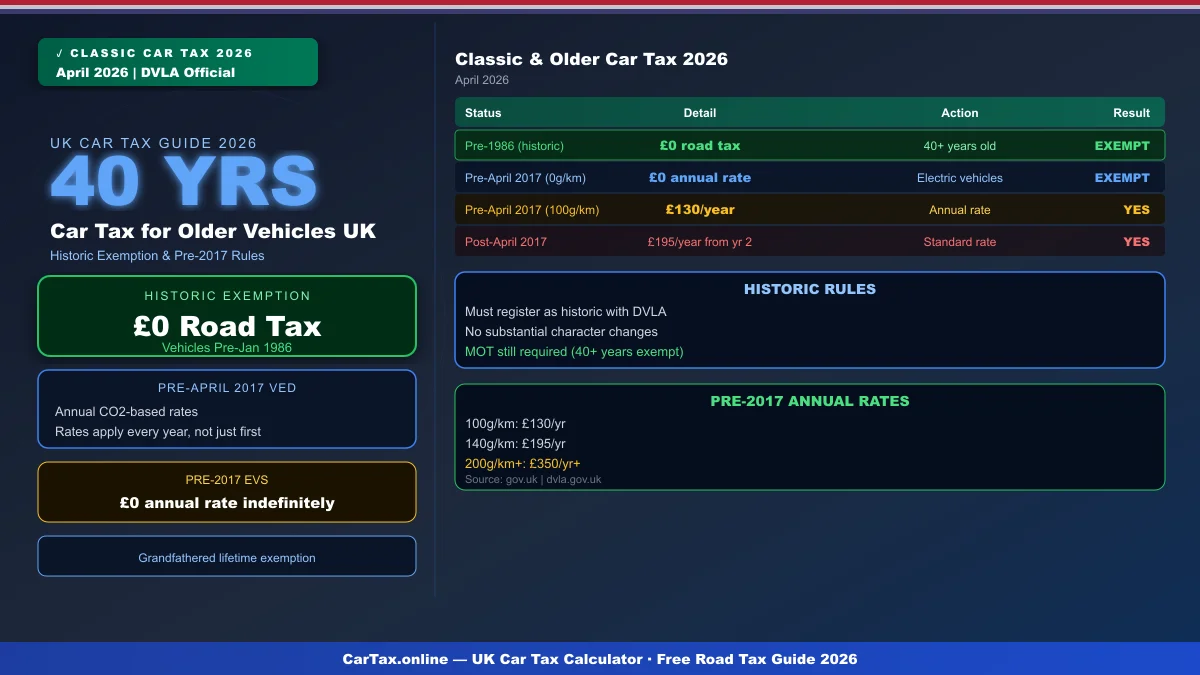
April 13, 2026 in United Kingdom — Older vehicles in the UK follow different road tax rules depending on their registration date. Vehicles registered before April 2017 pay annual CO2-based road tax rates (unlike post-2017 vehicles which only pay the first-year rate). And vehicles over 40 years old qualify for historic vehicle exemption, paying zero road tax indefinitely. This guide covers tax rules for older vehicles in 2026.
Two Tax Systems — Pre and Post April 2017
The UK road tax system changed on 1 April 2017. Vehicles registered before this date follow the older CO2-based annual system, where road tax rates change based on emissions every year. Vehicles registered from April 2017 onwards pay a first-year rate then a flat £195/year standard rate.
Pre-April 2017 Vehicles
- CO2 emissions determine the annual road tax rate every year
- Rates range from £0 (zero emission) to £580+ for high-emission vehicles
- The rate applies to each annual renewal, not just the first year
- No premium supplement for vehicles over £40,000 (this only applies post-2017)
- Zero-emission electric vehicles pay £0 road tax every year
Post-April 2017 Vehicles
- First-year rate based on CO2, then £195/year standard rate every year after
- Premium supplement of £390/year for vehicles over £40,000 (years 2-6)
- Electric vehicles pay £0 first year then £195/year from year two
Historic Vehicle Exemption — Vehicles Over 40 Years Old
The most significant exemption for older vehicles is the historic vehicle rule. Vehicles manufactured before 1 January 1986 are exempt from road tax as historic vehicles. This exemption is automatic — you simply register the vehicle as historic with the DVLA.
Requirements for historic vehicle exemption:
- Vehicle manufactured before 1 January 1986
- No substantial changes to character since manufacture
- Registered with the DVLA as a historic vehicle
- Displaying valid number plates
- Valid MOT if over 3 years old
The 'substantial changes' rule is important. Modifications that significantly alter the vehicle's performance, construction, or appearance from the original specification can disqualify the exemption. Engine swaps, chassis changes, or major structural alterations that change the vehicle's character mean the exemption may not apply. The DVLA can request evidence of the vehicle's original specification.
Pre-April 2017 Annual VED Rates
| CO2 Emissions (g/km) | Annual Road Tax Rate |
|---|---|
| 0 | £0 — zero-emission electric vehicles |
| 1–100 | £130/year |
| 101–110 | £145/year |
| 111–120 | £160/year |
| 121–130 | £175/year |
| 131–140 | £195/year |
| 141–150 | £215/year |
| 151–165 | £250/year |
| 166–175 | £285/year |
| 176–185 | £315/year |
| 186–200 | £350/year |
| 201–225 | £495/year |
| 226–255 | £580/year |
| Over 255 | £580/year (maximum rate) |
Classic Car Tax — What You Need to Know
For a vehicle to qualify as a classic car for tax purposes, it needs to be over 40 years old and registered as historic. A 1985 Land Rover Defender is a historic vehicle; a 1990s BMW M3 is not, even though it may be considered a 'classic' by enthusiasts.
If you own a pre-1986 vehicle, the steps to claim historic exemption are:
- Apply to the DVLA to register the vehicle as historic
- Provide evidence of manufacture date (factory records, Heritage Certificate)
- DVLA updates the vehicle record and removes road tax liability
- The vehicle shows as 'Historic Vehicle' — road tax is £0
MoT Requirements for Older Vehicles
Historic exemption from road tax does not mean exemption from MoT. All vehicles over 3 years old must have a valid MOT to be driven on public roads, regardless of age. A 1970s classic Mini still needs an annual MOT test — the only exemption is for vehicles over 40 years old that were constructed or first used before 1960 (and certain other specific categories).
Classic Car Insurance and Road Tax
Classic car insurance policies often come with specific conditions — the vehicle must be kept in a garage, not used for commuting, and limited to a set number of mileage per year. These policies are significantly cheaper than standard motor insurance but require the vehicle to be taxed or on SORN.
Frequently Asked Questions
When does a vehicle become a historic vehicle?
A vehicle becomes historic when it reaches 40 years of age from the date of manufacture — specifically, vehicles manufactured before 1 January 1986 qualify as of January 2026. The exemption applies automatically once registered with the DVLA as historic.
Can I claim historic exemption for a modified classic car?
Only if the modifications have not substantially changed the vehicle's character from the original specification. A standard 1978 Ford Cortina that has been resprayed and fitted with new seats still qualifies. The same car with a turbocharged engine swap, widened chassis, and stripped interior may not qualify — the DVLA can request evidence of the original specification.
Do pre-April 2017 vehicles pay more or less road tax than newer ones?
It depends on CO2. A pre-2017 vehicle with 100g/km CO2 pays £130/year. A post-2017 vehicle with the same CO2 pays £165 in year one then £195/year from year two. After year one, the older vehicle is cheaper. After year two, the newer vehicle in this example is more expensive by £65/year.
Do all pre-April 2017 electric vehicles pay £0 road tax?
Yes. Zero-emission electric vehicles registered before April 2017 pay £0 road tax annually. This is different from post-April 2017 EVs which pay £0 first year then £195/year from year two. Pre-2017 EVs enjoy a lifetime £0 rate under the grandfathered rule.
Conclusion
Pre-April 2017 vehicles pay annual CO2-based road tax rates. Vehicles over 40 years old (manufactured before 1 January 1986) qualify for historic exemption and pay £0 road tax. Use our UK car tax calculator to estimate costs for any vehicle based on its registration date and CO2 emissions.
Official Resources: GOV.UK Check Vehicle Tax | GOV.UK Vehicle Tax | DVLA Online