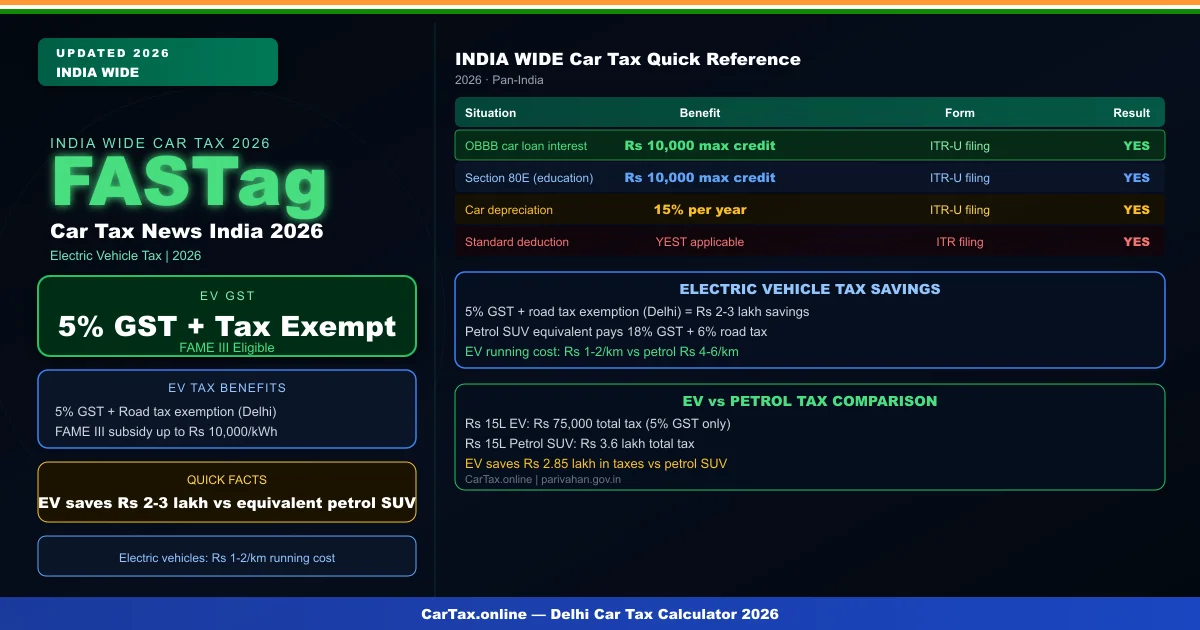
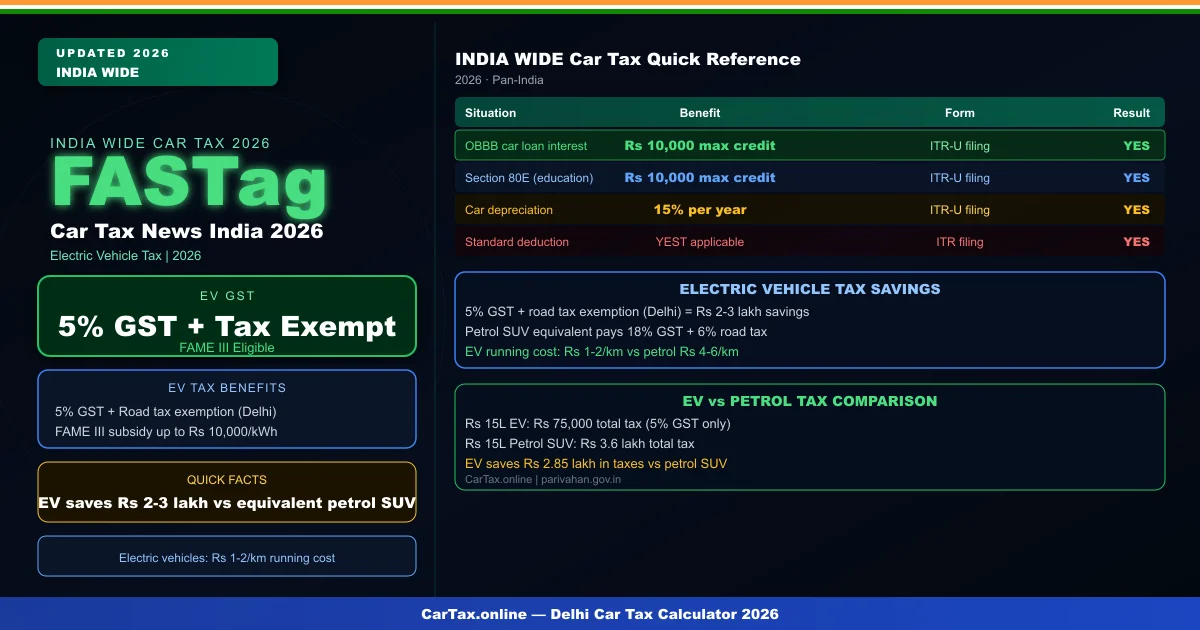
Car Tax News India 2026 — Major Policy Developments
The Indian automobile tax landscape in 2026 is characterised by several significant policy developments that affect every car buyer in the country. From GST Council deliberations on automobile tax restructuring to the activation of the FAME IV scheme and ongoing state road tax reforms, April 2026 brings important updates for anyone purchasing or selling a vehicle. This article provides a comprehensive roundup of the key car tax news and developments affecting India in 2026.
The most significant ongoing development is the proposed GST 2.0 automobile tax restructuring, which has been under discussion by the GST Council throughout 2025-2026. While the final rates are still being deliberated, the direction of travel suggests potential adjustments to the GST rates for various vehicle categories, with particular attention to luxury vehicles, electric vehicles, and small affordable cars.
GST 2.0 — Proposed Automobile Tax Restructuring
The GST Council has been examining proposals for GST 2.0 automobile tax restructuring since mid-2025. The proposed changes aim to rationalise the current multi-tier rate structure (5% for EVs, 18% for hybrids, 28% for most petrol/diesel cars) and potentially introduce a new luxury cess on vehicles above a certain value threshold. The April 2026 Council meeting is expected to provide more clarity on the final structure.
Key proposals under discussion include: a potential increase in the GST rate for large SUVs above 4 metres length from 28% to a higher bracket with compensatory cess; a potential reduction or maintenance of the 5% EV rate beyond the current sunset clause; a review of the 18% rate for hybrid vehicles; and a potential new tier for ultra-luxury vehicles above INR 2 crore with cess up to 50%.
While no final decision had been made as of April 2026, car buyers in the premium and luxury segments should monitor these discussions closely. Any new cess or rate increase for large SUVs would add several lakhs to the cost of vehicles like the Fortuner, Endeavour, and luxury imports. The auto industry has been lobbying intensively on both sides of this debate.
FAME IV Scheme — Active from January 2026
The FAME IV (Faster Adoption and Manufacturing of Electric Vehicles Phase IV) scheme officially became active from January 2026, replacing FAME III which concluded its programme period. FAME IV brings revised subsidy structures and extended eligibility criteria for electric and hybrid vehicles, continuing the government's commitment to electric mobility despite some changes to the subsidy quantum.
Under FAME IV, eligible electric vehicles continue to receive purchase subsidies, with the exact quantum depending on vehicle category and battery capacity. Two-wheelers, three-wheelers, and four-wheelers all have separate eligibility criteria and subsidy amounts. The subsidy is administered through authorised dealers and is claimed at the time of purchase, reducing the on-road price directly.
The FAME IV scheme also introduces enhanced incentives for electric buses and fleet vehicles, reflecting the government's focus on electrifying public transport. For four-wheelers, the subsidy structure has been revised to focus more on vehicles with higher battery capacity and longer range, incentivising the adoption of genuinely practical EVs rather than low-range urban commuters.
State Road Tax Reforms — Ongoing in Multiple States
Several Indian states are actively reforming their road tax structures in 2026, with a general trend toward slab-based systems that more closely link road tax to vehicle value. Karnataka, Tamil Nadu, and Maharashtra have been particularly active in reviewing and updating their road tax schedules, while Delhi has maintained relative stability in its road tax rates.
Karnataka's road tax reform has been the most discussed, with proposals to restructure the current percentage-based system into a more granular slab system that would reduce road tax for mid-range vehicles while potentially increasing it for premium SUVs. Tamil Nadu has been reviewing its road tax structure to create a more competitive environment for automobile purchases, given significant cross-border buying from Karnataka and Maharashtra.
West Bengal introduced revised road tax rates effective from April 2026, with a new structure that adjusts rates based on vehicle length and engine capacity for SUVs. These changes have been particularly significant for large SUVs like the Fortuner and Endeavour, which have seen their road tax burden increase further in West Bengal.
TCS 1% on Car Sales — Rules Clarified in 2026
The Tax Collected at Source (TCS) provision requiring sellers to collect 1% TCS on car sales above INR 10 lakh has been in effect, but practical implementation guidelines were significantly clarified in March 2026. The clarification addressed several ambiguities that had created compliance challenges for dealers and private sellers alike.
Under the clarified rules: TCS applies at 1% of the sale price for cars sold above INR 10 lakh; sellers (both dealers and individuals selling at or above the threshold) are responsible for TCS collection and remittance; buyers must provide PAN details to the seller for TCS certificate issuance; and TCS certificates must be issued within the standard timelines to enable buyers to claim credit.
The TCS provision has had a noticeable effect on the used car market, with some sellers attempting to structure transactions below the INR 10 lakh threshold to avoid the compliance burden. Buyers should be aware that transactions above INR 10 lakh will include TCS in the total transaction cost and should verify that the seller has properly remitted the TCS before completing the purchase.
New Vehicle Registration and RTO Digital Updates
Several digital RTO updates are affecting car tax and registration processes in 2026. The Parivahan portal continues to expand its online services, with road tax payment now available online in most major states through the Vahan portal and state-specific transport department websites. This has significantly reduced the physical processing burden for new car registration.
FastTag integration with vehicle records has been strengthened in 2026, with the government linking FastTag details to vehicle registration records. This integration enables automatic road tax compliance tracking and simplifies the annual road tax renewal process for many vehicle categories. The integration also enables toll plazas to flag vehicles with unpaid road tax, creating a stronger enforcement mechanism.
Frequently Asked Questions
Has GST 2.0 been implemented for cars in India 2026?
As of April 2026, GST 2.0 automobile tax restructuring remains under discussion by the GST Council. No final decision has been implemented. Key proposals include potential new cess on luxury vehicles and adjustments to EV and hybrid rates. The GST Council is expected to deliberate further at its mid-2026 meeting. Current GST rates — 5% for EVs, 18% for hybrids, 28% for petrol/diesel cars — remain in effect until any formal change is announced and implemented.
What is the FAME IV scheme and how does it affect car buyers?
FAME IV (Faster Adoption and Manufacturing of Electric Vehicles Phase IV) is the government's active electric vehicle subsidy programme, which became effective from January 2026, replacing FAME III. Under FAME IV, eligible electric vehicles receive purchase subsidies administered through authorised dealers at the point of sale. Four-wheelers must meet specific battery capacity and range criteria to qualify. The subsidy quantum varies by vehicle category and has been revised from FAME III levels. Visit the official FAME portal or your authorised EV dealer for current eligibility and subsidy amounts.
What TCS rules apply to car sales in India 2026?
Under the TCS provisions applicable to car sales in India, sellers must collect Tax Collected at Source (TCS) at 1% of the sale price for all car sales above INR 10 lakh. This applies to both dealer sales and private sales at or above the threshold. Sellers must remit the TCS to the government and issue a TCS certificate to the buyer, who can claim credit for the TCS paid. Buyers must provide their PAN to the seller to facilitate TCS certificate issuance. The rules were clarified in March 2026 to address compliance challenges in practical implementation.
Which Indian states are reforming their road tax structure in 2026?
Several Indian states are actively reforming road tax structures in 2026. Karnataka has proposals to restructure its percentage-based system into a slab-based system affecting mid-range and premium vehicles. Tamil Nadu is reviewing its road tax to remain competitive with neighbouring states. West Bengal introduced revised road tax rates effective April 2026 with adjustments for SUVs based on length and engine capacity. Maharashtra has maintained its high road tax rates without major reform. Delhi's road tax structure has remained relatively stable. Check your specific state RTO website for current road tax rates applicable to your vehicle category.
What digital updates have been made to RTO and car tax services in 2026?
RTO digital services have been significantly enhanced in 2026. Road tax payment is now available online in most major states through the Parivahan and Vahan portals and state-specific transport department websites. FastTag integration with vehicle registration records has been strengthened, enabling automatic compliance tracking and automatic flagging of non-compliant vehicles at toll plazas. The government is also progressing plans for a unified vehicle fitness and tax compliance database accessible across all states, which would significantly improve interstate enforcement of road tax obligations.