Getting your first car is an exciting milestone, but the costs add up quickly — insurance, fuel, road tax, and maintenance. Road tax is one of the more predictable costs, and choosing the right vehicle from the start can save you hundreds over the years you own your first car.
How Road Tax Works for New Drivers
New drivers pay the same road tax rates as any other driver. There is no special discount or surcharge based on driving experience — road tax is calculated purely on the vehicle's characteristics. However, new drivers tend to buy less expensive, smaller vehicles that typically have lower CO2 emissions and therefore lower road tax. This means the average new driver's road tax bill is lower than the average driver, though this is by vehicle choice rather than any special exemption.
Cheapest Cars to Tax
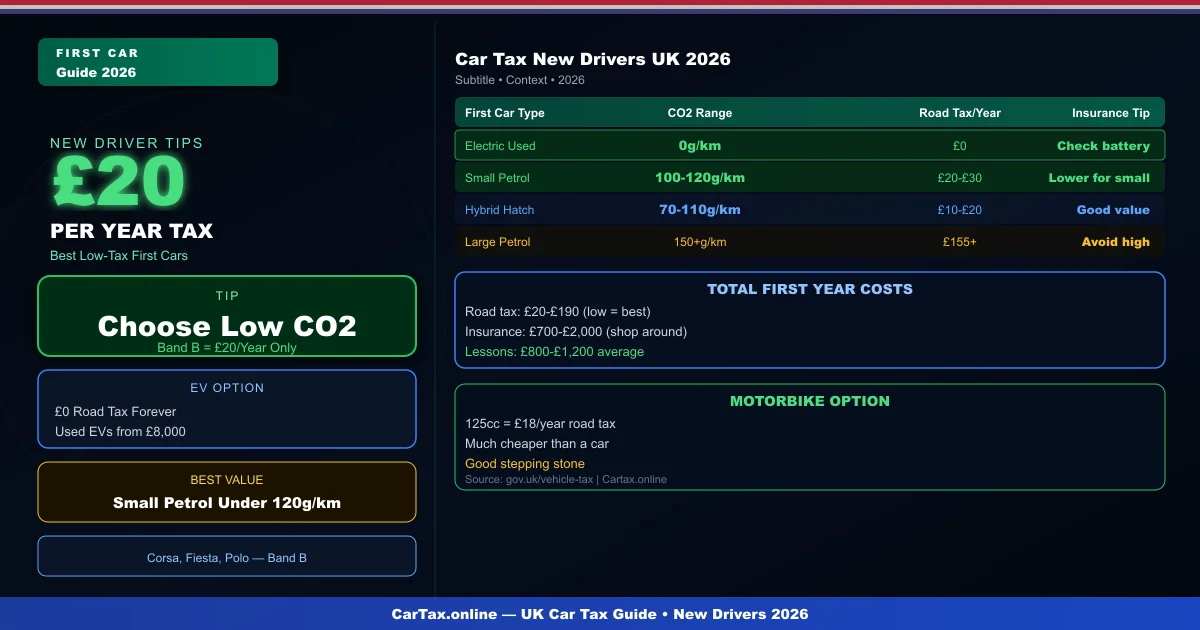
The cheapest cars to tax are those with zero CO2 emissions — fully electric vehicles pay £0 road tax. While electric cars may have higher purchase prices, they eliminate road tax entirely, making them cost-competitive over a three-to-five-year ownership period. Second to EVs, small hybrid and petrol hatchbacks emitting under 120g/km CO2 fall into Band B or C, paying as little as £20-£30 per year in standard rate road tax.
Good First Cars with Low Road Tax
Popular first cars that are cheap to tax include the Vauxhall Corsa, Ford Fiesta, and Volkswagen Polo in their smaller engine variants. These typically emit 110-125g/km CO2, placing them in VED Bands C and D with annual road tax of £110-£120. The Kia Picanto and Hyundai i10 are also excellent choices — small, economical, and falling into low-emission bands. Avoid high-performance versions of the same models, which can emit 150g/km or more. Related: Car Tax for Your First Car UK 2026 | Car Tax for New Drivers UK 2026 | Car Tax for Your First Car UK 2026 | Car Tax for New Drivers UK 2026.
Electric Options for New Drivers
New drivers can legally drive electric vehicles — there is no restriction on EV type for new drivers. Used electric vehicles are increasingly affordable, with models like the Nissan Leaf, Renault Zoe, and BMW i3 available from £8,000-£15,000. These pay zero road tax and have very low running costs beyond insurance. The main consideration is charging access — having a driveway or garage with a home charger makes EV ownership practical.
Motorbike Road Tax for New Riders
New motorcyclists face significantly lower road tax costs than car drivers. Motorbike VED rates range from £15-£50 per year depending on engine size, compared to £190 for a standard car. A 125cc motorcycle can cost as little as £18 per year in road tax. This makes motorcycling a cost-effective way to get on the road for new drivers who may later transition to a car — or who prefer two wheels for commuting.
Total First-Year Cost for New Drivers
Budget planning for a new driver's first year should include: provisional licence (£34), theory test (£23), driving lessons (£45-£60 per hour), practical test (£62), road tax (£20-£190 depending on vehicle), insurance (£700-£1,500 for new drivers), and fuel. Road tax is one of the smaller costs — but choosing a low-CO2 vehicle helps keep this cost minimal while also reducing insurance premiums, as smaller cars with lower performance typically attract lower insurance rates.
Official Resources: Parivahan Portal | Vahan Road Tax | India GST Portal | FAME-III Scheme
Frequently Asked Questions
Q: What is the current road tax rate for cars in India 2026?
Road tax rates in India vary by state and vehicle category. For new cars, GST is charged at 5% for EVs, 18% for hybrids under 1,200cc, and up to 28% for petrol/diesel SUVs. State road tax is charged separately and varies from Rs3,000-15,000 annually depending on the state's slab system. Check your specific state's RTO website for current rates.
Q: How do I calculate my car road tax online in India?
You can calculate your car road tax using online calculators available on state RTO portals and CarTax.online. The calculation considers your vehicle's ex-showroom price, fuel type, engine capacity, and state of registration. Road tax is payable annually or for the vehicle's lifetime depending on your state's rules.
Q: Is GST included in the road tax for new cars in India?
No — GST and road tax are separate charges. GST is a central tax charged by the vehicle manufacturer at the time of purchase. State road tax is a separate annual or one-time charge levied by your state's transport department. Both apply at the time of first registration, and annual road tax continues for subsequent years.
Q: Do electric vehicles get tax benefits in India 2026?
Yes — electric vehicles in India qualify for a reduced GST rate of 5% (down from 28% for petrol cars). Under FAME-III subsidies, EVs may also qualify for additional state-level incentives, reduced road tax, and free registration in many states. The exact benefits vary by state.
Q: What happens if I don't pay my car road tax on time?
If you don't pay road tax, your vehicle's registration can be flagged in the Vahan database, preventing renewal of fitness certificates and creating legal liability during police checks. Penalties range from Rs200-500 per day of default in most states. Road tax is a legal requirement under the Motor Vehicles Act.