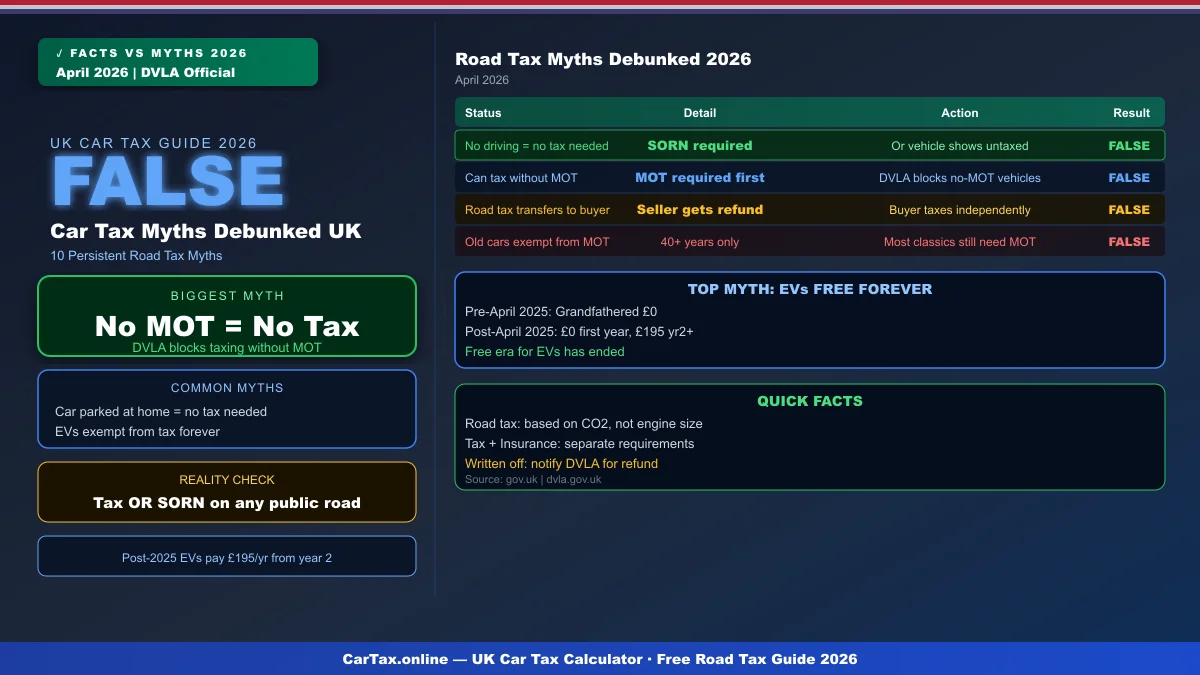
April 13, 2026 in United Kingdom — Car tax is one of the most misunderstood areas of UK motoring law. Every year, thousands of drivers make costly mistakes based on popular myths and incorrect assumptions. This guide debunks the most persistent and costly road tax myths with the facts you need to stay legal and avoid penalties in 2026.
Myth 1: "You don't need road tax if you don't drive the car"
FACT: Road tax is not optional based on usage. If a vehicle is on a public road, it must be taxed. If you are not using the vehicle, you must declare a SORN (Statutory Off Road Notification). Without tax OR a SORN, the vehicle is illegally on the road and you risk a £80 Fixed Penalty Notice.
Myth 2: "You can tax a car without an MOT if you just got it"
FACT: For vehicles over 3 years old, you cannot tax the vehicle without a valid MOT. The DVLA system checks the MOT database in real-time and blocks road tax transactions for vehicles with expired or missing MOT certificates. Book and pass the MOT first, then tax.
Myth 3: "Electric vehicles are completely exempt from road tax forever"
FACT: This changed in April 2025. Pure electric vehicles registered from April 2025 onwards pay £0 in the first year, then £195/year from year two — the same as petrol cars. Pre-April 2025 EVs are grandfathered at £0 indefinitely. The 'free road tax forever' era for EVs has ended. Related: Car Tax Myths Debunked UK 2026 | Car Tax Myths UK 2026 | Car Tax Renewal UK 2026 | How Much Is Car Tax UK 2026? The Honest Answer.
Myth 4: "Road tax transfers to the new owner when you sell the car"
FACT: Road tax does not transfer between owners. When you sell a vehicle, the DVLA refunds any unused whole months to the seller automatically. The buyer must tax the vehicle independently — starting a fresh 12-month period. There is no credit, transfer, or assignment of road tax between parties.
Myth 5: "You can park a car on the road without tax if it's in front of your house"
FACT: Your car being parked in front of your house does not exempt it from road tax. Any vehicle on a public road must be taxed. Road tax is a requirement of keeping the vehicle on any road — not just when driving. Only vehicles on private land (not visible from or accessible from a public road) can be left untaxed with a SORN.
Myth 6: "Paying road tax means your car is insured"
FACT: Road tax and insurance are completely separate. Paying road tax does not provide or imply insurance coverage. You must have valid motor insurance before driving on any public road. The DVLA's Continuous Insurance Enforcement programme flags uninsured vehicles separately — these face immediate clamping and removal regardless of tax status.
Myth 7: "Old cars don't need an MOT"
FACT: All vehicles over 3 years old need an MOT, regardless of age. The only historic vehicle exemption from MOT is for vehicles that were constructed before 1960 and have not been substantially altered — this is a narrow category. A 1970s or 1980s car needs an MOT every year without exception. A 1986 car became MOT-exempt at age 40 in 2026 — but not before.
Myth 8: "I can claim back road tax if my car is written off"
FACT: Road tax is refundable for unused months when you notify the DVLA that a vehicle has been scrapped ( deregistered). The notification must be made through the DVLA's notification of scrapping service. Simply having a car written off by an insurer does not automatically trigger a refund — you must formally notify the DVLA.
Myth 9: "The seller should pay the road tax for the first year"
FACT: There is no obligation for sellers to pay road tax for the buyer or provide any road tax credit. The seller's obligation is to notify the DVLA of the change of keeper. The buyer is entirely responsible for taxing the vehicle immediately upon purchase. Sellers sometimes pre-tax vehicles as a goodwill gesture, but this is not required.
Myth 10: "Road tax is based on the engine size"
FACT: Road tax in the UK has been based on CO2 emissions since 2001, not engine size. A 2.0L petrol Ford Mondeo (139g/km CO2) pays less road tax than a 1.0L petrol Ford Fiesta (119g/km CO2) if both are post-April 2017. The engine capacity is shown on the V5C but does not directly determine the VED rate.
| Myth | Reality |
|---|---|
| Road tax optional if car not driven | Must have SORN or tax on public road |
| Can tax without MOT | No — MOT required for vehicles over 3 years |
| EVs exempt from road tax forever | Pre-2025 only — post-2025 EVs pay £195/yr from year 2 |
| Road tax transfers to buyer | Seller gets refund, buyer taxes independently |
| Parked outside house = no tax needed | No — any vehicle on public road needs tax or SORN |
| Road tax implies insurance | Separate requirement — need valid insurance separately |
| Old cars exempt from MOT | Only vehicles 40+ years (pre-1986) are historic |
| Written off = automatic tax refund | Must notify DVLA of scrapping to get refund |
| Seller must pay first-year tax | No obligation — buyer is responsible |
| Road tax based on engine size | Based on CO2 emissions only |
Frequently Asked Questions
Can I drive my car to the MOT test centre without tax?
Yes — but only with a pre-booked MOT appointment. Driving directly to a pre-booked MOT test is permitted under a specific exemption, even if the vehicle is untaxed. Keep your booking confirmation as evidence. You cannot drive to the test centre if you turn up without an appointment.
What's the biggest road tax mistake people make?
Relying on Direct Debit without keeping bank details updated. When the Direct Debit fails, the vehicle immediately shows as untaxed. Drivers who don't check regularly may drive for days or weeks without knowing their vehicle is technically untaxed, exposing them to the £80 Fixed Penalty Notice.
Do classic cars over 40 years old still need an MOT?
Yes, with a narrow exception. Vehicles over 40 years old (manufactured before 1 January 1986) are exempt from road tax as historic vehicles. But MOT is still required unless the vehicle was constructed before 1960 and has not been substantially altered. Most classic cars between 1986 and 1960 still need annual MOTs.
Conclusion
Road tax myths cause thousands of penalties every year. Key rules: keep vehicles taxed or on SORN, MOT must precede taxing for vehicles over 3 years, EVs registered post-April 2025 pay £195/year from year two, and road tax does not transfer between seller and buyer. Use the GOV.UK free vehicle check to verify your vehicle's status and never rely on assumptions.
Frequently Asked Questions
Q: How much is car tax (VED) in the UK 2026?
Car tax rates in the UK depend on your vehicle's CO2 emissions and list price. Standard rates start from £190 per year for petrol and diesel cars, with zero-rated VED for EVs. First-year rates vary from £0 to £2,605 depending on emissions. Additional premiums apply for vehicles over £40,000.
Q: How do I check if my car is taxed online?
You can check your vehicle's tax status for free on the Gov.uk website at gov.uk/check-vehicle-tax. You'll need your vehicle's registration number (number plate). You can also check via the Motor Insurance Database to verify road tax and insurance status simultaneously.
Q: Can I get a refund on car tax if I sell my vehicle?
Yes — if you sell or scrap your vehicle, you can claim a refund on any full months of remaining road tax. Contact DVLA with the V11 reminder letter or apply online at gov.uk. Refunds are usually processed within 4-6 weeks.
Q: Is road tax refund available when transferring ownership?
No — road tax does not transfer with the vehicle. When you sell your car, the tax is automatically cancelled and any remaining months are refunded to you by DVLA. The new owner must tax the vehicle immediately. As a buyer, always verify the vehicle's tax status before purchasing.
Q: What is the luxury car tax threshold in the UK 2026?
The additional rate for vehicles over £40,000 (list price) adds £410 per year to standard VED rates for years 2-6 of registration. This surcharge brings the annual cost for high-emission vehicles over £40,000 to around £600-690 per year. Pure EVs under £40,000 pay zero VED.