When budgeting for a vehicle, road tax is an ongoing cost worth considering. Motorcycles and cars have completely different VED structures — and motorcycles often come out significantly cheaper to tax. Here is how they compare.
Motorcycle VED Is Based on Engine Size
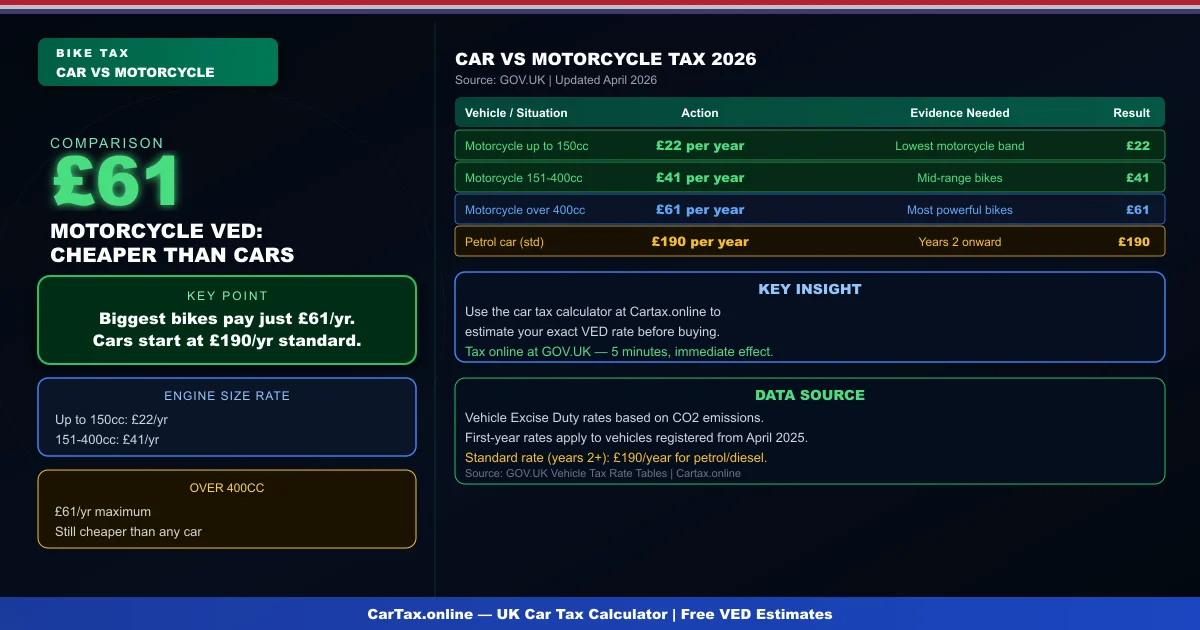
Unlike cars, which are taxed based on CO2 emissions, motorcycle VED is determined solely by engine power — specifically the rated engine capacity in cubic centimetres (cc). Motorcycles with engines up to 150cc pay just £22 per year. Those between 151 and 400cc pay £41 per year. Motorcycles over 400cc pay £61 per year. There is no first-year rate for motorcycles — the annual rate applies from the moment the bike is registered.
VED Rates: Motorcycles vs Cars
A large 1,000cc motorcycle pays £61 per year in road tax. A petrol car — even an economical family hatchback — pays £190 per year from year two. The most expensive motorcycles cost just £61 annually, while the cheapest cars start at £190. This means a motorcycle is always cheaper to tax than any car, purely on VED. For high-mileage riders, this is a meaningful annual saving.
Zero-Emission Motorcycles: No VED
Electric motorcycles and mopeds that produce zero CO2 emissions are exempt from road tax entirely. This includes electric scooters and motorbikes registered as zero-emission vehicles. As the electric motorcycle market grows, more riders can benefit from VED exemption. Check the specific model's classification with DVLA, as some electric two-wheelers fall into different tax categories. Related: Car Tax vs Motorcycle Tax UK 2026 | Car Tax vs Motorcycle Tax UK 2026 | Car Tax vs Motorcycle Tax UK 2026 | Car Tax vs Motorcycle Tax UK 2026.
Sidecars and Trailers
A motorcycle with a sidecar is taxed at the motorcycle rate based on engine size — not the car rate. Adding a trailer does not change the motorcycle's VED classification. However, trailers themselves require separate road tax if they exceed 750kg MAM (maximum authorised mass). Check DVLA's rate tables for trailer VED bands.
SORN for Motorcycles
Like cars, motorcycles can have a SORN declared if they are off the road. During winter months, many riders declare SORN to avoid paying VED while the bike is garaged. A SORN for a motorcycle costs nothing and can be declared online. The VED refund is proportional to unused months. This is a practical way to reduce costs if you only ride seasonally.
Insurance and Other Costs
While VED is cheaper for motorcycles, insurance costs are often higher for new riders due to accident statistics. Motorcycles also lack the safety features and weather protection of cars. When comparing total cost of ownership, factor in the full picture — VED savings on a motorcycle may be offset by higher insurance premiums or the cost of wet weather gear. Use the car tax calculator at Cartax.online to compare VED across different vehicle types.
Frequently Asked Questions
Q: How much is car tax (VED) in the UK 2026?
Car tax rates in the UK depend on your vehicle's CO2 emissions and list price. Standard rates start from £190 per year for petrol and diesel cars, with zero-rated VED for EVs. First-year rates vary from £0 to £2,605 depending on emissions. Additional premiums apply for vehicles over £40,000.
Q: How do I check if my car is taxed online?
You can check your vehicle's tax status for free on the Gov.uk website at gov.uk/check-vehicle-tax. You'll need your vehicle's registration number (number plate). You can also check via the Motor Insurance Database to verify road tax and insurance status simultaneously.
Q: Can I get a refund on car tax if I sell my vehicle?
Yes — if you sell or scrap your vehicle, you can claim a refund on any full months of remaining road tax. Contact DVLA with the V11 reminder letter or apply online at gov.uk. Refunds are usually processed within 4-6 weeks.
Q: Is road tax refund available when transferring ownership?
No — road tax does not transfer with the vehicle. When you sell your car, the tax is automatically cancelled and any remaining months are refunded to you by DVLA. The new owner must tax the vehicle immediately. As a buyer, always verify the vehicle's tax status before purchasing.
Q: What is the luxury car tax threshold in the UK 2026?
The additional rate for vehicles over £40,000 (list price) adds £410 per year to standard VED rates for years 2-6 of registration. This surcharge brings the annual cost for high-emission vehicles over £40,000 to around £600-690 per year. Pure EVs under £40,000 pay zero VED.