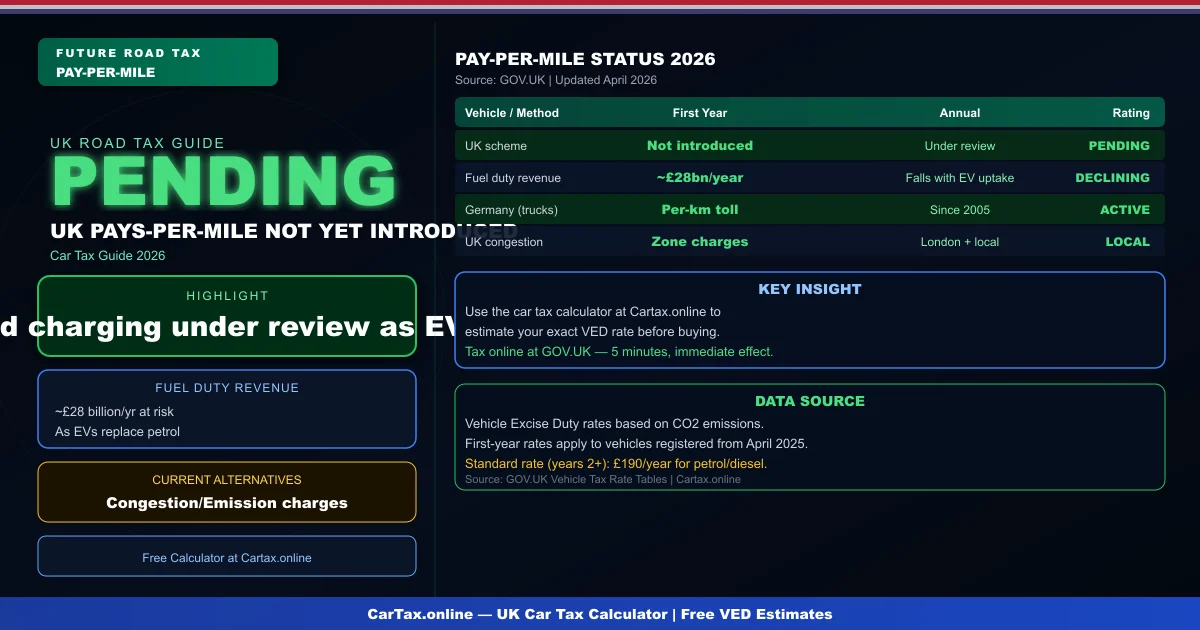
Car tax per mile UK — as fuel duty revenues decline with the shift to electric vehicles, distance-based road charging is increasingly discussed as a future replacement for current VED. Here is the current landscape in 2026.
Why Pay-Per-Mile Is Being Considered
Fuel duty currently raises approximately £28 billion per year from drivers. As more electric vehicles replace petrol and diesel cars, this revenue declines — EVs pay zero fuel duty and minimal VED. The government must find alternative revenue to maintain road infrastructure funding. Pay-per-mile road charging is one of the leading options.
The UK's Current Position on Road Pricing
No national pay-per-mile scheme has been introduced in the UK as of 2026. The government has commissioned research into road pricing models, and several local authorities have introduced or are piloting congestion and emissions-based charging (such as the London Congestion Charge and ULEZ). However, a national mileage-based tax system remains under review.
International Comparison: How Other Countries Charge
- Germany: LKW-Maut truck toll on all federal roads since 2005
- Netherlands: Plans for kilometre charge cancelled in 2012 due to privacy concerns
- New Zealand: Road User Charges (RUC) for vehicles over 3.5 tonnes — distance-based
- USA: Per-state mile-based taxes for heavy vehicles, pilots for passenger cars
How a UK Pay-Per-Mile Scheme Might Work
Any UK pay-per-mile scheme would likely use GPS or odometer-based tracking to record distance driven. Black-box insurance policies have already familiarised many UK drivers with telematics technology. Privacy concerns are significant — drivers are wary of government tracking their every journey. Related: Car Tax per Mile UK 2026 | Car Tax Future UK 2026 | Future of Car Tax UK 2026 | Car Tax and Telematics UK 2026.
Conclusion
Car tax per mile UK is not yet in place but remains under active consideration. The transition will affect all drivers, especially EV owners. GOV.UK research publications track the latest developments.
Vehicle Excise Duty (VED) rates in the UK are reviewed annually, typically in April with the new financial year. The DVLA administers all vehicle taxation and registration, and you can check your vehicle's current tax status for free at gov.uk/check-vehicle-tax using only your registration number. Rates are determined by the vehicle's CO2 emissions and list price at the time of first registration, with additional premiums applying for high-value vehicles.
Frequently Asked Questions
Q: How much is car tax (VED) in the UK 2026?
Car tax rates in the UK depend on your vehicle's CO2 emissions and list price. Standard rates start from £190 per year for petrol and diesel cars, with zero-rated VED for EVs. First-year rates vary from £0 to £2,605 depending on emissions. Additional premiums apply for vehicles over £40,000.
Q: How do I check if my car is taxed online?
You can check your vehicle's tax status for free on the Gov.uk website at gov.uk/check-vehicle-tax. You'll need your vehicle's registration number (number plate). You can also check via the Motor Insurance Database to verify road tax and insurance status simultaneously.
Q: Can I get a refund on car tax if I sell my vehicle?
Yes — if you sell or scrap your vehicle, you can claim a refund on any full months of remaining road tax. Contact DVLA with the V11 reminder letter or apply online at gov.uk. Refunds are usually processed within 4-6 weeks.
Q: Is road tax refund available when transferring ownership?
No — road tax does not transfer with the vehicle. When you sell your car, the tax is automatically cancelled and any remaining months are refunded to you by DVLA. The new owner must tax the vehicle immediately. As a buyer, always verify the vehicle's tax status before purchasing.
Q: What is the luxury car tax threshold in the UK 2026?
The additional rate for vehicles over £40,000 (list price) adds £410 per year to standard VED rates for years 2-6 of registration. This surcharge brings the annual cost for high-emission vehicles over £40,000 to around £600-690 per year. Pure EVs under £40,000 pay zero VED.