April 13, 2026 in United Kingdom — Choosing between car leasing and buying in the UK has significant tax implications. Whether you are a business owner, company car driver, or personal buyer, understanding the VED, BIK tax, VAT, and capital allowance differences between leasing vs buying a car in the UK is essential for making the most cost-effective decision.
VED Treatment: Leased vs Purchased Vehicles
Both leased and purchased vehicles are subject to Vehicle Excise Duty in the same way — the registered keeper pays VED. For a purchased vehicle, the owner pays the annual rate directly. For a leased vehicle, the leasing company remains the registered keeper and includes the VED cost in the lease rental.
The key difference is transparency: with a purchased vehicle, you see the exact VED cost; with a lease, it is bundled into monthly payments. Both attract the same VED rates based on CO2 emissions, so there is no inherent advantage from the VED perspective.
VED Rates Comparison: Leasing vs Buying
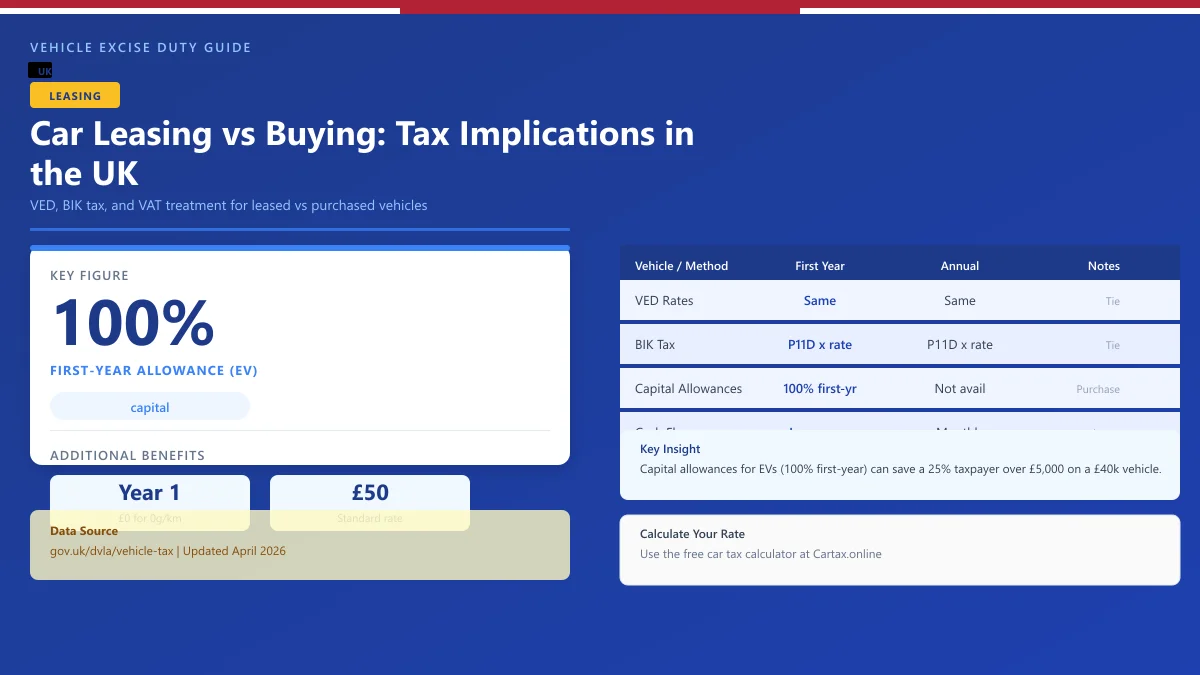
- VED Rates: Same for both — CO2-based graduated rates apply regardless of purchase method
- BIK Tax: Same for both — P11D value x BIK rate based on CO2 emissions
- VAT Recovery: Both at 50% for mixed use, 100% for exclusively business
- Capital Allowances: Purchase wins — 100% first-year allowance for EVs vs none for leasing
- Cash Flow: Lease wins — monthly payments vs large upfront lump sum
Company Car Benefit-in-Kind Tax on Leased Vehicles
Leasing a company car creates a benefit-in-kind liability for the employee. The BIK value is calculated as a percentage of the vehicle's list price (P11D value) based on its CO2 emissions. For example, a zero-emission EV with a P11D value of £40,000 and 2% BIK rate attracts an annual BIK tax of £800. Related: Car Leasing vs Buying UK 2026 | Buying a Car Online and Road Tax UK 2026 | Car Tax and Leasing UK 2026 | Car Tax and Leasing UK 2026.
If you purchase a vehicle through a company and use it privately, the BIK calculation is identical. However, some company car schemes offer salary sacrifice arrangements where the BIK is mitigated by converting cash salary into a lease, making the net tax position more favourable for lower-rate taxpayers.
VAT Recovery on Leased vs Purchased Vehicles
Businesses can generally recover 50% of the VAT on leased vehicle payments if the vehicle is used for both business and private purposes. If the vehicle is exclusively business use, 100% VAT recovery is possible.
For purchased vehicles, VAT recovery on the acquisition is more complex. Input VAT on the purchase price is generally not recoverable for passenger cars, though it may be reclaimable for dealer/demo vehicles or where the vehicle is exclusively used for VATable supplies.
Capital Allowances: Why Buying Can Win for EVs
When a business purchases a vehicle outright, it can claim capital allowances against taxable profits. For zero-emission vehicles, 100% first-year capital allowance is available — the entire cost can be deducted from taxable profits in the year of purchase.
For a higher-rate taxpayer (25% corporation tax) buying a £40,000 EV, the first-year capital allowance saves £10,000 in tax. Leased vehicles cannot benefit from capital allowances, though lease payments are deducted as a business expense. For high-value electric vehicles, purchasing often provides a better tax outcome.
Conclusion
Car leasing vs buying in the UK depends on your tax position. For personal buyers, the choice is primarily about cash flow. For business owners and higher-rate taxpayers, the 100% first-year capital allowance for EVs makes purchasing more attractive. Compare both options using our car tax calculator. Read the full guidance on GOV.UK capital allowances.
Frequently Asked Questions
Q: How much is car tax (VED) in the UK 2026?
Car tax rates in the UK depend on your vehicle's CO2 emissions and list price. Standard rates start from £190 per year for petrol and diesel cars, with zero-rated VED for EVs. First-year rates vary from £0 to £2,605 depending on emissions. Additional premiums apply for vehicles over £40,000.
Q: How do I check if my car is taxed online?
You can check your vehicle's tax status for free on the Gov.uk website at gov.uk/check-vehicle-tax. You'll need your vehicle's registration number (number plate). You can also check via the Motor Insurance Database to verify road tax and insurance status simultaneously.
Q: Can I get a refund on car tax if I sell my vehicle?
Yes — if you sell or scrap your vehicle, you can claim a refund on any full months of remaining road tax. Contact DVLA with the V11 reminder letter or apply online at gov.uk. Refunds are usually processed within 4-6 weeks.
Q: Is road tax refund available when transferring ownership?
No — road tax does not transfer with the vehicle. When you sell your car, the tax is automatically cancelled and any remaining months are refunded to you by DVLA. The new owner must tax the vehicle immediately. As a buyer, always verify the vehicle's tax status before purchasing.
Q: What is the luxury car tax threshold in the UK 2026?
The additional rate for vehicles over £40,000 (list price) adds £410 per year to standard VED rates for years 2-6 of registration. This surcharge brings the annual cost for high-emission vehicles over £40,000 to around £600-690 per year. Pure EVs under £40,000 pay zero VED.