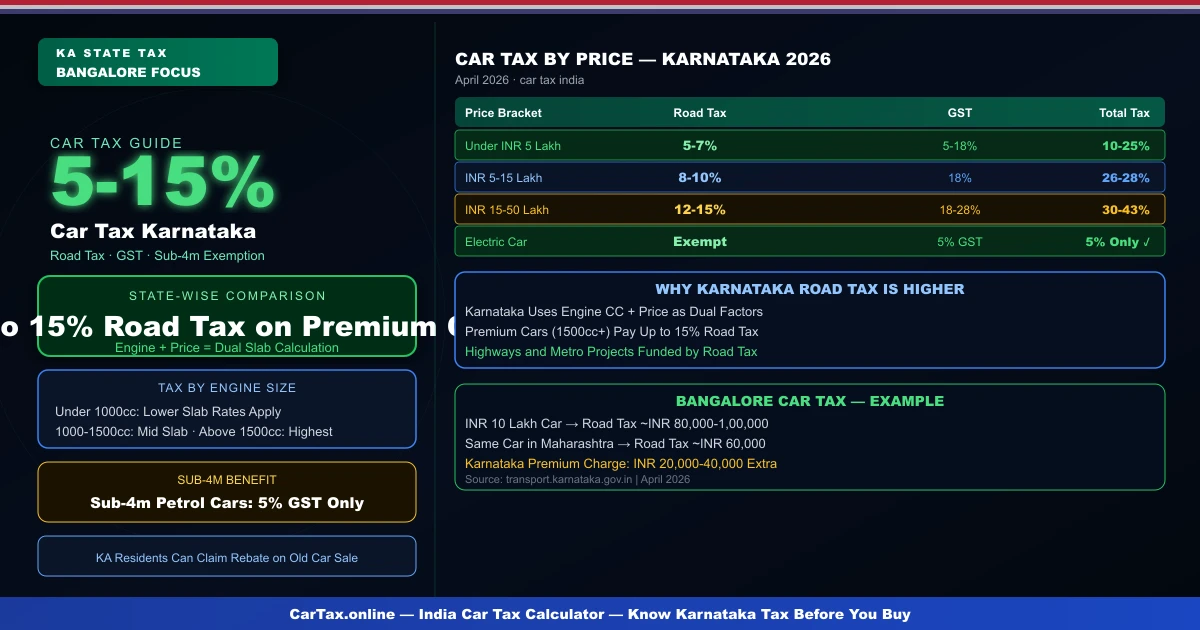
Karnataka road tax for cars in 2026 follows revised slabs introduced earlier in the year, making the state one of the higher-tax jurisdictions for vehicle ownership in India. Understanding Karnataka's car tax structure is essential whether you're buying a new car in Bangalore, registering a used car from another state, or simply want to calculate the true cost of your next vehicle.
As of April 18, 2026, Karnataka applies road tax based on vehicle value with slabs ranging from 8% for economy cars to 20% for premium vehicles. The state also levies an additional cess on petrol and diesel vehicles under 4 metres in length, with different treatment for electric vehicles that enjoy road tax exemption for the first 5 years.
Karnataka Road Tax Slabs for Cars
Karnataka road tax for new passenger cars follows value-based slabs. Vehicles priced up to INR 5 lakh attract road tax at 8%, vehicles between INR 5 to 10 lakh at 10%, vehicles between INR 10 to 15 lakh at 14%, and vehicles above INR 15 lakh at 20%. This slab system was revised in 2025-2026, increasing the burden on buyers of mid-range and premium vehicles.
For a practical example, a Maruti Baleno priced at INR 10 lakh attracts road tax of INR 1 lakh in Karnataka, while the same car in Delhi attracts road tax of INR 60,000 at the 6% rate. The Karnataka tax is 67% higher than Delhi for an equivalent vehicle, making Karnataka among the more expensive states for car ownership despite being one of India's economic centres.
GST and Road Tax: Separate Charges
GST and road tax are distinct charges applied by different authorities. GST is a central government tax applied to the vehicle transaction price at rates between 5% and 43% depending on vehicle type. Karnataka road tax is a state-level charge applied on the vehicle's ex-showroom price, and it must be paid separately to the Karnataka Transport Department at the time of registration.
When you purchase a new car in Karnataka, you pay GST to the dealer, road tax to the RTO, and registration fees to the Transport Department. The total tax burden depends on vehicle type, price, and fuel. Using our India car tax calculator provides an instant estimate of all charges combined.
Sub-4 Metre Car Cess in Karnataka
Karnataka applies an additional cess on vehicles under 4 metres in length, which includes most hatchbacks and compact sedans. The cess is 4% for petrol vehicles under 4 metres and 8% for diesel vehicles under 4 metres. This additional cess makes compact cars relatively more expensive to tax in Karnataka compared to states that do not apply a sub-4 metre differentiation.
Despite the additional cess, sub-4 metre vehicles remain the most tax-efficient option in Karnataka for budget-conscious buyers. The cess is calculated on the vehicle price and added to the base road tax. Vehicles over 4 metres in length, including most SUVs and sedans, do not pay the additional cess but fall into the higher slab rates based on their overall price.
Road Tax for Used Cars in Karnataka
When purchasing a used car in Karnataka, the road tax treatment depends on whether you are buying from within Karnataka or transferring from another state. For intra-state transfers, you pay road tax based on the vehicle's current assessed value, which is typically the original price minus depreciation over the vehicle's age.
For inter-state transfers into Karnataka, you must first obtain an NOC from the origin state, then pay Karnataka road tax based on the vehicle's current value in Karnataka's slab system. Karnataka's road tax rates may be higher than the origin state, creating a potential additional cost that buyers should budget for before committing to an inter-state purchase.
Electric Vehicle Road Tax in Karnataka
Electric vehicles registered in Karnataka enjoy road tax exemption for the first 5 years of registration. After the exemption period, EVs pay road tax at 50% of the standard rate applicable to equivalent petrol vehicles. The exemption provides significant savings, particularly for premium EVs where the standard road tax would otherwise be substantial.
For example, an electric SUV priced at INR 30 lakh would attract road tax of INR 6 lakh over 5 years after the exemption period ends, compared to INR 6 lakh per 5 years if the exemption did not exist. The exemption effectively provides INR 6 lakh in savings over the first 5 years of ownership.
Frequently Asked Questions
What is the current road tax rate for cars in Karnataka?
Karnataka road tax for new cars varies by vehicle value and type. Cars priced below INR 5 lakh pay 8% road tax, vehicles between INR 5 to 10 lakh pay 10%, vehicles INR 10 to 20 lakh pay 14%, and cars above INR 15 lakh pay 20% road tax as of 2026. Electric vehicles enjoy road tax exemption for the first 5 years of registration.
Is GST included in the Karnataka road tax calculation?
No, GST and road tax are separate charges. GST is levied by the central government on the vehicle sale price, while Karnataka road tax is a state-level charge based on the vehicle ex-showroom price. Both must be paid when purchasing a new vehicle in Karnataka.
What is the sub-4 metre car tax in Karnataka?
Sub-4 metre cars in Karnataka pay a reduced additional cess of 4% under the Karnataka Motor Vehicles Taxation Act. This applies to all petrol and diesel vehicles under 4 metres in length, providing some cost relief compared to larger vehicles in the same price segment.
How much is total road tax for a car in Bangalore?
Total road tax in Bangalore equals the Karnataka state road tax rate applied to the vehicle price, with no additional municipal charges. For a car priced at INR 10 lakh, road tax is approximately INR 1 lakh (10%). For the same car in Delhi, road tax would be approximately INR 60,000 (6%), making Karnataka more expensive for mid-range vehicles.
Can I calculate Karnataka road tax online?
Yes, you can calculate Karnataka road tax using the Karnataka Transport Department website or our India car tax calculator. Simply enter the vehicle price, fuel type, and category to get an instant estimate of the total road tax and registration fees applicable in Karnataka.
Official Resources: Parivahan Portal | Vahan Road Tax | India GST Portal | FAME-III Scheme
Frequently Asked Questions
Q: What is the current road tax rate for cars in India 2026?
Road tax rates in India vary by state and vehicle category. For new cars, GST is charged at 5% for EVs, 18% for hybrids under 1,200cc, and up to 28% for petrol/diesel SUVs. State road tax is charged separately and varies from Rs3,000-15,000 annually depending on the state's slab system. Check your specific state's RTO website for current rates.
Q: How do I calculate my car road tax online in India?
You can calculate your car road tax using online calculators available on state RTO portals and CarTax.online. The calculation considers your vehicle's ex-showroom price, fuel type, engine capacity, and state of registration. Road tax is payable annually or for the vehicle's lifetime depending on your state's rules.
Q: Is GST included in the road tax for new cars in India?
No — GST and road tax are separate charges. GST is a central tax charged by the vehicle manufacturer at the time of purchase. State road tax is a separate annual or one-time charge levied by your state's transport department. Both apply at the time of first registration, and annual road tax continues for subsequent years.
Q: Do electric vehicles get tax benefits in India 2026?
Yes — electric vehicles in India qualify for a reduced GST rate of 5% (down from 28% for petrol cars). Under FAME-III subsidies, EVs may also qualify for additional state-level incentives, reduced road tax, and free registration in many states. The exact benefits vary by state.
Q: What happens if I don't pay my car road tax on time?
If you don't pay road tax, your vehicle's registration can be flagged in the Vahan database, preventing renewal of fitness certificates and creating legal liability during police checks. Penalties range from Rs200-500 per day of default in most states. Road tax is a legal requirement under the Motor Vehicles Act.