April 13, 2026 in United Kingdom — Car insurance groups and Vehicle Excise Duty bands are separate rating systems, but both are influenced by the same vehicle characteristics. Understanding the relationship between insurance groups and car tax in the UK helps you choose vehicles that minimise total motoring costs in 2026.
Insurance Groups vs VED Bands: Understanding the Relationship
Car insurance groups (1-50, with 50 being the highest) and Vehicle Excise Duty bands are separate rating systems that do not directly interact, but both are heavily influenced by the vehicle's specifications — particularly CO2 emissions, engine size, and market value.
Insurance groups reflect the cost of repairing or replacing a vehicle in the event of a claim, combined with theft risk and accident frequency data. VED bands reflect the environmental impact of the vehicle as measured by CO2 emissions. Both systems tend to favour lower-emission, less expensive vehicles.
Vehicle Tax and Insurance Groups: Comparison Table
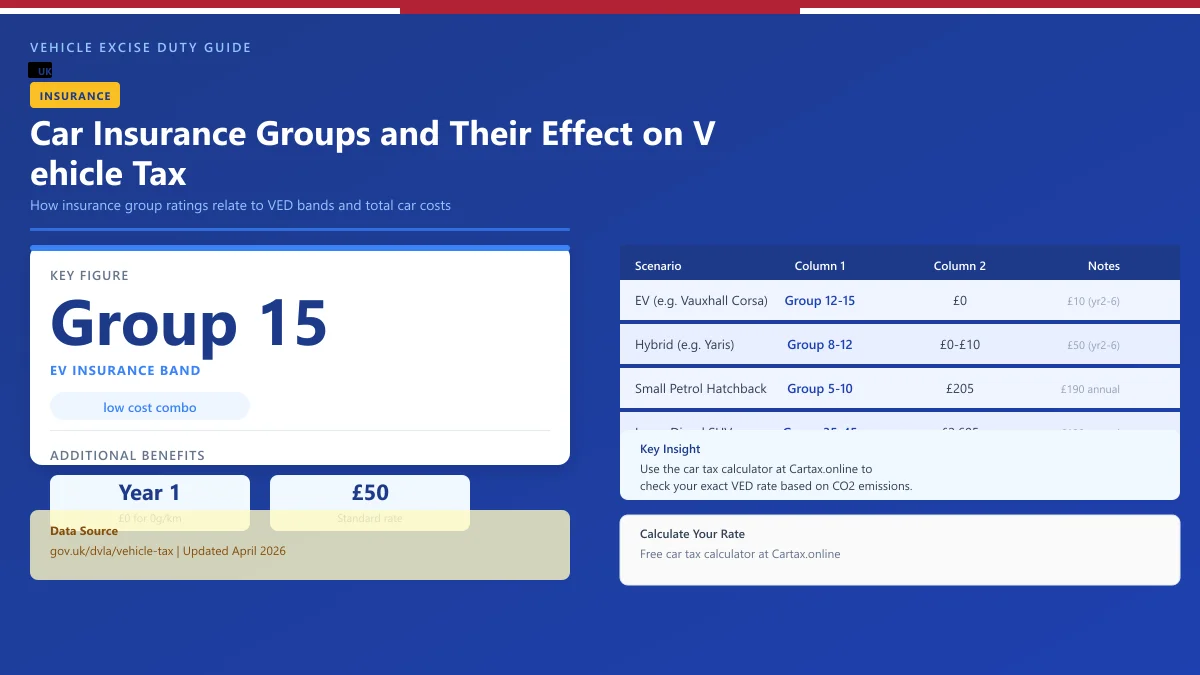
- EV (e.g. Vauxhall Corsa Electric): Insurance Group 12-15 — First-year VED £0 — Annual road tax £10 (years 2-6)
- Hybrid (e.g. Toyota Yaris Hybrid): Insurance Group 8-12 — First-year VED £0-£10 — Annual road tax £50
- Small Petrol Hatchback: Insurance Group 5-10 — First-year VED £205 — Annual road tax £190
- Large Diesel SUV: Insurance Group 35-45 — First-year VED £2,605 — Annual road tax £190
- Performance Car (BMW M4): Insurance Group 45-48 — First-year VED £2,605 — Annual road tax £190
Low Insurance Group + Low VED: The Ideal Combination
The most cost-effective vehicles combine low insurance groups with low or zero CO2 emissions. Electric vehicles typically fall into low insurance groups (10-20) due to their simpler construction and lower repair costs, while also paying minimal road tax. A new EV in group 15 paying £0 first-year VED represents the lowest combined cost. Related: Car Insurance Groups and Vehicle Tax UK 2026 | UK Car Insurance Costs 2026 | Car Tax and Insurance Connection UK 2026 | Car Tax and Insurance Premium UK 2026.
Hybrid vehicles also score well on both metrics — a Toyota Prius in group 12-14 attracts low insurance premiums and VED rates of £0-£10 in year one. This combination makes hybrids an attractive option for cost-conscious buyers who want to minimise both running costs and car tax in the UK.
High-Performance Cars: Double Tax Penalty
High-performance vehicles face a double burden. A BMW M4 with 250g/km CO2 emissions pays £2,605 in first-year VED, while its high specification, powerful engine, and expensive parts place it in insurance group 45-48. The combined annual cost (VED + insurance) can exceed £3,000 per year before fuel.
This effectively acts as a progressive levy on more powerful vehicles — consistent with the environmental principle that those who use more road space and produce more emissions should contribute more.
Choosing Vehicles for Minimum Total Cost
For the lowest total cost of ownership, target vehicles with 0g/km CO2 emissions (Group 1-20 insurance), engine size under 1.5 litres, active safety features that reduce accident frequency, and recovery-friendly design that lowers repair costs.
Use a car insurance group lookup tool alongside the car tax calculator to estimate total annual costs before purchasing. The VED rate is just one component of running costs — a vehicle paying £190 road tax but group 5 insurance may cost less than one paying £0 road tax in group 35.
Conclusion
The link between car insurance groups and vehicle tax in the UK is indirect but real — low-emission vehicles tend to score well on both metrics. EVs in groups 12-15 with £0 first-year VED offer the best combined value. Use our car tax calculator alongside an insurance group lookup to find vehicles that minimise your total annual motoring costs.
Official Resources: GOV.UK Check Vehicle Tax | GOV.UK Vehicle Tax | DVLA Online | MOT Check
Frequently Asked Questions
Q: How much is car tax (VED) in the UK 2026?
Car tax rates in the UK depend on your vehicle's CO2 emissions and list price. Standard rates start from £190 per year for petrol and diesel cars, with zero-rated VED for EVs. First-year rates vary from £0 to £2,605 depending on emissions. Additional premiums apply for vehicles over £40,000.
Q: How do I check if my car is taxed online?
You can check your vehicle's tax status for free on the Gov.uk website at gov.uk/check-vehicle-tax. You'll need your vehicle's registration number (number plate). You can also check via the Motor Insurance Database to verify road tax and insurance status simultaneously.
Q: Can I get a refund on car tax if I sell my vehicle?
Yes — if you sell or scrap your vehicle, you can claim a refund on any full months of remaining road tax. Contact DVLA with the V11 reminder letter or apply online at gov.uk. Refunds are usually processed within 4-6 weeks.
Q: Is road tax refund available when transferring ownership?
No — road tax does not transfer with the vehicle. When you sell your car, the tax is automatically cancelled and any remaining months are refunded to you by DVLA. The new owner must tax the vehicle immediately. As a buyer, always verify the vehicle's tax status before purchasing.
Q: What is the luxury car tax threshold in the UK 2026?
The additional rate for vehicles over £40,000 (list price) adds £410 per year to standard VED rates for years 2-6 of registration. This surcharge brings the annual cost for high-emission vehicles over £40,000 to around £600-690 per year. Pure EVs under £40,000 pay zero VED.