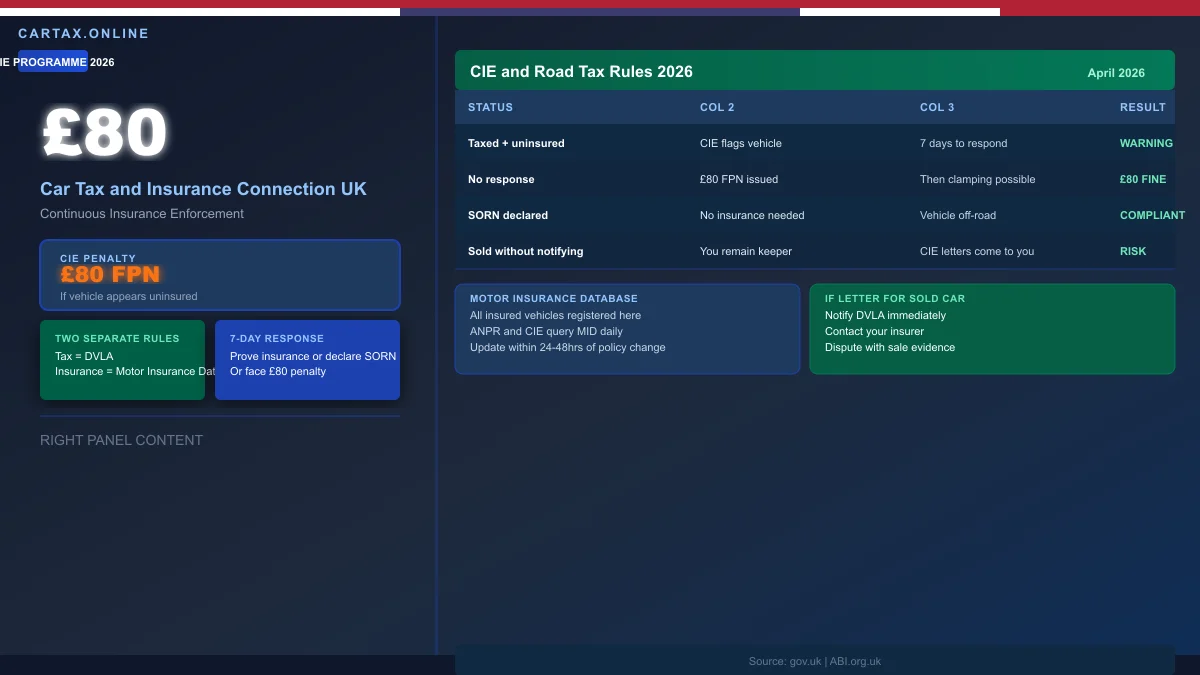
April 13, 2026 in United Kingdom — Road tax and car insurance are two entirely separate legal requirements, but they are connected through the DVLA's Continuous Insurance Enforcement (CIE) programme. Understanding how insurance status interacts with your road tax obligations can help you avoid penalties that may otherwise seem unrelated. This guide covers the insurance-tax connection in 2026.
Road Tax and Insurance: Two Separate Requirements
Road tax (VED) and car insurance are independent legal obligations:
- Road tax: Paid to the DVLA, based on CO2 emissions, funds the road network
- Car insurance: Required by law to drive on any public road, covers liability for damage and injury
Paying one does not satisfy the other. You cannot claim that your road tax payment provides any form of insurance coverage, and paying for insurance does not exempt you from road tax. Both must be maintained simultaneously.
Continuous Insurance Enforcement (CIE)
The DVLA's Continuous Insurance Enforcement programme identifies vehicles that appear to be uninsured by cross-referencing the Motor Insurance Database (MID) with the vehicle licensing database. If a taxed vehicle appears to have no insurance, the DVLA sends a warning letter to the registered keeper, requiring them to either insure the vehicle or declare a SORN. Related: Car Tax and Insurance Connection UK 2026 | Car Insurance Groups and Vehicle Tax UK 2026 | Car Tax and Insurance UK 2026 | Car Tax and MOT Connection UK 2026.
What Happens If Your Vehicle Appears Uninsured
If the DVLA's CIE programme flags your vehicle as potentially uninsured:
- Warning letter: Sent to the registered keeper — you have 7 days to respond with proof of insurance or declare SORN
- £80 Fixed Penalty Notice: If you do not respond or cannot prove insurance, an FPN is issued
- Clamping and removal: If the FPN is unpaid, the vehicle can be clamped and removed regardless of tax status
Why CIE Exists
CIE targets vehicles that are taxed but apparently uninsured — a common scenario where owners let insurance lapse but forget to cancel the road tax. The programme aims to reduce the number of uninsured vehicles on UK roads, which cause significant costs to other road users through higher insurance premiums. By cross-referencing the MID and vehicle licensing database, CIE catches uninsured vehicles that would otherwise go undetected.
The SORN Exception
If your vehicle is declared SORN, it is off the road and does not need insurance. CIE ignores SORN'd vehicles — the programme only targets taxed vehicles that appear to lack insurance. If you are not driving your vehicle, declare SORN immediately. A vehicle that is taxed but not driven without a SORN is an insurance risk that CIE will flag.
Can You Tax a Car Without Insurance?
Yes — in limited circumstances. You can tax a vehicle without having insurance in your name if the vehicle is going to be kept off-road (on SORN). You cannot tax and insure simultaneously in different names — the insurance must match the registered keeper. However, you can tax a vehicle and arrange insurance within 14 days of the tax start date — but you cannot drive it until insurance is in place.
Insuring a Vehicle Before Taxing
To tax a vehicle, you must be the registered keeper on the V5C. Once you are the keeper, you can tax online — and as part of the tax process, the DVLA shares your information with the Motor Insurance Database. Your insurance policy must be active before you drive the vehicle, but the tax and insurance systems operate independently of each other. As long as you have insurance before you drive, you are compliant.
What to Do If You Receive a CIE Letter for a Vehicle You Have Sold
If you sold a vehicle but did not notify the DVLA, you may receive a CIE warning letter for a vehicle you no longer own. In this case:
- Contact the DVLA immediately to notify the sale — use GOV.UK's tell us you sold your vehicle service
- Contact your insurance company to confirm the policy has been cancelled for the sold vehicle
- If the buyer drove uninsured and was flagged by CIE, the penalty may come to you as the registered keeper — dispute immediately with evidence of the sale
The Motor Insurance Database (MID)
The Motor Insurance Database is maintained by the Motor Insurers' Bureau (MIB) and records all valid motor insurance policies in the UK. Police ANPR cameras and the CIE programme both query the MID to check whether vehicles are insured. The MID is updated daily by insurance companies — when you buy or cancel a policy, the change is reflected in the MID within 24-48 hours.
Clamping for Uninsurance
Uninsured vehicles flagged by CIE can be clamped and removed by contracted enforcement agents, separate from the DVLA's tax clamping. The release fee for an uninsured-vehicle clamp is typically higher than for an untaxed-vehicle clamp, and the police can seize uninsured vehicles immediately if found on the road.
Conclusion
Road tax and insurance are separate legal requirements — both must be maintained simultaneously. The DVLA's CIE programme identifies taxed vehicles that appear uninsured by cross-referencing the Motor Insurance Database. If flagged, you have 7 days to prove insurance or declare SORN to avoid a penalty. Always notify the DVLA when selling a vehicle to protect yourself from CIE letters for vehicles you no longer own. Keep insurance active from the moment you become the keeper.
Frequently Asked Questions
Q: How much is car tax (VED) in the UK 2026?
Car tax rates in the UK depend on your vehicle's CO2 emissions and list price. Standard rates start from £190 per year for petrol and diesel cars, with zero-rated VED for EVs. First-year rates vary from £0 to £2,605 depending on emissions. Additional premiums apply for vehicles over £40,000.
Q: How do I check if my car is taxed online?
You can check your vehicle's tax status for free on the Gov.uk website at gov.uk/check-vehicle-tax. You'll need your vehicle's registration number (number plate). You can also check via the Motor Insurance Database to verify road tax and insurance status simultaneously.
Q: Can I get a refund on car tax if I sell my vehicle?
Yes — if you sell or scrap your vehicle, you can claim a refund on any full months of remaining road tax. Contact DVLA with the V11 reminder letter or apply online at gov.uk. Refunds are usually processed within 4-6 weeks.
Q: Is road tax refund available when transferring ownership?
No — road tax does not transfer with the vehicle. When you sell your car, the tax is automatically cancelled and any remaining months are refunded to you by DVLA. The new owner must tax the vehicle immediately. As a buyer, always verify the vehicle's tax status before purchasing.
Q: What is the luxury car tax threshold in the UK 2026?
The additional rate for vehicles over £40,000 (list price) adds £410 per year to standard VED rates for years 2-6 of registration. This surcharge brings the annual cost for high-emission vehicles over £40,000 to around £600-690 per year. Pure EVs under £40,000 pay zero VED.