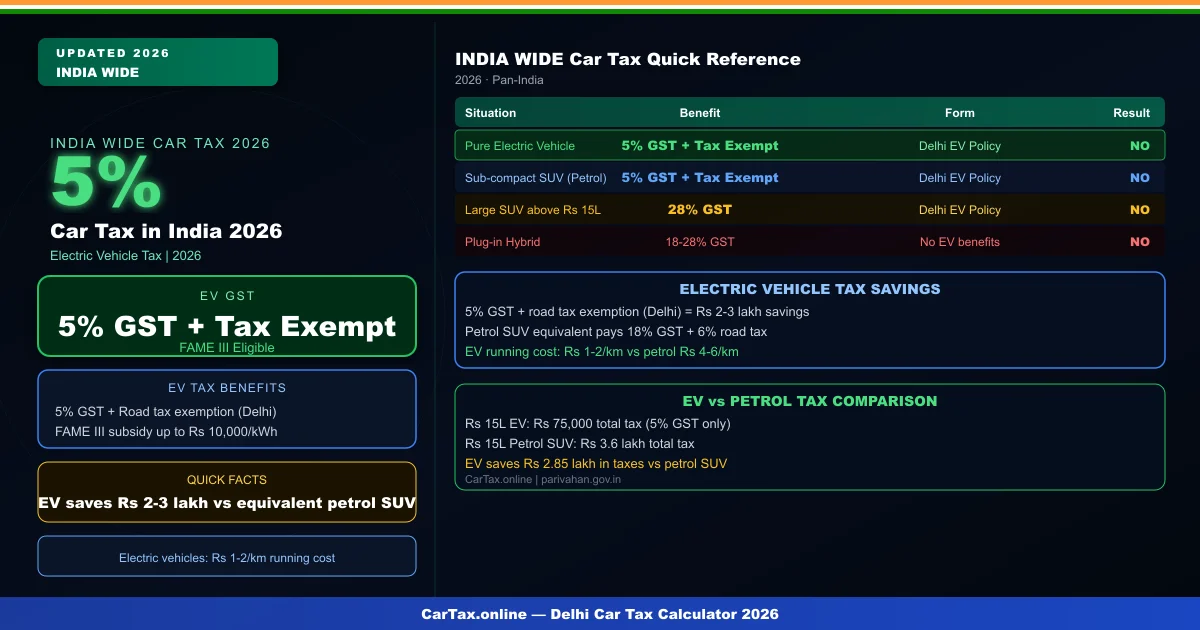
Understanding car tax in India requires knowing two distinct taxes that together can account for 20-45% of your vehicle's total purchase cost. GST (Goods and Services Tax) is applied uniformly across India by the manufacturer and is included in the ex-showroom price. Road tax is a state government levy paid separately at the RTO, with rates that vary dramatically — from 4% in Delhi to 18% in Karnataka. The combination of these two taxes means the true cost of a ₹10 lakh car on-road can range from ₹12.3 lakh in Delhi to ₹14 lakh in Karnataka.
The April 2026 GST 2.0 reform brought significant changes for the automobile sector — most notably reducing GST on sub-compact SUVs from 28% to 18%, creating a ₹1-3 lakh saving for buyers in this popular segment. This guide covers everything you need to know about car tax in India for 2026.
How Car Tax Works in India
Every new car purchase in India attracts multiple layers of tax. The ex-showroom price set by the manufacturer includes GST at the applicable rate — this is paid directly to the dealer. After purchase, the buyer visits the RTO to complete registration, where road tax is paid based on the ex-showroom price and the state's slab rates. This combination of GST and road tax is the primary reason why on-road prices are significantly higher than ex-showroom prices.
GST 2.0: What Changed in April 2026
The GST Council's April 2026 revision (effective April 1, 2026) introduced GST 2.0 for the automobile sector. The headline change: sub-compact SUVs — India's most popular vehicle segment — saw GST drop from 28% to 18%. Small cars also saw a modest reduction from 6% to 5%. Large SUVs and luxury vehicles remained at 28% GST.
What are the two main taxes on cars in India?
Cars in India attract two main taxes: GST (Goods and Services Tax) and Road Tax. GST is applied by the vehicle manufacturer and is included in the ex-showroom price — it ranges from 5% (small cars and EVs) to 28% (large SUVs). Road tax is paid separately at the RTO and varies by state from 4% to 18% of the ex-showroom price.
What is the current GST rate on cars in India?
GST 2.0 rates effective April 2026: Small cars (under 4m, petrol under 1200cc) at 5%; sub-compact SUVs at 18%; large SUVs above ₹15 lakh at 28%; and electric vehicles at 5%. GST is uniform across all Indian states.
Which state has the lowest road tax for cars?
Delhi NCT has one of the lowest road tax rates in India at 4-8% (one-time). Rajasthan, Gujarat, and Goa also have competitive road tax rates. Karnataka has some of the highest at 8-18% for premium vehicles.
Do EVs pay road tax in India?
Electric vehicles are exempt from road tax in Delhi under the Delhi EV Policy 2024. Many other states also offer partial or full road tax exemptions for EVs to promote clean mobility. GST on EVs is 5% — the lowest bracket for any vehicle type.
Can I calculate total car tax before buying?
Yes — use CarTax.online's car tax calculator. Enter the vehicle's ex-showroom price and select your state to get instant GST, road tax, RTO fees, and total on-road price estimate with April 2026 rates.
Official Resources: Parivahan Portal | India GST Portal | NHAI