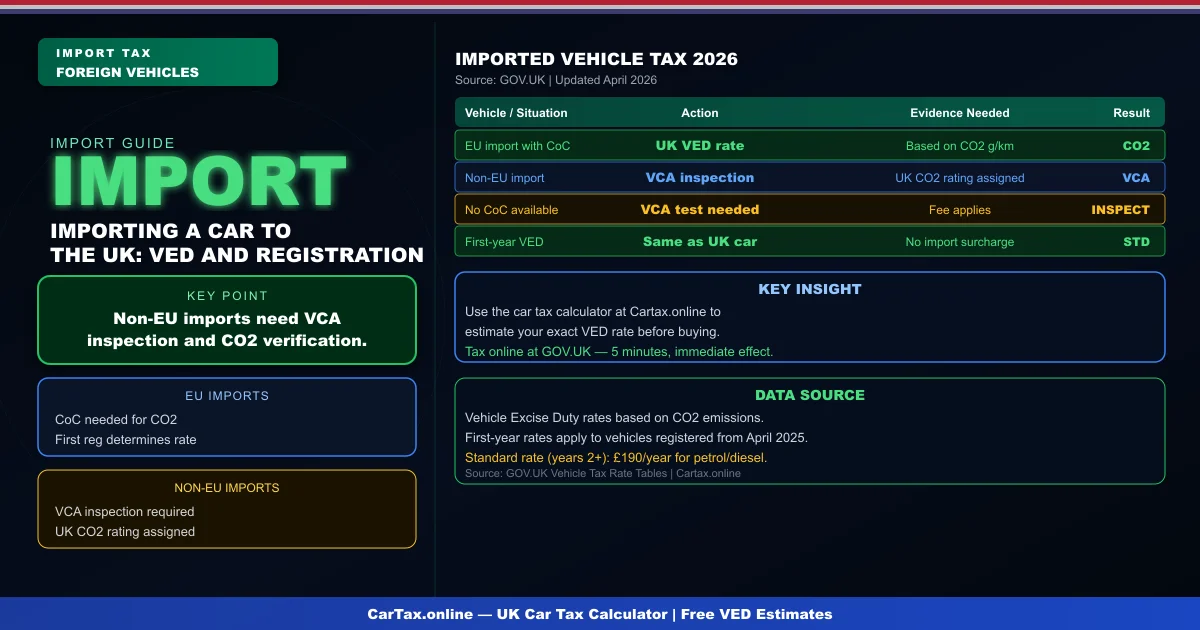
Importing a vehicle from abroad and registering it in the UK triggers a specific set of road tax obligations. The process is more complex than buying a UK-registered car, and getting the VED calculation right is essential to avoid overpaying or underpaying.
UK-Registered Vehicles from the EU
Since Brexit, EU-sourced vehicles that were already UK-registered before export can be re-imported without paying import duty. However, the vehicle must be re-registered with DVLA on return to the UK. The first-year VED rate is based on the vehicle's original UK first registration date, not the re-registration date. You will need the original UK V5C or evidence of the original registration to prove this.
New EU Imports: First Registration in the UK
When importing a vehicle from the EU that has never been registered in the UK, you must first register it with DVLA. The first-year VED rate is based on the vehicle's CO2 emissions as recorded on the Certificate of Conformity (CoC). If the vehicle has a CoC, DVLA uses that figure. If it does not — common for older or non-EU vehicles — a VCA inspection is required to establish the CO2 rating.
Non-EU Imports: VCA Inspection Required
Vehicles imported from outside the EU — such as from Japan, the USA or Australia — must undergo a Vehicle Identity Check (VIC) by the VCA. This inspection verifies the vehicle's identity, mileage and CO2 rating. The inspection fee applies on top of the VED. CO2 figures from foreign test cycles may not directly map to UK WLTP figures — the VCA assigns a UK-equivalent CO2 rating. This can sometimes result in a higher VED band than expected. Related: Car Tax for Imported Vehicles UK 2026 | Car Tax and Importing a Car UK 2026 | Car Tax and Foreign Cars UK 2026 | Car Tax When Moving to the UK 2026.
The Certificate of Conformity and CO2
The Certificate of Conformity (CoC) is the key document for establishing your imported vehicle's VED band. It is issued by the manufacturer and shows the official CO2 emissions in g/km according to the relevant European test standard. Without a CoC, DVLA cannot calculate the correct VED rate and you may face delays. CoCs can be obtained from the manufacturer for a fee, typically £30 to £150 depending on the brand.
First-Year VED for Imports
Imported vehicles pay the standard first-year VED rate based on their CO2 emissions — there is no special import surcharge. A low-emission imported EV pays £0 first year, just like a UK-registered EV. A high-emission imported diesel pays the same first-year rate as an equivalent UK-registered diesel. The VED rate is entirely CO2-driven, not origin-driven. Use the car tax calculator at Cartax.online to estimate VED for a specific imported model.
Paying VED on an Imported Vehicle
Once registered with DVLA, you pay the first-year VED to DVLA directly — either online or by post using the V11 form. The vehicle cannot be used on UK roads until the first-year VED is paid and a tax disc (or digital record) is in place. After the first year, the standard annual rate applies based on fuel type. Imported vehicles are not eligible for any reduced VED solely due to import status.
Official Resources: GOV.UK Check Vehicle Tax | GOV.UK Vehicle Tax | DVLA Online | MOT Check
Frequently Asked Questions
Q: How much is car tax (VED) in the UK 2026?
Car tax rates in the UK depend on your vehicle's CO2 emissions and list price. Standard rates start from £190 per year for petrol and diesel cars, with zero-rated VED for EVs. First-year rates vary from £0 to £2,605 depending on emissions. Additional premiums apply for vehicles over £40,000.
Q: How do I check if my car is taxed online?
You can check your vehicle's tax status for free on the Gov.uk website at gov.uk/check-vehicle-tax. You'll need your vehicle's registration number (number plate). You can also check via the Motor Insurance Database to verify road tax and insurance status simultaneously.
Q: Can I get a refund on car tax if I sell my vehicle?
Yes — if you sell or scrap your vehicle, you can claim a refund on any full months of remaining road tax. Contact DVLA with the V11 reminder letter or apply online at gov.uk. Refunds are usually processed within 4-6 weeks.
Q: Is road tax refund available when transferring ownership?
No — road tax does not transfer with the vehicle. When you sell your car, the tax is automatically cancelled and any remaining months are refunded to you by DVLA. The new owner must tax the vehicle immediately. As a buyer, always verify the vehicle's tax status before purchasing.
Q: What is the luxury car tax threshold in the UK 2026?
The additional rate for vehicles over £40,000 (list price) adds £410 per year to standard VED rates for years 2-6 of registration. This surcharge brings the annual cost for high-emission vehicles over £40,000 to around £600-690 per year. Pure EVs under £40,000 pay zero VED.