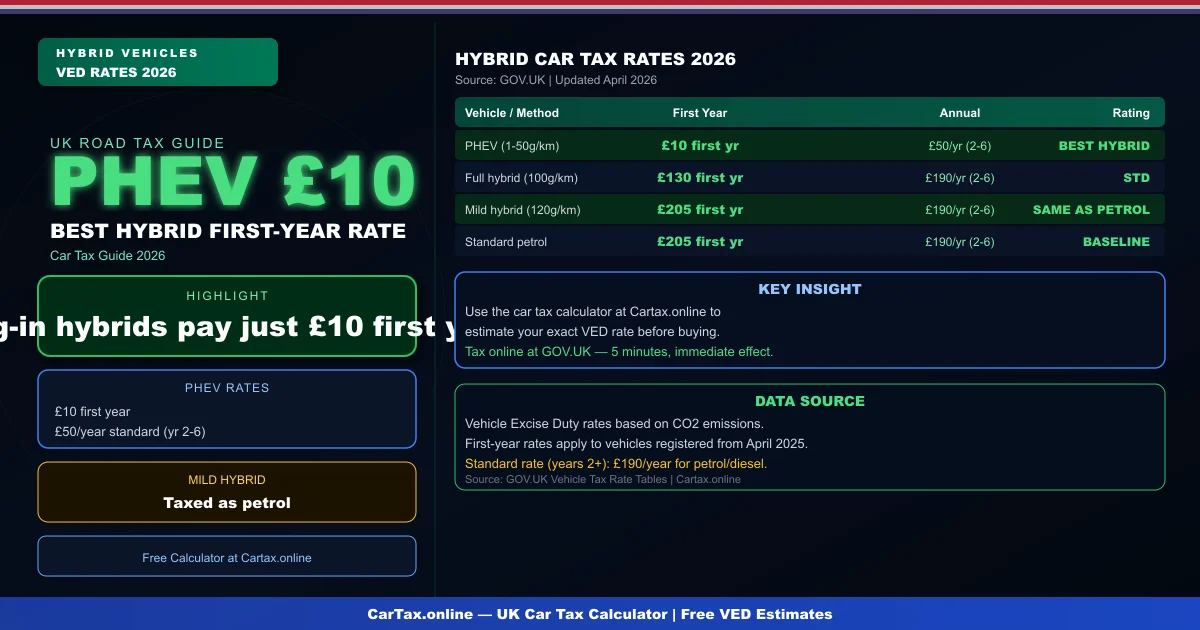
Hybrid car tax UK — the term "hybrid" covers a wide range of vehicles, each taxed differently based on their CO2 emissions. Here is what hybrid owners actually pay in road tax for 2026.
Mild Hybrids: Taxed Like Standard Petrol
Mild hybrid vehicles (MHEVs) do not qualify for any reduced VED rate. Their CO2 emissions are measured identically to petrol vehicles — a mild hybrid with 120g/km pays exactly the same as a petrol car at 120g/km. First-year rates and standard annual rates apply fully.
Full Hybrids (Self-Charging): Standard VED
Full hybrid vehicles (HEVs) that cannot be plugged in but charge via regenerative braking are taxed at standard rates. Their CO2 figures are typically 80-120g/km, placing them in mid-range VED bands. They pay the same road tax as equivalent petrol vehicles — usually £130-£205 first year and £190/year thereafter.
Plug-In Hybrids (PHEVs): Best Hybrid Tax Rate
Plug-in hybrids (PHEVs) with CO2 emissions of 1-50g/km qualify for the lowest hybrid tax rate: £10 first-year VED and £50/year standard rate (years 2-6). This is the best road tax deal available for non-zero-emission vehicles. Related: Hybrid Car Tax UK 2026 | Hybrid Car Tax UK 2026 | Car Tax for Hybrid Vehicles UK 2026 | Car Tax for Hybrid Vehicles UK 2026.
Hybrid vs Petrol: Tax Comparison
- PHEV (40g/km): £10 first year, £50/year standard
- Full hybrid (100g/km): £130 first year, £190/year standard
- Mild hybrid (120g/km): £205 first year, £190/year standard
- Standard petrol (130g/km): £205 first year, £190/year standard
Conclusion
Hybrid car tax UK varies widely. PHEVs get the best rates — £10 first year. Mild hybrids are taxed identically to petrol. Use our car tax calculator to find your exact hybrid VED rate.
Official Resources: GOV.UK Check Vehicle Tax | GOV.UK Vehicle Tax | DVLA Online | MOT Check
Vehicle Excise Duty (VED) rates in the UK are reviewed annually, typically in April with the new financial year. The DVLA administers all vehicle taxation and registration, and you can check your vehicle's current tax status for free at gov.uk/check-vehicle-tax using only your registration number. Rates are determined by the vehicle's CO2 emissions and list price at the time of first registration, with additional premiums applying for high-value vehicles.
Frequently Asked Questions
Q: How much is car tax (VED) in the UK 2026?
Car tax rates in the UK depend on your vehicle's CO2 emissions and list price. Standard rates start from £190 per year for petrol and diesel cars, with zero-rated VED for EVs. First-year rates vary from £0 to £2,605 depending on emissions. Additional premiums apply for vehicles over £40,000.
Q: How do I check if my car is taxed online?
You can check your vehicle's tax status for free on the Gov.uk website at gov.uk/check-vehicle-tax. You'll need your vehicle's registration number (number plate). You can also check via the Motor Insurance Database to verify road tax and insurance status simultaneously.
Q: Can I get a refund on car tax if I sell my vehicle?
Yes — if you sell or scrap your vehicle, you can claim a refund on any full months of remaining road tax. Contact DVLA with the V11 reminder letter or apply online at gov.uk. Refunds are usually processed within 4-6 weeks.
Q: Is road tax refund available when transferring ownership?
No — road tax does not transfer with the vehicle. When you sell your car, the tax is automatically cancelled and any remaining months are refunded to you by DVLA. The new owner must tax the vehicle immediately. As a buyer, always verify the vehicle's tax status before purchasing.
Q: What is the luxury car tax threshold in the UK 2026?
The additional rate for vehicles over £40,000 (list price) adds £410 per year to standard VED rates for years 2-6 of registration. This surcharge brings the annual cost for high-emission vehicles over £40,000 to around £600-690 per year. Pure EVs under £40,000 pay zero VED.