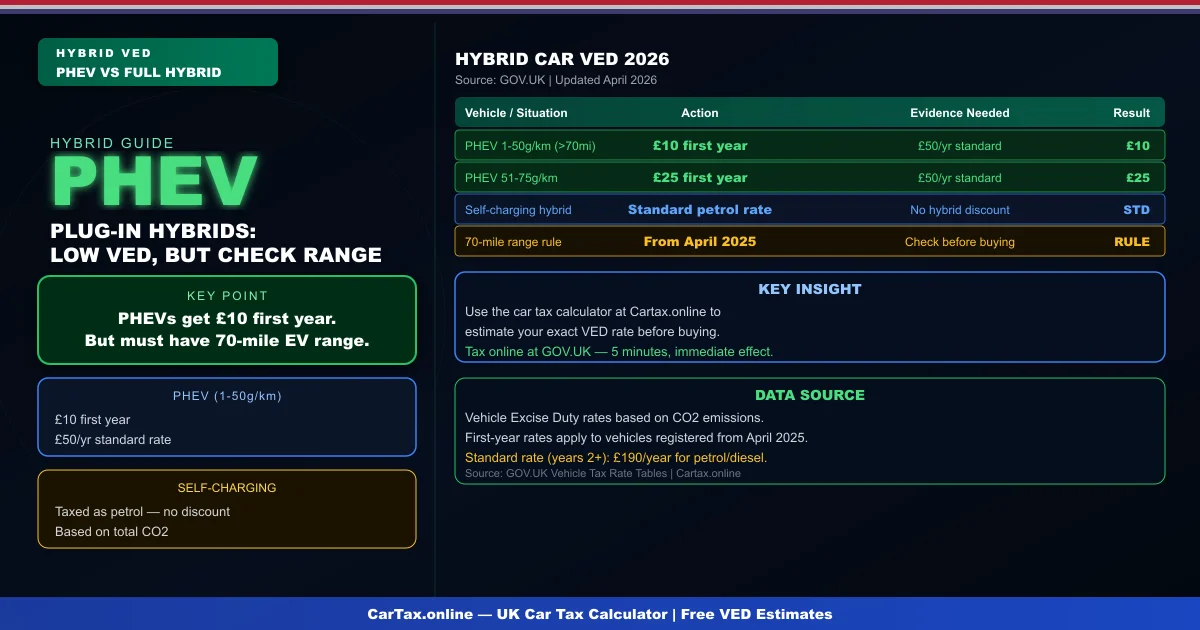
Hybrid cars are not all taxed equally. The type of hybrid system matters enormously for road tax — a plug-in hybrid electric vehicle (PHEV) attracts very different VED treatment from a conventional self-charging hybrid. Understanding the distinction is essential for anyone considering a hybrid purchase.
Plug-in Hybrid Electric Vehicles (PHEVs)
PHEVs have a plug-in battery that can be charged from an external power source. They have both an internal combustion engine and an electric motor, with a usable electric-only range typically of 30-50 miles. PHEVs are taxed based on their official CO2 emissions, which are low due to the hybrid system — typically between 1 and 50g/km for most models. A PHEV in the 1-50g/km band pays just £10 first-year VED and £50 standard annual rate from year two.
The 70-Mile Range Requirement
From April 2025, HMRC tightened the criteria for the lowest PHEV VED bands. To qualify for the 1-50g/km band, a PHEV must now have an official electric-only range of more than 70 miles under WLTP testing. This excludes many popular PHEVs that previously qualified. Models with shorter electric range may fall into higher CO2 bands — potentially paying the same VED as equivalent petrol cars. Always check the specific model's qualifying criteria.
Self-Charging Hybrids: No Special Treatment
Conventional self-charging hybrids — sometimes marketed as mild hybrids or hybrid without a plug — do not qualify for reduced VED rates based on their hybrid status alone. Their road tax is based entirely on their total CO2 emissions as measured under WLTP. A self-charging hybrid Toyota Prius emitting 120g/km pays exactly the same VED as a petrol-only Toyota Corolla with identical emissions: £165 first year, £190 from year two. The hybrid system does not reduce road tax for non-plug-in vehicles. Related: Hybrid Car Tax UK 2026 | Hybrid Car Tax UK 2026 | Car Tax for Hybrid Vehicles UK 2026 | Car Tax for Hybrid Vehicles UK 2026.
PHEV Company Car BIK
PHEVs are highly tax-efficient as company cars because their low official CO2 emissions generate low BIK rates. A PHEV emitting 30g/km at 9% BIK rate on a £40,000 P11D value costs £3,600 per year in BIK tax — compared to £12,250 for a diesel equivalent at 35% BIK. However, the tightening of the 70-mile range rule from April 2025 may push some PHEVs into higher BIK bands, reducing their company car appeal.
Which Hybrids Are Worth Buying for Tax Purposes?
For private buyers, a PHEV makes sense if you can regularly charge it and achieve the official electric-only range in real-world driving. If you mostly drive short urban trips and can charge at home, the £50 annual standard VED rate (compared to £190 for petrol) saves £140 per year. However, if you rarely charge and drive mostly on the engine, a standard petrol car may be a more straightforward and cost-effective choice. Use the car tax calculator at Cartax.online to compare specific models.
Official Resources: GOV.UK Check Vehicle Tax | GOV.UK Vehicle Tax | DVLA Online | MOT Check
Frequently Asked Questions
Q: How much is car tax (VED) in the UK 2025?
Car tax rates in the UK depend on your vehicle's CO2 emissions and list price. Standard rates start from £190 per year for petrol and diesel cars, with zero-rated VED for EVs. First-year rates vary from £0 to £2,605 depending on emissions. Additional premiums apply for vehicles over £40,000.
Q: How do I check if my car is taxed online?
You can check your vehicle's tax status for free on the Gov.uk website at gov.uk/check-vehicle-tax. You'll need your vehicle's registration number (number plate). You can also check via the Motor Insurance Database to verify road tax and insurance status simultaneously.
Q: Can I get a refund on car tax if I sell my vehicle?
Yes — if you sell or scrap your vehicle, you can claim a refund on any full months of remaining road tax. Contact DVLA with the V11 reminder letter or apply online at gov.uk. Refunds are usually processed within 4-6 weeks.
Q: Is road tax refund available when transferring ownership?
No — road tax does not transfer with the vehicle. When you sell your car, the tax is automatically cancelled and any remaining months are refunded to you by DVLA. The new owner must tax the vehicle immediately. As a buyer, always verify the vehicle's tax status before purchasing.
Q: What is the luxury car tax threshold in the UK 2025?
The additional rate for vehicles over £40,000 (list price) adds £410 per year to standard VED rates for years 2-6 of registration. This surcharge brings the annual cost for high-emission vehicles over £40,000 to around £600-690 per year. Pure EVs under £40,000 pay zero VED.