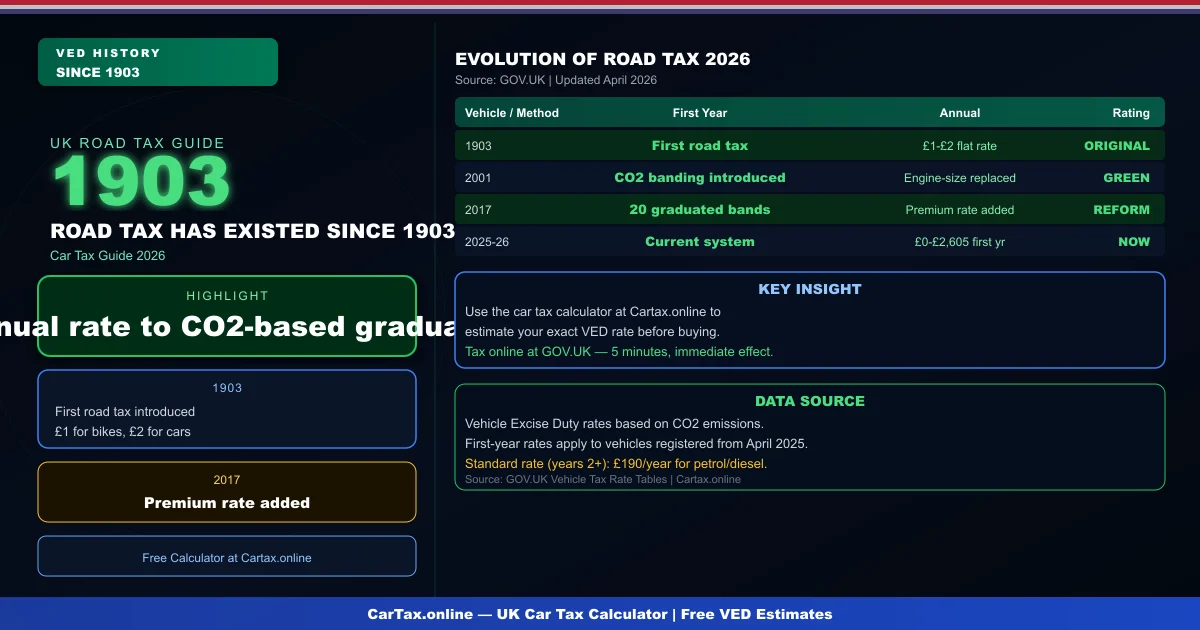
Car tax history UK — Vehicle Excise Duty has been part of British motoring for over 120 years. Here is a brief history of road tax and how it has evolved to the current system in 2026.
1900s: The First Road Tax
Road tax was first introduced in the United Kingdom in 1903 with the introduction of the Motor Car Act 1903. The initial annual rate was £2 for cars and £1 for motorcyclists — equivalent to approximately £250 and £125 today. The tax funded road maintenance, which was increasingly needed as motor vehicles caused damage to roads built for horses.
The Tax Disc Era
From 1921, a paper tax disc was issued and displayed on the windscreen of every taxed vehicle. This physical disc became an iconic symbol of motoring in Britain. The disc showed the expiry date and was checked by police officers on patrol. The system remained largely unchanged until digitisation in 2014, when paper tax discs were abolished.
1990s: CO2-Based Graduated System
In 2001, the UK introduced the first graduated road tax system based on CO2 emissions. Prior to this, tax rates were based on engine size. The new system linked environmental impact to tax liability — lower CO2 vehicles paid less, high-emission vehicles paid more. This was an early form of green taxation that influenced many subsequent policy decisions. Related: Car Tax History UK 2026 | Road Fund Licence History UK | Road Fund Licence History UK | Understanding Your Tax Disc UK 2026.
2010s: First-Year Rates and Premium Rate
From April 2017, the first-year VED system was reformed to introduce 20 graduated bands for first-year road tax. The premium rate for vehicles over £40,000 was also introduced in 2017. This added a £320/year supplement (now £355/year) for high-value vehicles — primarily targeting luxury cars and high-end electric vehicles.
2020s: Electric Vehicle Transition
From April 2025, the current 20-band first-year system applies. Zero-emission vehicles pay £0 first-year VED, with the same bands continuing. As EV uptake increases, road tax revenue from high-emission vehicles decreases — prompting ongoing government reviews of future road pricing solutions.
Conclusion
Car tax history UK shows a gradual shift from engine-size to CO2-based taxation. Digital systems replaced paper discs. EVs drive revenue pressure. Use our calculator for current rates.
Official Resources: GOV.UK Check Vehicle Tax | GOV.UK Vehicle Tax | DVLA Online | MOT Check
Frequently Asked Questions
Q: How much is car tax (VED) in the UK 2026?
Car tax rates in the UK depend on your vehicle's CO2 emissions and list price. Standard rates start from £190 per year for petrol and diesel cars, with zero-rated VED for EVs. First-year rates vary from £0 to £2,605 depending on emissions. Additional premiums apply for vehicles over £40,000.
Q: How do I check if my car is taxed online?
You can check your vehicle's tax status for free on the Gov.uk website at gov.uk/check-vehicle-tax. You'll need your vehicle's registration number (number plate). You can also check via the Motor Insurance Database to verify road tax and insurance status simultaneously.
Q: Can I get a refund on car tax if I sell my vehicle?
Yes — if you sell or scrap your vehicle, you can claim a refund on any full months of remaining road tax. Contact DVLA with the V11 reminder letter or apply online at gov.uk. Refunds are usually processed within 4-6 weeks.
Q: Is road tax refund available when transferring ownership?
No — road tax does not transfer with the vehicle. When you sell your car, the tax is automatically cancelled and any remaining months are refunded to you by DVLA. The new owner must tax the vehicle immediately. As a buyer, always verify the vehicle's tax status before purchasing.
Q: What is the luxury car tax threshold in the UK 2026?
The additional rate for vehicles over £40,000 (list price) adds £410 per year to standard VED rates for years 2-6 of registration. This surcharge brings the annual cost for high-emission vehicles over £40,000 to around £600-690 per year. Pure EVs under £40,000 pay zero VED.