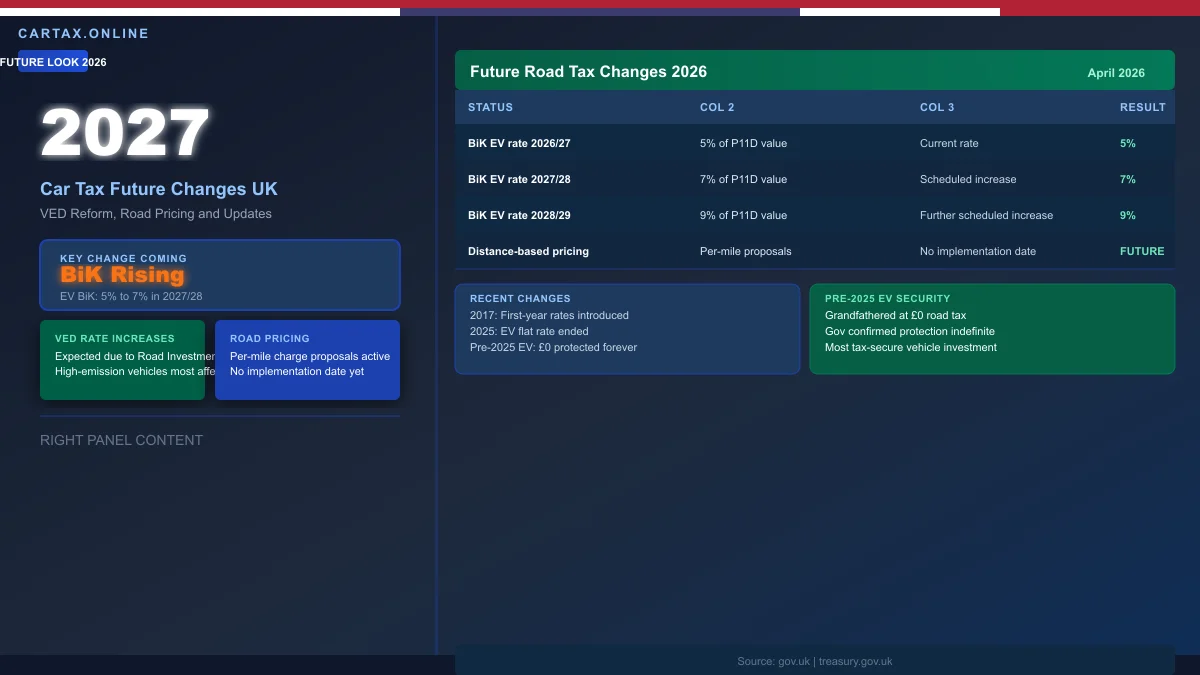
April 13, 2026 in United Kingdom — UK vehicle excise duty (road tax) has undergone significant changes in recent years and will continue to evolve. With electric vehicles eroding the traditional fuel duty revenue base, the government is under pressure to reform how road usage is funded. This guide covers the known changes, current proposals, and what drivers should be aware of heading into the coming years.
Recent Changes: 2017 and 2025 Reforms
Two major VED reforms have occurred in recent years:
- April 2017 reform: First-year rates were introduced for all vehicles (previously only new cars paid first-year rates), and the additional rate for vehicles over £40,000 was introduced. Annual rates also changed from a flat rate to a CO2-based system for post-2017 vehicles.
- April 2025 reform: The flat £0 road tax for pure electric vehicles ended. Post-April 2025 EVs pay a first-year rate (£0 for 0g/km) then £195/year from year 2. Pre-April 2025 EVs remain grandfathered at £0 indefinitely.
The Road Fund Revenue Challenge
Road tax (VED) and fuel duty together fund the UK's road network. As more drivers switch to electric vehicles, fuel duty revenue declines — while VED from EVs remains relatively modest (£195/year for a post-2025 EV vs the average £400-600/year that high-emission petrol cars pay). The Treasury faces a growing funding gap that will eventually need to be addressed.
Vehicle Excise Duty Revenue Sources
In the current system: Related: Car Tax Future Changes UK 2026 | Car Tax Changes 2025 UK | Future of Car Tax UK 2026 | Car Tax Future UK 2026.
- Fuel duty: 58p per litre of petrol/diesel — raises ~£26 billion/year. Revenue falling as EV uptake increases.
- VED (road tax): Raises ~£7 billion/year. Currently growing as vehicle numbers increase, but EV uptake will reduce average VED per vehicle.
Potential Future Reforms: What Might Change
1. Distance-Based Road Pricing
The most frequently discussed reform is replacing fuel duty with a per-mile charge. Under this model, every mile driven would be taxed at a rate that varies by vehicle type, time of day, and road used. This would ensure EV drivers pay their fair share of road usage costs. Pilot schemes have been discussed but no national scheme has been implemented. The political sensitivity is high — any per-mile charge would be controversial.
2. Higher VED for High-Emission Vehicles
The government may increase annual VED rates for high-emission vehicles to further incentivise the switch to lower-emission cars. Current rates have not been substantially increased since 2017, and inflation has eroded their real value. An increase in the standard rate, particularly for bands above 165g/km, is possible in upcoming Budget statements.
3. Reduction in EV BiK Rates
Company car BiK rates for EVs are currently at 5% (2026/27). The current schedule shows BiK rates rising for EVs in future years (to 7% in 2027/28, 9% in 2028/29), making company EVs slightly less attractive financially. Watch for policy changes that could accelerate or slow this schedule.
4. Premium Supplement Expansion
The £410/year additional VED rate for vehicles over £40,000 (years 2-5) could be expanded — either by lowering the threshold (to £35,000) or by making it apply to all years rather than just years 2-5. This would particularly affect premium EVs, which currently enjoy a relatively low effective tax rate.
5. Road Investment Strategy Charges
Periodic increases in Vehicle Excise Duty to fund the Road Investment Strategy (RIS) are expected. Every 5 years, the RIS sets out planned road improvements funded partly through VED increases. The next RIS period runs from 2025-2030, so expect further VED adjustments during this parliament.
What Drivers Should Do Now
Given the uncertainty around future road tax reforms:
- Budget for road tax increases: If you own a high-emission vehicle, expect VED rates to increase over the next 5 years
- Consider EV transition timing: If you are planning to switch to an EV, doing so before any future rate changes locks in current BiK and VED rates
- Monitor Budget announcements: VED rate changes typically appear in the annual Budget statement in Autumn
- Watch for road pricing pilots: Any national road pricing scheme would require significant public consultation — likely years away from implementation
Environmental Zone Charges and VED Interaction
Beyond VED, drivers face additional charges in urban areas:
- Ultra Low Emission Zone (ULEZ): London — £12.50/day for non-compliant vehicles (12.50/day for cars, higher for vans and trucks)
- Clean Air Zones (CAZ): Birmingham, Bath, Bristol, Manchester, Oxford, Sheffield, Newcastle, Leeds, Nottingham, Bradford — daily charges from £7-£12/day for non-compliant vehicles
- Low Traffic Neighbourhoods: Localised restrictions in many urban areas
These charges are separate from VED but are designed to reduce emissions in urban centres. High-emission vehicles face ongoing daily charges in these zones — a cost that far exceeds annual VED. When choosing a vehicle, consider the total environmental cost including these zone charges.
Pre-April 2025 EV Grandfather Protection
For those who already own pre-April 2025 pure EVs, the grandfather protection is robust — the government has confirmed these vehicles pay £0 road tax indefinitely as long as they remain registered and in the same ownership. This protection is unlikely to be removed given the political difficulty of retroactively taxing existing vehicle owners. Pre-2025 EVs represent the most tax-secure vehicle investment available.
Conclusion
UK road tax will continue to evolve as the government addresses declining fuel duty revenue from EVs. Watch for distance-based road pricing proposals, potential VED rate increases for high-emission vehicles, and BiK rate changes for company car EVs. The pre-April 2025 EV grandfather protection is secure. Stay informed through annual Budget announcements and consider your vehicle's long-term tax position when buying. Use GOV.UK VED rate tables for current rates.
Frequently Asked Questions
Q: How much is car tax (VED) in the UK 2026?
Car tax rates in the UK depend on your vehicle's CO2 emissions and list price. Standard rates start from £190 per year for petrol and diesel cars, with zero-rated VED for EVs. First-year rates vary from £0 to £2,605 depending on emissions. Additional premiums apply for vehicles over £40,000.
Q: How do I check if my car is taxed online?
You can check your vehicle's tax status for free on the Gov.uk website at gov.uk/check-vehicle-tax. You'll need your vehicle's registration number (number plate). You can also check via the Motor Insurance Database to verify road tax and insurance status simultaneously.
Q: Can I get a refund on car tax if I sell my vehicle?
Yes — if you sell or scrap your vehicle, you can claim a refund on any full months of remaining road tax. Contact DVLA with the V11 reminder letter or apply online at gov.uk. Refunds are usually processed within 4-6 weeks.
Q: Is road tax refund available when transferring ownership?
No — road tax does not transfer with the vehicle. When you sell your car, the tax is automatically cancelled and any remaining months are refunded to you by DVLA. The new owner must tax the vehicle immediately. As a buyer, always verify the vehicle's tax status before purchasing.
Q: What is the luxury car tax threshold in the UK 2026?
The additional rate for vehicles over £40,000 (list price) adds £410 per year to standard VED rates for years 2-6 of registration. This surcharge brings the annual cost for high-emission vehicles over £40,000 to around £600-690 per year. Pure EVs under £40,000 pay zero VED.