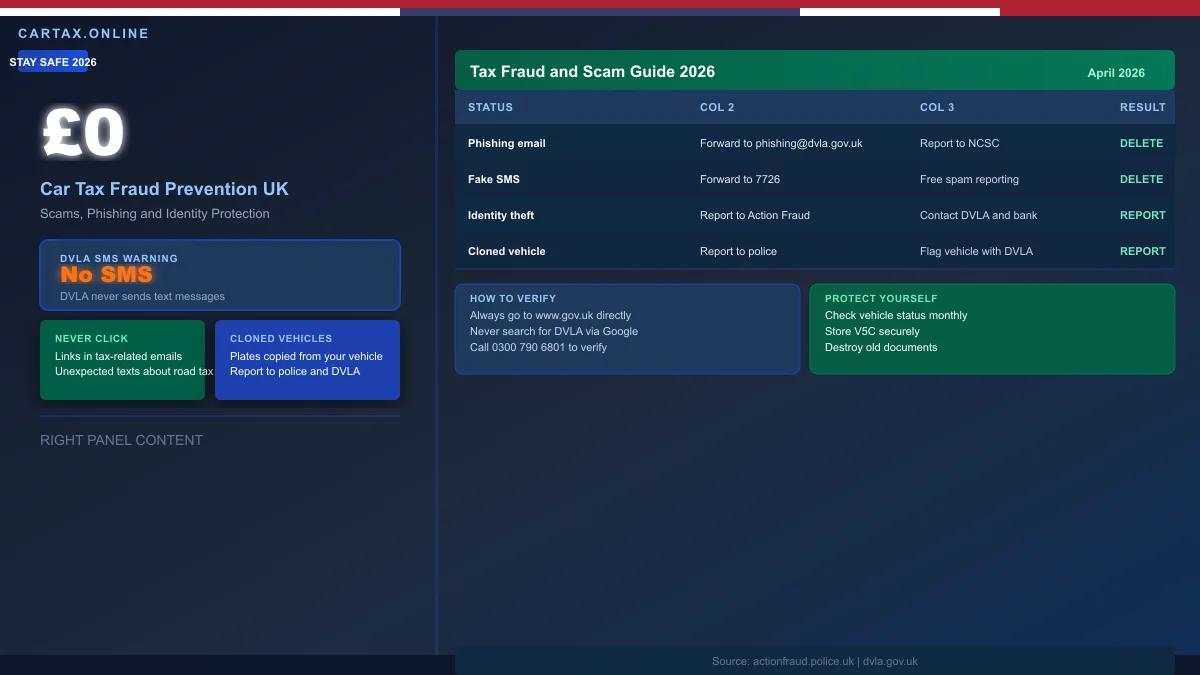
April 13, 2026 in United Kingdom — Vehicle tax fraud and scams are increasingly common, with fraudsters targeting drivers through phishing emails, phone calls, and even cloned vehicle identities. Understanding the risks and knowing how to protect yourself is essential for every UK driver. This guide covers the most common tax-related scams and how to avoid them in 2026.
Common Vehicle Tax Scams
1. DVLA Phishing Emails
Fraudsters send emails claiming to be from the DVLA, often stating that your vehicle tax is about to expire, that you are owed a refund, or that there is a problem with your vehicle registration. These emails typically include a link to a fake GOV.UK website that looks identical to the real one — but steals your personal and payment details.
How to spot it: The DVLA never sends emails asking you to confirm personal details or click links to make payments. Always navigate directly to www.gov.uk rather than clicking email links.
2. Fake SMS Tax Reminders
Text messages claiming to be from DVLA asking you to click a link to renew your tax. These texts may reference your actual vehicle registration number to appear convincing. The link leads to a phishing site that captures your card details. Related: Car Tax Fraud Prevention UK 2026 | 5 Clever Ways to Tax My Car Online and Save Money | Pay Car Tax Online UK 2026 | Car Tax Check UK.
How to spot it: The DVLA sends reminders via email only if you have registered for the reminder service. If you receive an unexpected text, do not click — go directly to GOV.UK and check your vehicle status there.
3. Roadside Tax Scams
Scammers posing as DVLA enforcement officers at car parks or roadside locations claim your vehicle is untaxed and demand an immediate payment — often in cash or via a mobile payment app. Genuine DVLA enforcement does not collect payments in person.
How to spot it: The DVLA does not send enforcement officers to collect cash on the spot. Clamping contractors operate through official channels with proper documentation.
4. V5C Identity Theft
Your V5C logbook contains enough personal information (name, address, NI number indirectly through keeper records) for fraudsters to commit identity theft. If your V5C is stolen or the details are scraped from documents you have discarded, criminals can use them to register vehicles in your name or obtain fraudulent documentation.
How to protect: Store your V5C securely. Never throw it away — if you receive a new V5C when you are the keeper, destroy the old one by shredding it. Report any suspected V5C theft to the DVLA.
5. Cloned Vehicles
A cloned vehicle is one that has had its identity stolen — the plates and registration documents are copied from a legitimate, taxed vehicle and fitted to a different, often untaxed or written-off vehicle. The cloned vehicle appears to have valid tax and MOT on ANPR checks, but is actually illegal.
How to spot: If you receive penalty notices, parking fines, or letters about vehicles you do not recognise, your identity may have been used to clone a vehicle. Report to the police and DVLA immediately.
How to Verify a Genuine DVLA Communication
| Communication Type | Genuine DVLA? | What to Do |
|---|---|---|
| Email from @dvla.gov.uk | Possible — but check domain carefully | Navigate to GOV.UK manually, do not click links |
| SMS from DVLA | No — DVLA does not send SMS | Delete, do not click |
| Letter from DVLA, Swansea | Possible — verify letter content | Check against known DVLA formats |
| Phone call claiming to be DVLA | Verify by calling 0300 790 6801 back | Do not give personal details to cold callers |
Reporting Scams
If you receive a suspected scam communication:
- Email: Forward to phishing@dvla.gov.uk and report to the National Cyber Security Centre (NCSC) at report phishing.service.ncsc.gov.uk
- SMS: Forward to 7726 (spambot) — a free reporting service operated by mobile network operators
- Suspected fraud: Report to Action Fraud at actionfraud.police.uk or call 0300 123 2040
- Identity theft: Contact the DVLA and your bank immediately
Protecting Your Vehicle Identity
- Check your vehicle status regularly: Use the free GOV.UK checker monthly to ensure no unexpected changes
- Secure your V5C: Keep it in a safe place, destroy old documents thoroughly
- Report suspicious activity: If you see your vehicle being driven in an unusual location, report to the police
- Be careful what you share online: Posting photos of your vehicle showing the full number plate can help fraudsters clone it
What to Do If You Are a Victim of Tax Fraud
If your personal details or vehicle identity have been used fraudulently:
- Report to Action Fraud immediately — reference number will be assigned
- Contact the DVLA to flag your vehicle record and prevent further misuse
- Contact your bank if financial details were compromised
- Notify the police — especially if a vehicle is registered in your name fraudulently
- Monitor your credit report for any unusual activity
Official DVLA Contact Methods
To ensure you are always dealing with genuine DVLA services:
- Website: Always use www.gov.uk — never search for DVLA via a search engine as results can include paid ads for scam sites
- Phone: 0300 790 6801 (official DVLA vehicle enquiry line)
- Post: DVLA, Swansea, SA99 1AR
- Email for phishing reports: phishing@dvla.gov.uk
Conclusion
Vehicle tax fraud is growing — phishing emails, cloned vehicles, and identity theft are the main threats. Never click links in unexpected emails or texts about vehicle tax. Always navigate to GOV.UK directly. Report suspicious communications to Action Fraud and phishing@dvla.gov.uk. Protect your V5C and check your vehicle status monthly using the free GOV.UK checker.
Official Resources: GOV.UK Check Vehicle Tax | GOV.UK Vehicle Tax | DVLA Online | MOT Check
Frequently Asked Questions
Q: How much is car tax (VED) in the UK 2026?
Car tax rates in the UK depend on your vehicle's CO2 emissions and list price. Standard rates start from £190 per year for petrol and diesel cars, with zero-rated VED for EVs. First-year rates vary from £0 to £2,605 depending on emissions. Additional premiums apply for vehicles over £40,000.
Q: How do I check if my car is taxed online?
You can check your vehicle's tax status for free on the Gov.uk website at gov.uk/check-vehicle-tax. You'll need your vehicle's registration number (number plate). You can also check via the Motor Insurance Database to verify road tax and insurance status simultaneously.
Q: Can I get a refund on car tax if I sell my vehicle?
Yes — if you sell or scrap your vehicle, you can claim a refund on any full months of remaining road tax. Contact DVLA with the V11 reminder letter or apply online at gov.uk. Refunds are usually processed within 4-6 weeks.
Q: Is road tax refund available when transferring ownership?
No — road tax does not transfer with the vehicle. When you sell your car, the tax is automatically cancelled and any remaining months are refunded to you by DVLA. The new owner must tax the vehicle immediately. As a buyer, always verify the vehicle's tax status before purchasing.
Q: What is the luxury car tax threshold in the UK 2026?
The additional rate for vehicles over £40,000 (list price) adds £410 per year to standard VED rates for years 2-6 of registration. This surcharge brings the annual cost for high-emission vehicles over £40,000 to around £600-690 per year. Pure EVs under £40,000 pay zero VED.