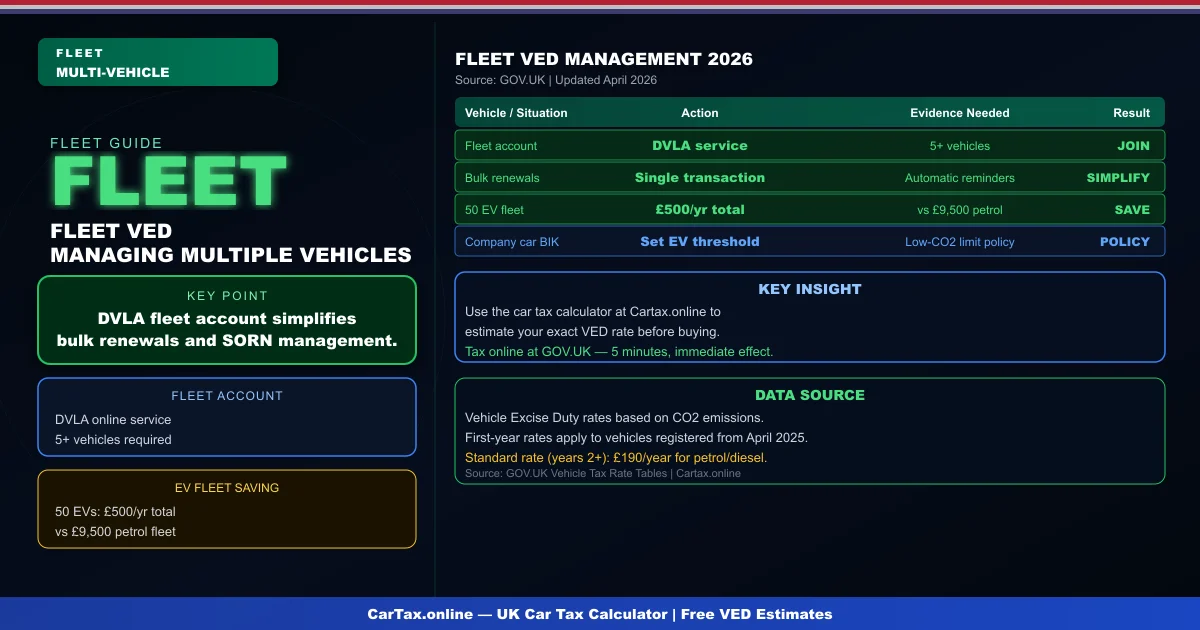
Fleet operators managing multiple vehicles face significant administrative challenges around road tax. DVLA offers a fleet licensing service that streamlines management of VED, SORN declarations and vehicle deregistration for businesses.
DVLA Fleet Licensing Service
The DVLA fleet licensing service allows businesses to manage all vehicles under a single fleet account. This simplifies renewals, automates reminders and allows bulk tax transactions. Fleet operators with five or more vehicles can apply for a fleet account. The service provides a dedicated online portal for managing all vehicle licensing tasks — a significant improvement over managing each vehicle individually through GOV.UK.
Bulk VED Renewals
With a fleet account, operators can renew multiple vehicles in a single transaction, reducing administrative overhead. The fleet service also supports automatic renewal via Direct Debit, ensuring vehicles never accidentally lapse into untaxed status. This is particularly valuable for large fleets where even a single inadvertently untaxed vehicle can result in fines and vehicle seizures that disrupt operations.
Fleet VED Strategy: Choosing Low-CO2 Vehicles
Fleet operators should factor VED into vehicle selection. A fleet of 50 vehicles averaging £190 per year in VED costs £9,500 annually. Transitioning to a fleet of 50 EVs at £10 per year reduces that to £500 annually — a £9,000 annual saving. With enhanced capital allowances available for low-CO2 vehicles, the financial case for electric fleet vehicles is compelling. Fleet managers should use the car tax calculator at Cartax.online to model VED costs across different vehicle options. Related: Car Tax for Fleet Operators UK 2026 | Car Tax for Fleet Managers UK 2026 | Car Tax Fleet Management UK 2026 | Car Tax Fleet Management UK 2026.
Company Car Policy and BIK Management
Fleet operators with company car schemes must manage BIK carefully. Setting appropriate CO2 thresholds for eligible company cars — ideally limiting choices to vehicles under 100g/km or requiring full-electric — reduces both employer and employee tax costs. A clear fleet policy that specifies maximum BIK bands for each role level helps manage the tax exposure. The HMRC advisory fuel rates for company car mileage reimbursement also need to be reviewed regularly as EV adoption changes the fuel reimbursement landscape.
Disposing of Fleet Vehicles: Tax Considerations
When disposing of fleet vehicles, notify DVLA promptly to cancel the road tax. Fleet operators often accumulate unused VED credits if vehicles are sold mid-tax-period and the refund has not been processed before new vehicles are taxed. Ensure the fleet account bank details are kept current so refunds arrive promptly. For end-of-life vehicles, the ATF (Authorised Treatment Facility) will notify DVLA directly when the vehicle is scrapped — triggering automatic VED cancellation.
Frequently Asked Questions
Q: How much is car tax (VED) in the UK 2026?
Car tax rates in the UK depend on your vehicle's CO2 emissions and list price. Standard rates start from £190 per year for petrol and diesel cars, with zero-rated VED for EVs. First-year rates vary from £0 to £2,605 depending on emissions. Additional premiums apply for vehicles over £40,000.
Q: How do I check if my car is taxed online?
You can check your vehicle's tax status for free on the Gov.uk website at gov.uk/check-vehicle-tax. You'll need your vehicle's registration number (number plate). You can also check via the Motor Insurance Database to verify road tax and insurance status simultaneously.
Q: Can I get a refund on car tax if I sell my vehicle?
Yes — if you sell or scrap your vehicle, you can claim a refund on any full months of remaining road tax. Contact DVLA with the V11 reminder letter or apply online at gov.uk. Refunds are usually processed within 4-6 weeks.
Q: Is road tax refund available when transferring ownership?
No — road tax does not transfer with the vehicle. When you sell your car, the tax is automatically cancelled and any remaining months are refunded to you by DVLA. The new owner must tax the vehicle immediately. As a buyer, always verify the vehicle's tax status before purchasing.
Q: What is the luxury car tax threshold in the UK 2026?
The additional rate for vehicles over £40,000 (list price) adds £410 per year to standard VED rates for years 2-6 of registration. This surcharge brings the annual cost for high-emission vehicles over £40,000 to around £600-690 per year. Pure EVs under £40,000 pay zero VED.