April 13, 2026 in United Kingdom — Businesses with company car fleets must navigate complex CO2 reporting obligations that directly affect Vehicle Excise Duty and benefit-in-kind tax. This fleet CO2 reporting guide for UK businesses covers P11D requirements, DVLA compliance, and strategies to reduce your fleet's car tax liability in 2026.
Why Fleet CO2 Reporting Matters for Business Tax
Businesses with company car fleets must report CO2 emissions data to HMRC annually via the P11D form. Each employee who has a company car with private use must have a P11D entry showing the vehicle's list price and CO2 emissions. From this, HMRC calculates the benefit-in-kind tax liability.
The accuracy of CO2 data is critical — if the reported figure is lower than the actual figure, the employer may face penalties for incorrect reporting. DVLA also uses CO2 data to determine the VED rate for each vehicle in the fleet.
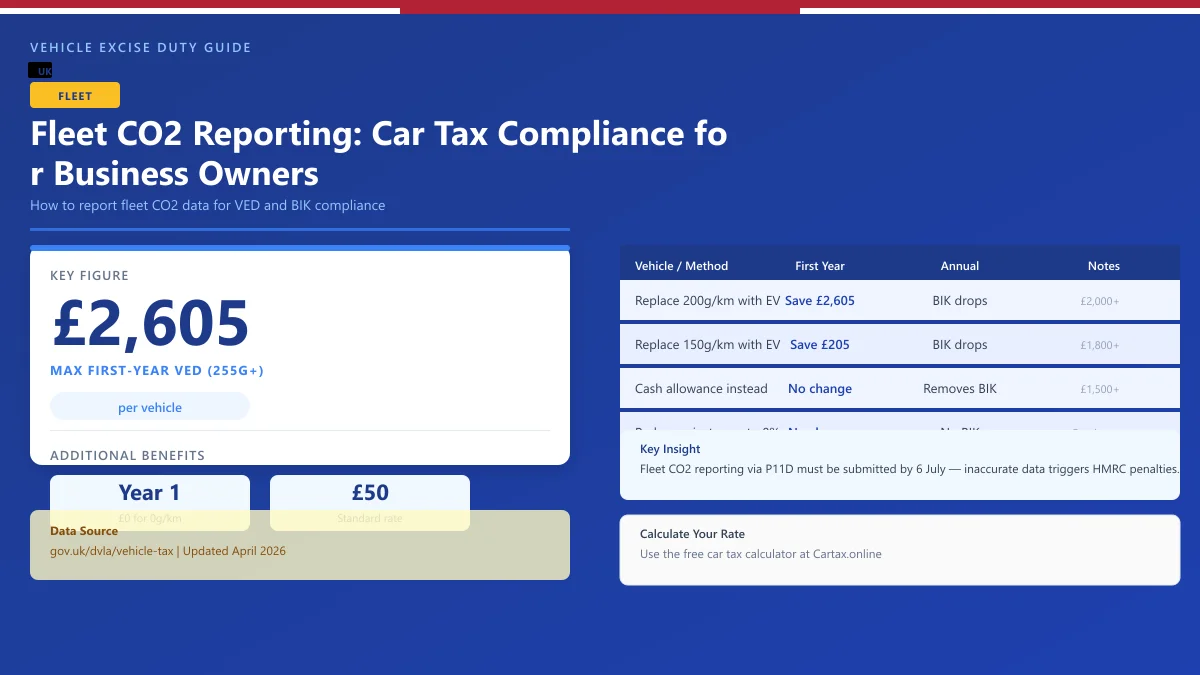
Fleet CO2 Reporting: Tax Impact Table
- Replace 200g/km with EV: Save £2,605 first-year VED — BIK drops to 2% from 37% — annual saving £2,000+
- Replace 150g/km with EV: Save £205 first-year VED — BIK drops to 2% — annual saving £1,800+
- Replace petrol with hybrid: Save first-year rate — BIK reduces — annual saving £300-600
- Cash allowance instead of car: No VED change — removes BIK entirely — saving £1,500-3,000
- Reduce private use to 0%: No VED change — no BIK if 0% private use — employee saves full amount
Annual P11D Reporting: Deadline and Requirements
P11D forms must be submitted to HMRC by 6 July following the end of the tax year (5 April). For the 2025-26 tax year, the deadline is 6 July 2026. The form must include the P11D value (list price including VAT and delivery charges), the CO2 emissions figure, and the fuel type for each company car. Related: Fleet CO2 Reporting UK 2026 | Car Tax and Company Car BiK UK 2026 | Car Tax and Company Car BiK UK 2026 | UK Company Car Benefit 2026.
Employers who fail to report on time face penalties. Incorrectly reported CO2 figures — even if done inadvertently — may trigger an HMRC enquiry. Using fleet management software that links to DVLA data can automate this process and reduce the risk of errors in fleet CO2 reporting.
CO2-based VED Calculations for the Fleet
Each vehicle in the fleet must be taxed at the appropriate VED rate based on its CO2 emissions. Fleet managers should review the VED status of all vehicles annually and renew before expiry. Untaxed fleet vehicles attract fines of £1,000 and can be clamped or removed by the DVLA enforcement team.
Fleet vehicles with 0g/km emissions (electric) currently qualify for the £0 first-year rate and £10 annual rate for years 2-6. Transitional rates apply to hybrid vehicles. Reviewing the fleet composition and replacing high-emission vehicles with EVs can significantly reduce fleet-wide car tax costs.
Reducing Fleet Tax Liability Through CO2 Management
The most effective fleet car tax reduction strategy is lowering the average CO2 emissions across the fleet:
- Transition to fully electric vehicles — 0g/km, lowest BIK rate at 2%
- Replace plug-in hybrids with full EVs when leases expire
- Set CO2 thresholds in company car policy — cap maximum emissions eligible for company car status
- Offer a cash option where employees take a cash allowance instead of a company car
- Implement salary sacrifice schemes that convert cash salary into lease payments
Conclusion
Fleet CO2 reporting in the UK requires accurate annual P11D submissions to HMRC by 6 July. Every vehicle in your fleet has a CO2-based car tax cost — managing that CO2 average directly reduces your tax liability. Transitioning to electric fleet vehicles saves up to £2,605 per vehicle in first-year VED. Get started with the GOV.UK P11D employer guidance.
Frequently Asked Questions
Q: How much is car tax (VED) in the UK 2026?
Car tax rates in the UK depend on your vehicle's CO2 emissions and list price. Standard rates start from £190 per year for petrol and diesel cars, with zero-rated VED for EVs. First-year rates vary from £0 to £2,605 depending on emissions. Additional premiums apply for vehicles over £40,000.
Q: How do I check if my car is taxed online?
You can check your vehicle's tax status for free on the Gov.uk website at gov.uk/check-vehicle-tax. You'll need your vehicle's registration number (number plate). You can also check via the Motor Insurance Database to verify road tax and insurance status simultaneously.
Q: Can I get a refund on car tax if I sell my vehicle?
Yes — if you sell or scrap your vehicle, you can claim a refund on any full months of remaining road tax. Contact DVLA with the V11 reminder letter or apply online at gov.uk. Refunds are usually processed within 4-6 weeks.
Q: Is road tax refund available when transferring ownership?
No — road tax does not transfer with the vehicle. When you sell your car, the tax is automatically cancelled and any remaining months are refunded to you by DVLA. The new owner must tax the vehicle immediately. As a buyer, always verify the vehicle's tax status before purchasing.
Q: What is the luxury car tax threshold in the UK 2026?
The additional rate for vehicles over £40,000 (list price) adds £410 per year to standard VED rates for years 2-6 of registration. This surcharge brings the annual cost for high-emission vehicles over £40,000 to around £600-690 per year. Pure EVs under £40,000 pay zero VED.