Choosing a family car involves balancing practicality, safety and running costs — and road tax is an often-overlooked element of the total cost of ownership. Here is how to pick a family car with low VED costs in mind.
CO2 and Family Car Size
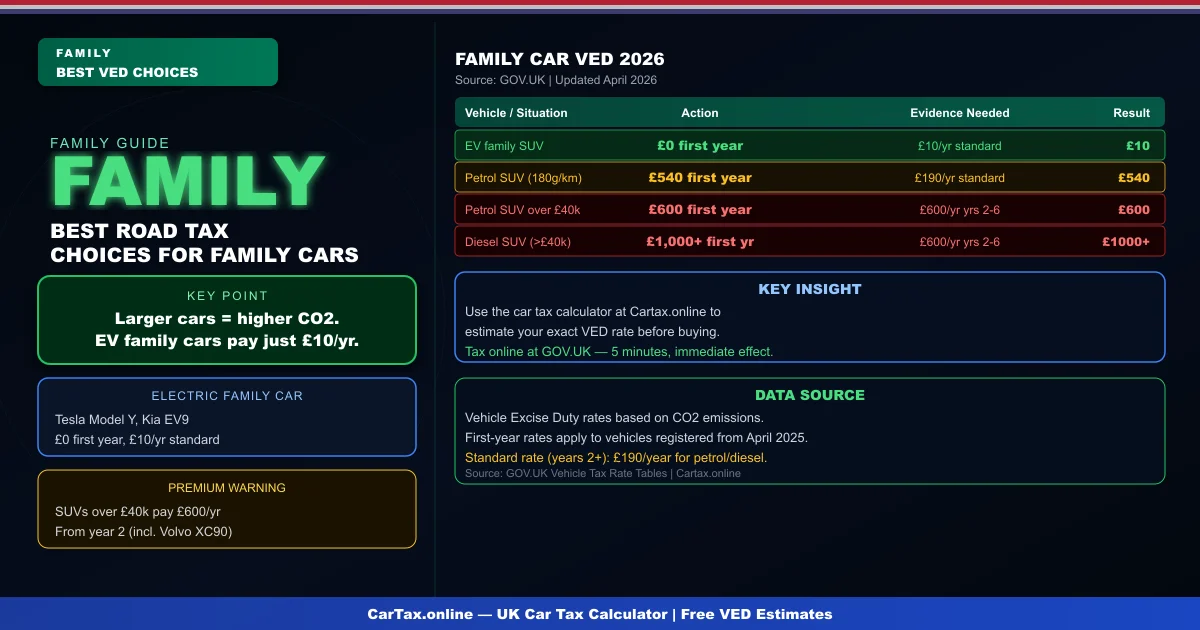
Family cars tend to be larger — SUVs, MPVs and estate cars — which typically produce higher CO2 emissions than small hatchbacks. A large SUV with a 2.0-litre turbo petrol engine may emit 180g/km or more, placing it in the £540 to £580 first-year VED band. A comparable petrol MPV may be similar. Choosing a model with a lower CO2 figure — even within the same body style — can save hundreds in first-year VED.
Zero-Emission Family EVs
Electric family cars such as the Tesla Model Y, Kia EV9 and Volvo EX90 offer the lowest possible VED: £0 first year and £10 per year from year two. While the upfront purchase price is higher, road tax savings accumulate significantly over ownership. For families keeping a car for five years, the £900+ saving in road tax versus a petrol equivalent (£190 x 5) is meaningful. Use the car tax calculator at Cartax.online to compare VED across specific family car models.
Taxis and Private Hire Vehicle Considerations
If you use your family car for private hire or taxi work, different rules apply. Private hire vehicles are classified separately for VED purposes and may qualify for reduced rates depending on their use. If a vehicle is used primarily as a licensed taxi, it may be exempt from standard car VED. Check with DVLA and your local licensing authority for specific rules. Incorrect classification can result in overpayment. Related: Car Tax for Family Cars UK 2026 | SUV Road Tax UK 2026 | SUV Road Tax UK 2026 | Diesel Car Tax Explained UK 2026.
Premium Rate Warning for Large Family Cars
Many popular large family SUVs and premium MPVs have list prices above £40,000 — including the BMW X5, Audi Q7, Mercedes GLE and Volvo XC90 in higher specifications. These attract the £410 annual premium supplement on top of the standard £190 rate: £600 per year from year two. This adds £2,050 over five years. Factor the premium rate into the total cost when comparing higher-specification variants of otherwise sensible family cars.
MPV vs SUV: Which Has Lower VED?
Both MPVs and SUVs span a wide range of CO2 emissions depending on engine and size. In general, purpose-built MPV platforms tend to have slightly lower CO2 than large SUV platforms because they prioritise interior space over styling and off-road capability. However, the difference is marginal — always check the specific model's WLTP CO2 figure rather than generalising by body type. A low-CO2 7-seat PHEV like the Volvo XC90 Recharge may have similar or lower VED than a higher-CO2 petrol MPV.
Official Resources: GOV.UK Check Vehicle Tax | GOV.UK Vehicle Tax | DVLA Online | MOT Check
Frequently Asked Questions
Q: How much is car tax (VED) in the UK 2026?
Car tax rates in the UK depend on your vehicle's CO2 emissions and list price. Standard rates start from £190 per year for petrol and diesel cars, with zero-rated VED for EVs. First-year rates vary from £0 to £2,605 depending on emissions. Additional premiums apply for vehicles over £40,000.
Q: How do I check if my car is taxed online?
You can check your vehicle's tax status for free on the Gov.uk website at gov.uk/check-vehicle-tax. You'll need your vehicle's registration number (number plate). You can also check via the Motor Insurance Database to verify road tax and insurance status simultaneously.
Q: Can I get a refund on car tax if I sell my vehicle?
Yes — if you sell or scrap your vehicle, you can claim a refund on any full months of remaining road tax. Contact DVLA with the V11 reminder letter or apply online at gov.uk. Refunds are usually processed within 4-6 weeks.
Q: Is road tax refund available when transferring ownership?
No — road tax does not transfer with the vehicle. When you sell your car, the tax is automatically cancelled and any remaining months are refunded to you by DVLA. The new owner must tax the vehicle immediately. As a buyer, always verify the vehicle's tax status before purchasing.
Q: What is the luxury car tax threshold in the UK 2026?
The additional rate for vehicles over £40,000 (list price) adds £410 per year to standard VED rates for years 2-6 of registration. This surcharge brings the annual cost for high-emission vehicles over £40,000 to around £600-690 per year. Pure EVs under £40,000 pay zero VED.