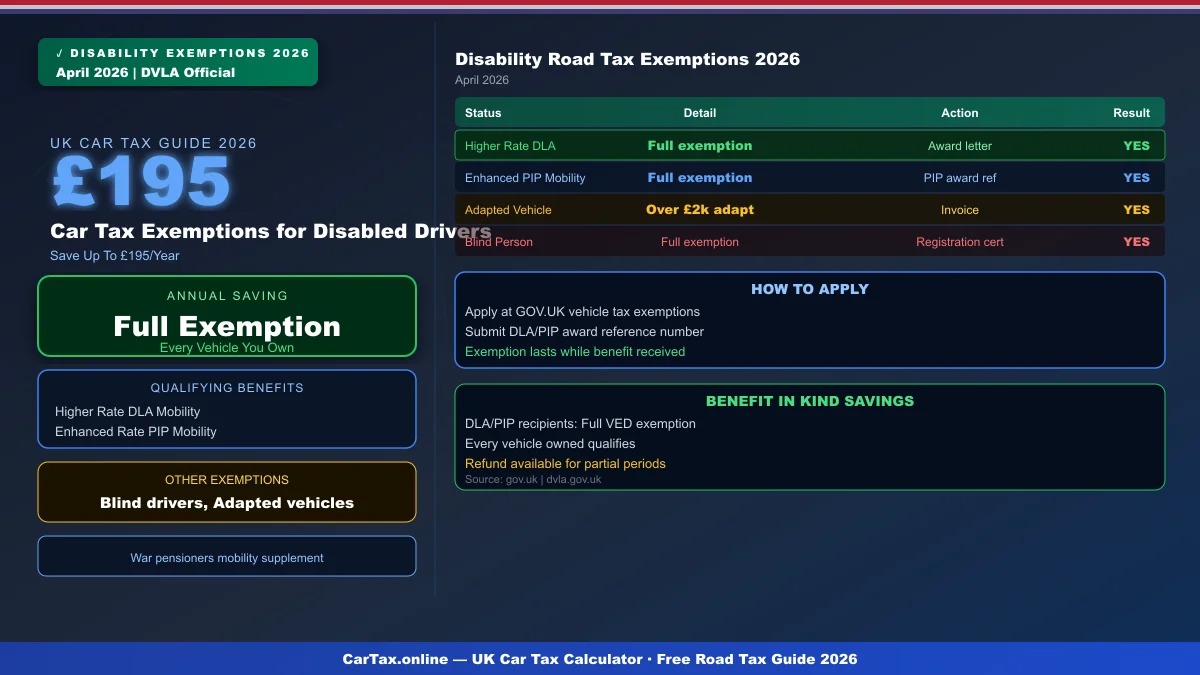
April 12, 2026 in United Kingdom — Disabled drivers and passengers in the UK may qualify for complete exemption from road tax, saving £195 per year. The Vehicle Excise Duty (VED) system includes specific provisions for individuals with qualifying disabilities, covering physical impairments, mobility benefit recipients, and those with adapted vehicles. This guide covers every disabled driver tax exemption available in 2026 and how to claim yours.
Who Qualifies for Disabled Driver Road Tax Exemption?
The DVLA grants road tax exemption to drivers and passengers with qualifying disabilities. The exemption applies to any vehicle owned or regularly used by the qualifying person, regardless of who drives it.
Higher Rate Mobility Component — DLA
If you receive the Higher Rate Mobility Component of Disability Living Allowance (DLA), you qualify for full road tax exemption. This applies to any vehicle you own or use regularly for personal transportation. The exemption is automatic once you notify the DVLA and is valid for as long as you receive the benefit.
Enhanced Rate Mobility Component — PIP
The Personal Independence Payment (PIP) replaced DLA for new claimants aged 16 to 64. If you receive the Enhanced Rate Mobility Component of PIP, you qualify for the same road tax exemption. Both DLA and PIP recipients are treated equally for VED purposes.
War Pensioners' Mobility Supplement
Veterans receiving the War Pensioners' Mobility Supplement (WPMS) through the Veterans' Agency qualify for road tax exemption. This is in addition to the standard mobility supplement and applies to any vehicle the veteran owns or uses.
Adapted Vehicle Tax Exemption
Vehicles substantially adapted to accommodate a disabled passenger may qualify for road tax exemption even if the driver does not have a qualifying disability. The adaptation must have cost over £2,000 and must enable travel by a person who would otherwise be unable to use the vehicle.
Examples of qualifying adaptations:
- Wheelchair lifts or hoists permanently fitted to the vehicle
- Internal structural modifications to lower the floor or expand the cabin
- Powered ramps for wheelchair access
- Seating modifications for passengers with severe physical disabilities
The adaptation must be the reason the vehicle qualifies — a car with standard accessibility features that could be used by anyone does not qualify. The adaptation must be specifically designed to enable disabled passenger use.
Blind Driver and Passenger Exemption
Vehicles registered to or regularly used by a registered blind person are exempt from road tax. This covers both the vehicle owner and any vehicle regularly used to transport the blind person. You must be registered as blind or severely sight impaired with your local authority to qualify.
To register as blind or severely sight impaired, contact your local social services or ophthalmology department. Registration is free and enables access to a range of benefits including road tax exemption, Blue Badge parking, and TV licence reductions.
How to Apply for Disabled Driver Tax Exemption
Applying for road tax exemption is done through the GOV.UK vehicle tax exemptions and relief service:
- Log in to GOV.UK with your Government Gateway account
- Select the vehicle you want to claim exemption for
- Choose the qualifying disability category
- Submit your DLA/PIP award reference or medical evidence
- DVLA processes the application and updates the vehicle record
| Exemption Type | Qualifying Criteria | Evidence Required |
|---|---|---|
| Higher Rate DLA Mobility | Receiving HR DLA mobility component | DLA award letter with reference |
| Enhanced Rate PIP Mobility | Receiving ER PIP mobility component | PIP award letter with reference |
| War Pensioners' Supplement | Receiving WPMS mobility supplement | Veterans' Agency award letter |
| Vehicle Adaptation | Adaptation cost over £2,000 for disabled passenger | Invoice from adaptation specialist |
| Blind Person | Registered blind / severely sight impaired | Certificate of registration from social services |
Blue Badge and Road Tax — Connection and Differences
The Blue Badge scheme provides parking concessions for disabled drivers and passengers but is a separate scheme from road tax exemption. Having a Blue Badge does not automatically mean you qualify for road tax exemption — the qualifying criteria are different.
Blue Badge eligibility includes those who receive the Higher Rate Mobility Component of DLA, receive a War Pensioners' Mobility Supplement, receive a lump sum payment under the Armed Forces Compensation Scheme (tariff 1-8), have a permanent and substantial disability that causes inability to walk, or have a severe disability in both arms.
Road tax exemption through DLA/PIP requires only that you receive the relevant mobility component — you do not need to drive or have a Blue Badge to claim it. The exemption applies to any vehicle you own or regularly use.
What Happens to the Exemption When Benefits Change?
If your DLA or PIP award is reassessed and you no longer receive the qualifying mobility component, you must notify the DVLA immediately. The road tax exemption ceases from the date the benefit ends, and you must tax the vehicle normally from that date.
Failure to notify the DVLA of a change in circumstances results in the vehicle showing as untaxed, exposing you to a £80 penalty. Contact the DVLA within 28 days of any change in your disability benefit status.
Frequently Asked Questions
Can I claim road tax exemption if I'm a passenger, not a driver?
Yes. The exemption applies to any vehicle regularly used by a qualifying disabled person, not just vehicles they drive. If a disabled passenger uses a vehicle regularly — even if driven by a family member — that vehicle can qualify for exemption.
Does the exemption cover all vehicles I own?
Yes. If you receive the Higher Rate DLA Mobility or Enhanced Rate PIP Mobility, every vehicle you own or regularly use qualifies for exemption. You do not need to choose one vehicle only.
What if my adaptation cost exactly £2,000?
For adapted vehicle exemption, the adaptation must have cost over £2,000. Adaptations costing exactly £2,000 do not qualify — the threshold is strict on this point.
Can I get a refund of road tax I already paid?
You can claim a refund of unused road tax if you become eligible for an exemption mid-tax-period. Contact the DVLA with your evidence of eligibility and they will calculate and issue a pro-rata refund for the remaining months.
Do electric vehicles have separate disabled exemptions?
No. EV exemptions from road tax are separate from disability exemptions. However, disabled EV owners benefit from both: the £0 first-year rate (standard for all 0g/km vehicles) plus the disability exemption from year two onwards if eligible.
Conclusion
Disabled drivers and passengers can save £195 per year through road tax exemption. Apply online at GOV.UK with your DLA/PIP award reference or supporting medical evidence. Use our UK car tax calculator to compare total costs across vehicles if you're choosing between models.