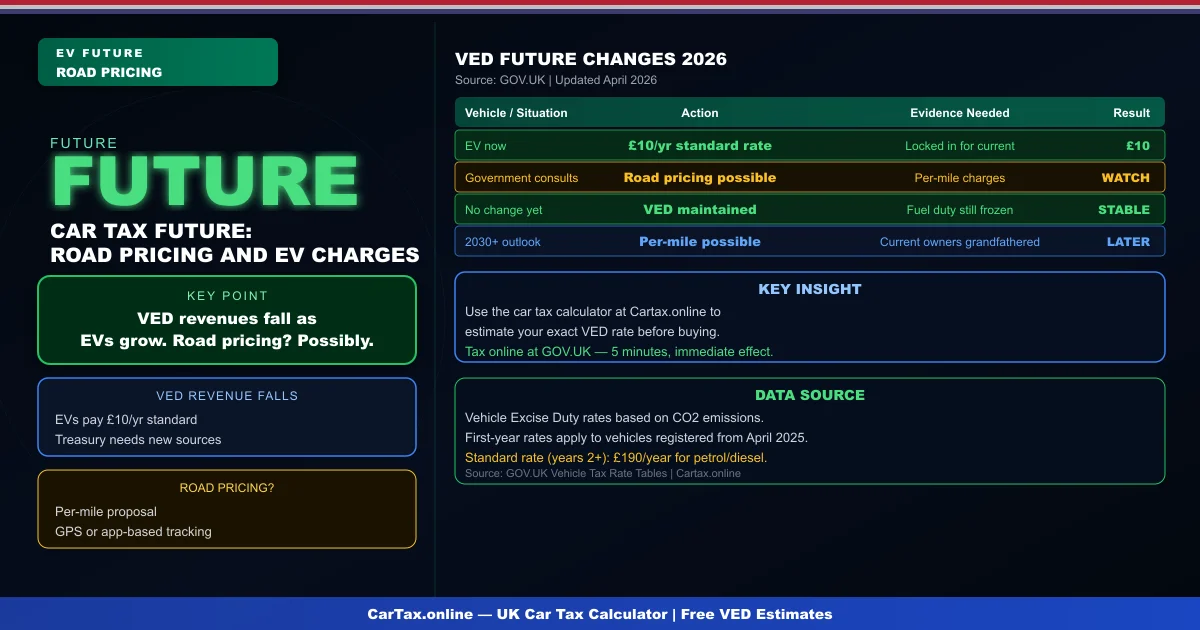
As electric vehicles become more common, the government faces a dilemma: VED revenues will decline as more cars pay £10 or £0 annually. The future of car taxation is under active consideration.
The VED Revenue Challenge
Electric vehicles currently pay minimal VED — £10 per year standard rate — and zero in their first year. As EV adoption grows, the total VED revenue collected will decline significantly. The Treasury has modelled scenarios where VED revenues fall by tens of millions of pounds per year as the vehicle fleet electrifies. This creates pressure to reform how road use is taxed to maintain funding for road infrastructure.
Government Consultations on Road Pricing
The government has repeatedly consulted on road pricing as a potential replacement for or supplement to VED. Proposals have included GPS-based mileage tracking, smartphone app logging, and smart meter-style road use charges. The concept is simple: instead of a flat annual charge, drivers pay per mile driven — making the cost proportional to actual road use. This would replace fuel duty (which also declines as EVs use less fuel) and VED.
Current Status of Road Pricing
As of 2026, no nationwide road pricing scheme has been implemented in the UK. Previous trials in Durham and Cambridge showed the concept is technically feasible but politically sensitive. The current government's position is to maintain VED and fuel duty while monitoring EV adoption rates. However, the 2025 Autumn Statement included no major announcements on road pricing, leaving uncertainty about timing. Related: Future of Car Tax UK 2026 | Car Tax Future UK 2026 | Car Tax Future UK 2026 | Car Tax Future Changes UK 2026.
How EVs Might Be Taxed
Several options are being considered for taxing EVs in the future: a flat annual EV supplement replacing the £10 standard rate, a per-mile charge for zero-emission vehicles, increased vehicle excise duty for EVs, or a hybrid approach combining elements. The AA and RAC have both published proposals suggesting per-mile charging as the fairest long-term solution, since it ties the cost to actual road use rather than ownership.
What This Means for EV Buyers
If you are buying an EV today, the current VED rules apply for the foreseeable future. The £10 annual standard rate for EVs is locked in for existing owners under current government policy. Changes, if they come, are likely to be implemented gradually and with notice — much like the taper of incentives for EVs over recent years. Monitor DVLA and Treasury announcements for policy updates. The car tax calculator at Cartax.online will be updated to reflect any changes to VED rates.
Frequently Asked Questions
Q: How much is car tax (VED) in the UK 2026?
Car tax rates in the UK depend on your vehicle's CO2 emissions and list price. Standard rates start from £190 per year for petrol and diesel cars, with zero-rated VED for EVs. First-year rates vary from £0 to £2,605 depending on emissions. Additional premiums apply for vehicles over £40,000.
Q: How do I check if my car is taxed online?
You can check your vehicle's tax status for free on the Gov.uk website at gov.uk/check-vehicle-tax. You'll need your vehicle's registration number (number plate). You can also check via the Motor Insurance Database to verify road tax and insurance status simultaneously.
Q: Can I get a refund on car tax if I sell my vehicle?
Yes — if you sell or scrap your vehicle, you can claim a refund on any full months of remaining road tax. Contact DVLA with the V11 reminder letter or apply online at gov.uk. Refunds are usually processed within 4-6 weeks.
Q: Is road tax refund available when transferring ownership?
No — road tax does not transfer with the vehicle. When you sell your car, the tax is automatically cancelled and any remaining months are refunded to you by DVLA. The new owner must tax the vehicle immediately. As a buyer, always verify the vehicle's tax status before purchasing.
Q: What is the luxury car tax threshold in the UK 2026?
The additional rate for vehicles over £40,000 (list price) adds £410 per year to standard VED rates for years 2-6 of registration. This surcharge brings the annual cost for high-emission vehicles over £40,000 to around £600-690 per year. Pure EVs under £40,000 pay zero VED.