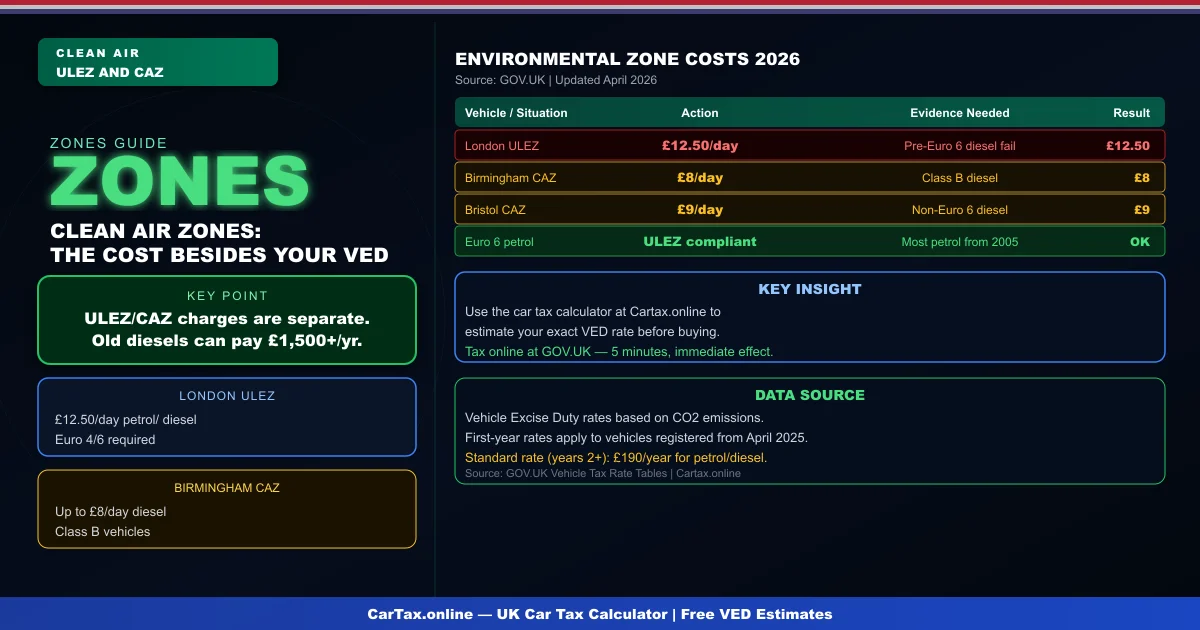
Road tax and environmental driving zones are separate but related costs. While VED is a national charge, clean air zones and the London ULEZ are local authority charges based on vehicle emissions standards. Understanding both helps you calculate the true annual cost of running any vehicle.
London Ultra Low Emission Zone (ULEZ)
The ULEZ covers all of Greater London and operates 24 hours a day, 365 days a year. Petrol cars must meet Euro 4 (generally those registered from 2005 onward) and diesel cars must meet Euro 6 (generally those registered from September 2015 onward) to avoid the £12.50 daily charge. The zone has expanded multiple times and now covers the entire area within the North Circular and South Circular roads. Check your vehicle's ULEZ compliance on TfL's website.
Clean Air Zones Across the UK
Birmingham, Bristol, Bath, Portsmouth, Sheffield, York, Newcastle, Oxford, Cambridge and Norwich are among the cities that have introduced or are planning Clean Air Zones (CAZs). These charge older, higher-emission vehicles for driving within the zone boundary. Charges range from £8 to £12.50 per day depending on the zone and vehicle type. Unlike the London ULEZ, most CAZs only apply to the city centre area and operate at specific times.
Euro Standards and Road Tax
The Euro standard — Euro 4, Euro 5, Euro 6 for petrol and diesel respectively — is primarily used to determine Clean Air Zone and ULEZ compliance, not VED rates. Your road tax is still based on CO2 emissions regardless of your Euro standard. However, Euro standards and CO2 are loosely correlated: newer vehicles tend to have both lower CO2 and meet higher Euro standards. Pre-2005 petrol cars typically fail Euro 4, and pre-2015 diesel cars typically fail Euro 6. Related: Car Tax and Environmental Zones UK 2026 | Diesel Car Tax Explained UK 2026 | Car Tax and Car Washes UK 2026 | Car Tax and Low Emission Vehicles UK 2026.
VED and CAZ Interaction
Road tax and clean air zone charges are completely separate. Paying your VED does not grant any exemption from a CAZ or ULEZ charge — and paying a CAZ charge does not reduce your VED. They are administered by different authorities (DVLA for VED, local authorities or TfL for CAZ/ULEZ) and have different enforcement mechanisms. The only way to avoid both is to drive a vehicle that meets the required emissions standards.
Future of Environmental Zones and VED
The government has signalled that clean air zones will eventually replace some aspects of VED as the primary mechanism for vehicle environmental charging. Some proposals suggest replacing the current CO2-based VED with a pay-per-mile scheme or zone-based charging. For now, VED remains a flat annual charge. Drivers in cities with CAZs should factor both VED and expected zone charges into their annual vehicle budget — for a pre-2015 diesel driver in Birmingham, the £50 annual road tax versus a potential £1,500+ annual CAZ charge illustrates how local charges can dwarf national VED.
Checking Your Vehicle's Compliance
Before buying a used car — particularly a diesel — check its Euro standard and CAZ/ULEZ compliance. A car that looks cheap to buy may cost £1,500 to £2,000 per year in London or Birmingham driving charges if it fails the applicable standard. Enter the registration at TfL's vehicle checker and the relevant local CAZ website. Then use the car tax calculator at Cartax.online to add VED to the total annual cost.
Frequently Asked Questions
Q: How much is car tax (VED) in the UK 2026?
Car tax rates in the UK depend on your vehicle's CO2 emissions and list price. Standard rates start from £190 per year for petrol and diesel cars, with zero-rated VED for EVs. First-year rates vary from £0 to £2,605 depending on emissions. Additional premiums apply for vehicles over £40,000.
Q: How do I check if my car is taxed online?
You can check your vehicle's tax status for free on the Gov.uk website at gov.uk/check-vehicle-tax. You'll need your vehicle's registration number (number plate). You can also check via the Motor Insurance Database to verify road tax and insurance status simultaneously.
Q: Can I get a refund on car tax if I sell my vehicle?
Yes — if you sell or scrap your vehicle, you can claim a refund on any full months of remaining road tax. Contact DVLA with the V11 reminder letter or apply online at gov.uk. Refunds are usually processed within 4-6 weeks.
Q: Is road tax refund available when transferring ownership?
No — road tax does not transfer with the vehicle. When you sell your car, the tax is automatically cancelled and any remaining months are refunded to you by DVLA. The new owner must tax the vehicle immediately. As a buyer, always verify the vehicle's tax status before purchasing.
Q: What is the luxury car tax threshold in the UK 2026?
The additional rate for vehicles over £40,000 (list price) adds £410 per year to standard VED rates for years 2-6 of registration. This surcharge brings the annual cost for high-emission vehicles over £40,000 to around £600-690 per year. Pure EVs under £40,000 pay zero VED.