Diesel cars have a complicated relationship with road tax. While they often match petrol cars on standard annual rates, their first-year VED charges can be significantly higher — and additional environmental surcharges apply in cities across the UK. Here is a full breakdown of diesel car tax in 2026.
First-Year VED for Diesel Cars
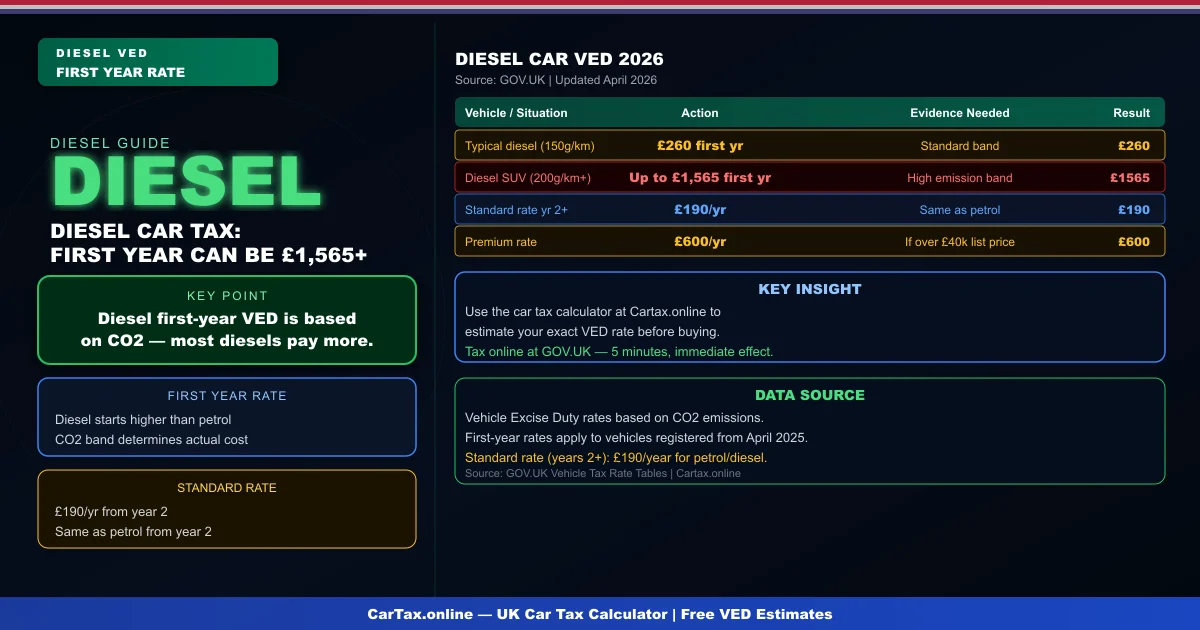
Diesel cars registered from April 2025 pay first-year VED based on their CO2 emissions. The difference from petrol is that diesel cars start in a higher CO2 band: most diesel cars emit over 130g/km of CO2, placing them in the £205 to £1,565 first-year band range. A typical 2.0-litre diesel family car emitting around 150g/km pays £260 for the first year. The highest-emitting diesel cars — often large SUVs — can pay £2,605 for the first year.
Standard Annual VED Rate
From year two onward, diesel and petrol cars pay the same standard annual VED rate. The standard rate for petrol and diesel cars is £190 per year. This standard rate has applied since 2017-18 and has not changed since. Whether you drive a petrol supermini or a diesel SUV, both pay £190 from year two. The fuel type distinction in VED has essentially disappeared after year one.
Premium Rate Surcharge for Diesel Cars
There is no diesel-specific premium rate for road tax — the premium supplement of £410 per year (years two through six) applies to any vehicle with a list price over £40,000, regardless of fuel type. A diesel BMW X5 over £40,000 list price pays the same £410 premium as an equivalent petrol model. The premium rate is driven by list price, not CO2 or fuel type. Check the VED rate tables on GOV.UK for full band listings. Related: Diesel Car Tax Explained UK 2026 | Diesel Car Tax UK 2026 | Car Tax | Petrol vs Diesel Car Tax UK 2026.
Diesel in Clean Air Zones and ULEZ
While not strictly road tax, diesel cars face significant additional charges in Clean Air Zones and London's Ultra Low Emission Zone. Diesel cars that do not meet Euro 6 emission standards face daily charges of up to £12.50 in Birmingham's CAZ and £15 in London's ULEZ (expanded zone). Older diesel vehicles — particularly pre-2015 — may face these charges every day they are driven in affected zones. Factor these charges into the total cost of owning a diesel car.
Company Car BIK for Diesel
For company car drivers, diesel cars attract higher Benefit in Kind rates than equivalent petrol models due to their higher CO2 emissions. A diesel company car emitting 140g/km at 35% BIK rate on a £35,000 P11D value costs £12,250 per year in BIK tax — nearly double that of an equivalent 120g/km petrol car at 28% BIK. Diesel company cars are increasingly losing their appeal for employee tax efficiency.
Residual Values and Future Costs
Diesel cars are depreciating faster than petrol and electric alternatives due to regulatory pressure, clean air zone restrictions and consumer preference shifts. This affects the total cost of ownership beyond VED. Diesel makes most financial sense for high-mileage drivers — those covering 30,000+ miles annually — where the superior fuel efficiency offsets the higher first-year VED and environmental charges. For average drivers, a petrol or hybrid may be more cost-effective overall.
Frequently Asked Questions
Q: How much is car tax (VED) in the UK 2026?
Car tax rates in the UK depend on your vehicle's CO2 emissions and list price. Standard rates start from £190 per year for petrol and diesel cars, with zero-rated VED for EVs. First-year rates vary from £0 to £2,605 depending on emissions. Additional premiums apply for vehicles over £40,000.
Q: How do I check if my car is taxed online?
You can check your vehicle's tax status for free on the Gov.uk website at gov.uk/check-vehicle-tax. You'll need your vehicle's registration number (number plate). You can also check via the Motor Insurance Database to verify road tax and insurance status simultaneously.
Q: Can I get a refund on car tax if I sell my vehicle?
Yes — if you sell or scrap your vehicle, you can claim a refund on any full months of remaining road tax. Contact DVLA with the V11 reminder letter or apply online at gov.uk. Refunds are usually processed within 4-6 weeks.
Q: Is road tax refund available when transferring ownership?
No — road tax does not transfer with the vehicle. When you sell your car, the tax is automatically cancelled and any remaining months are refunded to you by DVLA. The new owner must tax the vehicle immediately. As a buyer, always verify the vehicle's tax status before purchasing.
Q: What is the luxury car tax threshold in the UK 2026?
The additional rate for vehicles over £40,000 (list price) adds £410 per year to standard VED rates for years 2-6 of registration. This surcharge brings the annual cost for high-emission vehicles over £40,000 to around £600-690 per year. Pure EVs under £40,000 pay zero VED.