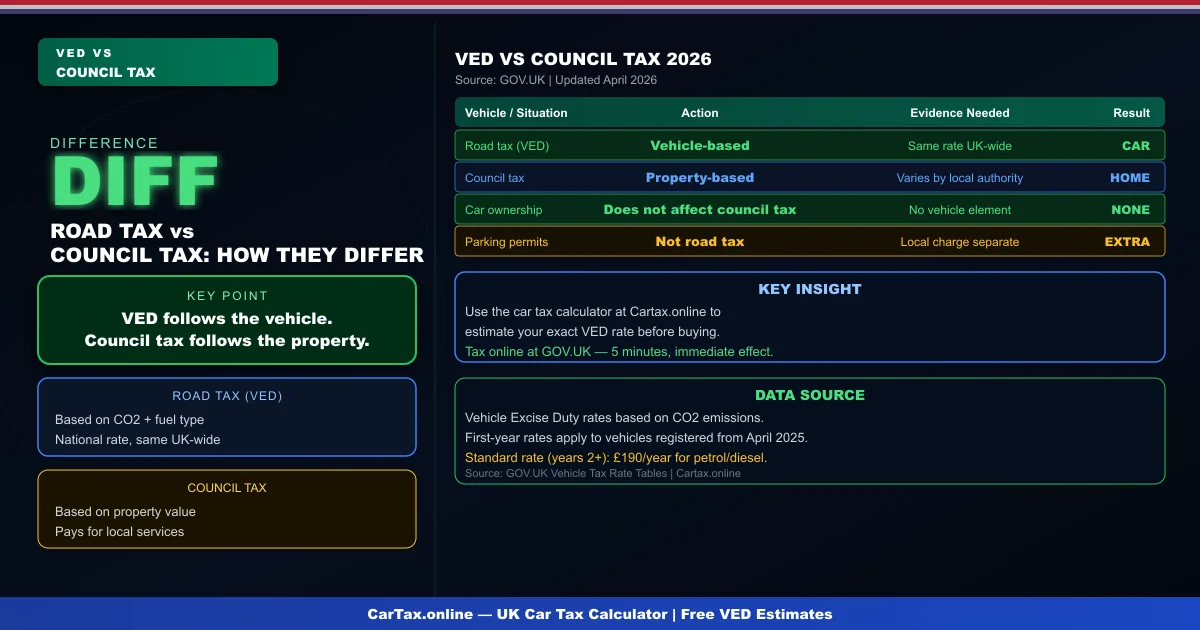
Road tax and council tax are two different taxes that many people confuse. Understanding the distinction helps you navigate both correctly and avoid overpaying or missing payments.
What Is Road Tax (VED)?
Vehicle Excise Duty (VED) — commonly called road tax — is a tax on owning and keeping a vehicle on a public road. It is a national tax collected by DVLA and the revenue is used for general road infrastructure spending. VED is based on the vehicle's CO2 emissions, fuel type and first registration date. The rate is the same regardless of where you live in the UK — a petrol car in London pays exactly the same VED as one in Edinburgh.
What Is Council Tax?
Council tax is a local tax collected by your local authority to fund local services: bin collection, libraries, road maintenance, social care and police. It is based on your residential property's assessed value band, not on your vehicle. Council tax has no connection to road tax — owning a car does not automatically increase council tax, and owning multiple cars does not increase it proportionally (though some councils apply a premium for additional properties).
The Vehicle Discount on Council Tax
Some single-person households receive a 25% council tax discount. Having a car does not affect this discount — it is based on the number of adults living in the property, not on vehicle ownership. A single occupant with two cars gets the same 25% discount as a single occupant with no car. The council tax band is fixed for the property and does not vary based on how many vehicles you own. Related: Car Tax vs Council Tax UK 2026 | Big Car Tax Changes Coming to UK 2026 | Car Tax Renewal UK 2026 | How Much Is Car Tax UK 2026? The Honest Answer.
Parking and Permits vs Road Tax
Some local authorities charge for resident parking permits, and these fees are sometimes confused with road tax. Parking permits are separate charges for the right to park on a public street near your home — they are not road tax and have no relationship with VED. Similarly, congestion charges, clean air zone fees and ULEZ charges are not road tax — they are local transport management charges that you pay on top of, not instead of, your annual VED.
Where the Confusion Comes From
The old paper tax disc — displayed on windscreens until 2014 — may have created the impression that road tax was somehow linked to the address shown on the disc, like a council tax bill. In reality, the two taxes are completely separate: VED follows the vehicle and is paid to DVLA, while council tax follows the property and is paid to your local authority. Use the car tax calculator at Cartax.online for your road tax and check your local authority's website for council tax queries.
Official Resources: GOV.UK Check Vehicle Tax | GOV.UK Vehicle Tax | DVLA Online | MOT Check
Frequently Asked Questions
Q: How much is car tax (VED) in the UK 2026?
Car tax rates in the UK depend on your vehicle's CO2 emissions and list price. Standard rates start from £190 per year for petrol and diesel cars, with zero-rated VED for EVs. First-year rates vary from £0 to £2,605 depending on emissions. Additional premiums apply for vehicles over £40,000.
Q: How do I check if my car is taxed online?
You can check your vehicle's tax status for free on the Gov.uk website at gov.uk/check-vehicle-tax. You'll need your vehicle's registration number (number plate). You can also check via the Motor Insurance Database to verify road tax and insurance status simultaneously.
Q: Can I get a refund on car tax if I sell my vehicle?
Yes — if you sell or scrap your vehicle, you can claim a refund on any full months of remaining road tax. Contact DVLA with the V11 reminder letter or apply online at gov.uk. Refunds are usually processed within 4-6 weeks.
Q: Is road tax refund available when transferring ownership?
No — road tax does not transfer with the vehicle. When you sell your car, the tax is automatically cancelled and any remaining months are refunded to you by DVLA. The new owner must tax the vehicle immediately. As a buyer, always verify the vehicle's tax status before purchasing.
Q: What is the luxury car tax threshold in the UK 2026?
The additional rate for vehicles over £40,000 (list price) adds £410 per year to standard VED rates for years 2-6 of registration. This surcharge brings the annual cost for high-emission vehicles over £40,000 to around £600-690 per year. Pure EVs under £40,000 pay zero VED.