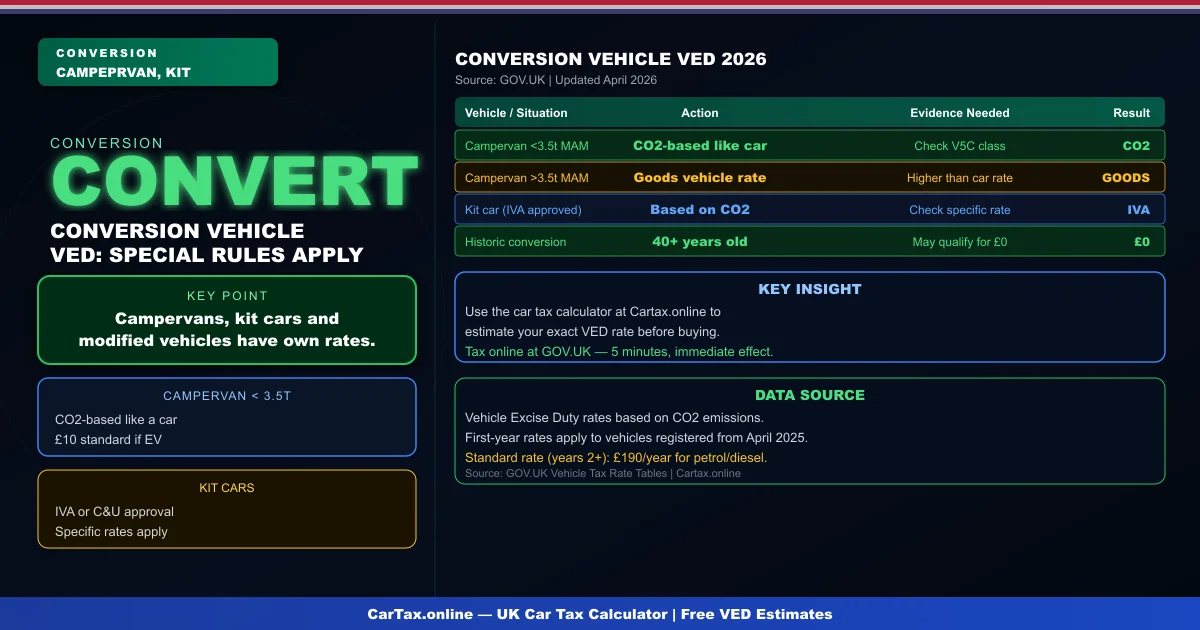
Conversion vehicles — including campervans, kit cars and modified vehicles — often fall into complex VED categories that differ from standard car taxation. The rules depend on the vehicle's type approval, weight classification and intended use.
Campervan VED Rates
Campervans are taxed differently from standard cars depending on their classification and weight. A campervan with a maximum authorised mass (MAM) under 3,500kg is taxed as a private light goods vehicle — essentially the same as a car, based on CO2 emissions. Zero-emission electric campervans pay just £10 per year. However, a campervan with MAM over 3,500kg falls into goods vehicle VED rates, which can be significantly higher. Check the V5C classification carefully before buying.
Kit Cars and VED
Kit cars — also called construction and use (C&U) vehicles — have their own VED rules. Individual vehicle approval (IVA) kit cars pay VED based on their CO2 emissions if they have type approval. Kit cars without full type approval may fall into a historic vehicle or special vehicle class. The VED rate can vary significantly depending on the kit car type, engine and weight. Check DVLA's specific rate tables for kit cars as they differ from standard car rates.
Modified Vehicles and CO2
Vehicle modifications that change CO2 emissions — such as engine swaps or alternative fuel conversions — may require a new CO2 rating from the VCA. If the modification results in higher CO2, the VED rate may increase. If the vehicle is converted to run on an alternative fuel such as autogas (LPG) or biomethane, the VED rate may be reclassified. The registered keeper must notify DVLA of significant modifications that affect the vehicle's CO2 rating. Related: Car Tax for Conversion Vehicles UK 2026 | Car Tax Conversion UK 2026 | Car Tax and Van Conversion UK 2026 | Car Tax Conversion UK 2026.
Type Approval: Whole Vehicle vs Individual
Conversion vehicles may have whole vehicle type approval (WVTA) if they were manufactured as a complete vehicle, or individual vehicle approval (IVA) if each individual vehicle was inspected. IVA-converted vehicles may have a different VED classification than the base vehicle. A Ford Transit van converted to a campervan by an independent converter typically receives IVA and may be reclassified. Always verify the classification on the V5C and check with DVLA if uncertain.
Historic Vehicle Exemption for Older Conversions
Some conversion vehicles over 40 years old may qualify for historic vehicle exemption from VED. This applies to vehicles substantially in their original condition — so a restored classic campervan or kit car may qualify for £0 annual road tax. However, the exemption applies to the vehicle as classified, not the base model. A 1985 van converted to a campervan in 2024 is still classified as a 1985 vehicle for historic purposes, provided it meets the criteria.
Frequently Asked Questions
Q: How much is car tax (VED) in the UK 2024?
Car tax rates in the UK depend on your vehicle's CO2 emissions and list price. Standard rates start from £190 per year for petrol and diesel cars, with zero-rated VED for EVs. First-year rates vary from £0 to £2,605 depending on emissions. Additional premiums apply for vehicles over £40,000.
Q: How do I check if my car is taxed online?
You can check your vehicle's tax status for free on the Gov.uk website at gov.uk/check-vehicle-tax. You'll need your vehicle's registration number (number plate). You can also check via the Motor Insurance Database to verify road tax and insurance status simultaneously.
Q: Can I get a refund on car tax if I sell my vehicle?
Yes — if you sell or scrap your vehicle, you can claim a refund on any full months of remaining road tax. Contact DVLA with the V11 reminder letter or apply online at gov.uk. Refunds are usually processed within 4-6 weeks.
Q: Is road tax refund available when transferring ownership?
No — road tax does not transfer with the vehicle. When you sell your car, the tax is automatically cancelled and any remaining months are refunded to you by DVLA. The new owner must tax the vehicle immediately. As a buyer, always verify the vehicle's tax status before purchasing.
Q: What is the luxury car tax threshold in the UK 2024?
The additional rate for vehicles over £40,000 (list price) adds £410 per year to standard VED rates for years 2-6 of registration. This surcharge brings the annual cost for high-emission vehicles over £40,000 to around £600-690 per year. Pure EVs under £40,000 pay zero VED.