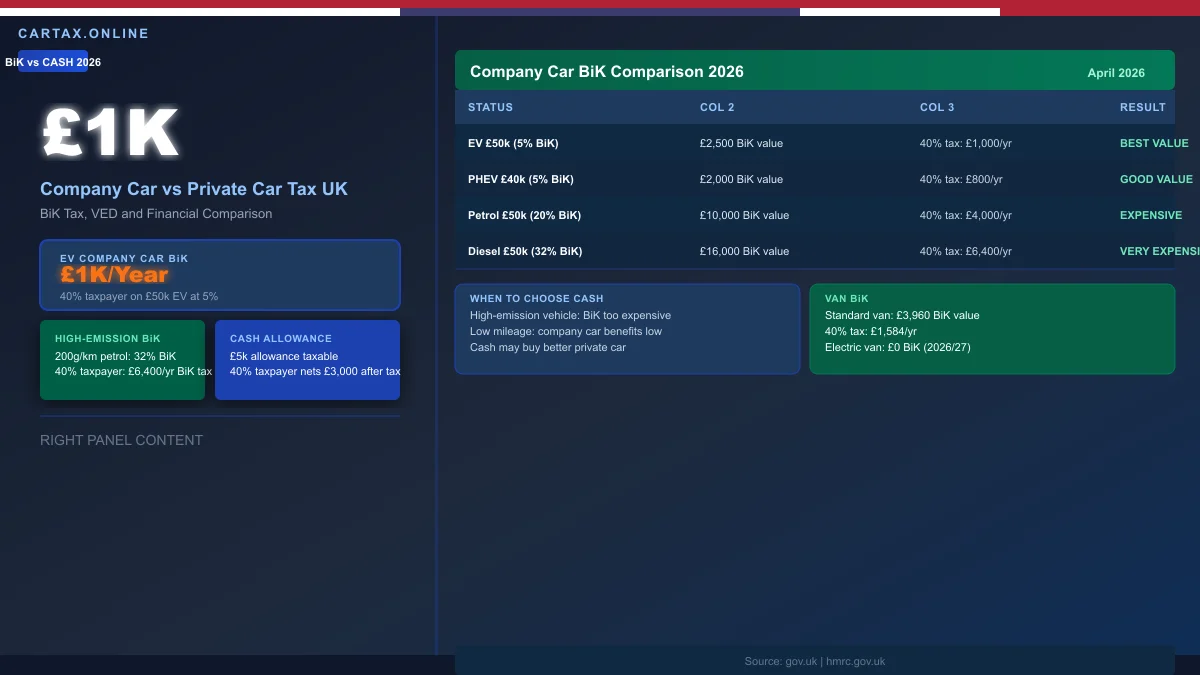
April 13, 2026 in United Kingdom — Choosing between a company car scheme and using your own private vehicle for work is a significant financial decision. This guide compares the tax implications of company cars versus private vehicles, including VED, Benefit-in-Kind (BiK) tax, and cash allowance options in 2026.
What Is a Company Car and How Is It Taxed?
A company car is a vehicle provided by your employer for private use. Even if you only use it for commuting, it counts as a benefit and you pay Income Tax on its value through the Benefit-in-Kind (BiK) system. The BiK value is based on the vehicle's P11D price (list price including options) multiplied by the BiK rate for that CO2 emission band.
BiK Tax Rates for Company Cars 2026/27
BiK rates are based on the vehicle's CO2 emissions. For 2026/27:
| CO2 Emissions | BiK Rate (2026/27) | Example P11D £50k Car | 40% Taxpayer Annual BiK Tax |
|---|---|---|---|
| 0 g/km (Pure EV) | 5% | £2,500 BiK value | £1,000/year |
| 1-50 g/km (PHEV) | 5% | £2,500 BiK value | £1,000/year |
| 51-75 g/km (hybrid) | 5% | £2,500 BiK value | £1,000/year |
| 76-99 g/km | 8% | £4,000 BiK value | £1,600/year |
| 100-110 g/km | 12% | £6,000 BiK value | £2,400/year |
| 130-135 g/km | 18% | £9,000 BiK value | £3,600/year |
| 160-170 g/km | 25% | £12,500 BiK value | £5,000/year |
| 190-200 g/km | 32% | £16,000 BiK value | £6,400/year |
| 225+ g/km | 37% | £18,500 BiK value | £7,400/year |
VED (Road Tax) for Company Cars
Company cars also pay VED (road tax). However, because company cars are registered to a business rather than an individual, the £0 first-year rate and the standard annual rate both apply. An employer must tax a company vehicle at the same VED rates as a private vehicle. Some employers include this in the package; others deduct it from the employee's salary. Check your employment contract for clarity. Related: Car Tax | Car Tax | Company Car vs Private Car Tax UK 2026 | UK Electric Vehicle Tax 2026.
Cash Allowance vs Company Car
Many employers offer a cash allowance instead of a company car — you receive extra salary to buy and run your own vehicle. The financial comparison:
- Company car (EV £50k): You pay £1,000/year BiK tax on £2,500 value. Employer pays for road tax, insurance, maintenance. You get a car worth £50k at £1,000/year personal tax cost.
- Cash allowance (£5,000/year): This is taxable income. A 40% taxpayer takes home £3,000 after tax. You must buy, insure, tax, and maintain your own vehicle from this.
For high-emission company cars, the BiK tax becomes punishing. A 200g/km petrol company car at £16,000 BiK value costs £6,400/year for a 40% taxpayer — far more than a low-emission EV at £1,000/year.
Personal (Private) Vehicle Road Tax
A private vehicle owner only pays VED (road tax). There is no BiK tax. The annual road tax cost depends on CO2 emissions — from £195/year for low-emission vehicles to £1,280+ for high-emission cars. This is significantly simpler than company car taxation, but you also cover all other costs (insurance, maintenance, fuel) yourself.
When Is a Company Car Better Financially?
A company car makes financial sense when:
- You drive a low or zero-emission vehicle (EV or PHEV) — BiK rates are 5%, so personal tax cost is low
- You drive many miles — employer covers running costs
- Your employer includes road tax and maintenance in the package
- You would otherwise buy an expensive new car anyway
When Is a Private Car Better Financially?
A private car (with or without cash allowance) makes more sense when:
- You drive a high-emission vehicle — BiK tax at 25-37% makes company car very expensive
- You do low annual mileage — employer benefits are less valuable
- Your cash allowance covers all vehicle costs with money left over
- You prefer flexibility in what car you drive
Van vs Car: Separate Rules
Vans have a separate and simpler BiK calculation. A company van has a flat BiK value of £3,960 (2026/27), regardless of the van's value or emissions. At 40% tax, this costs £1,584/year. Pure electric vans have a reduced BiK value of £nil for 2026/27 — making electric vans extremely tax-efficient for employers and employees.
Conclusion
Company cars are taxed through BiK on top of VED — low-emission EVs at 5% BiK are very cost-effective (£1,000/year for a £50k car), while high-emission petrol cars at 25-37% BiK are punishing (£5,000-£7,400/year). Cash allowances add taxable income. Compare your total cost including BiK tax, road tax, and running expenses before choosing. Use an employer car scheme calculator or consult a tax advisor for your specific situation.
Official Resources: GOV.UK Check Vehicle Tax | GOV.UK Vehicle Tax | DVLA Online | MOT Check
Frequently Asked Questions
Q: How much is car tax (VED) in the UK 2026?
Car tax rates in the UK depend on your vehicle's CO2 emissions and list price. Standard rates start from £190 per year for petrol and diesel cars, with zero-rated VED for EVs. First-year rates vary from £0 to £2,605 depending on emissions. Additional premiums apply for vehicles over £40,000.
Q: How do I check if my car is taxed online?
You can check your vehicle's tax status for free on the Gov.uk website at gov.uk/check-vehicle-tax. You'll need your vehicle's registration number (number plate). You can also check via the Motor Insurance Database to verify road tax and insurance status simultaneously.
Q: Can I get a refund on car tax if I sell my vehicle?
Yes — if you sell or scrap your vehicle, you can claim a refund on any full months of remaining road tax. Contact DVLA with the V11 reminder letter or apply online at gov.uk. Refunds are usually processed within 4-6 weeks.
Q: Is road tax refund available when transferring ownership?
No — road tax does not transfer with the vehicle. When you sell your car, the tax is automatically cancelled and any remaining months are refunded to you by DVLA. The new owner must tax the vehicle immediately. As a buyer, always verify the vehicle's tax status before purchasing.
Q: What is the luxury car tax threshold in the UK 2026?
The additional rate for vehicles over £40,000 (list price) adds £410 per year to standard VED rates for years 2-6 of registration. This surcharge brings the annual cost for high-emission vehicles over £40,000 to around £600-690 per year. Pure EVs under £40,000 pay zero VED.