Car tax CO2 certificate UK — the Certificate of Conformity (COC) is the definitive document proving your vehicle's CO2 emissions and VED classification. Here is why you need it in 2026.
What Is a Certificate of Conformity?
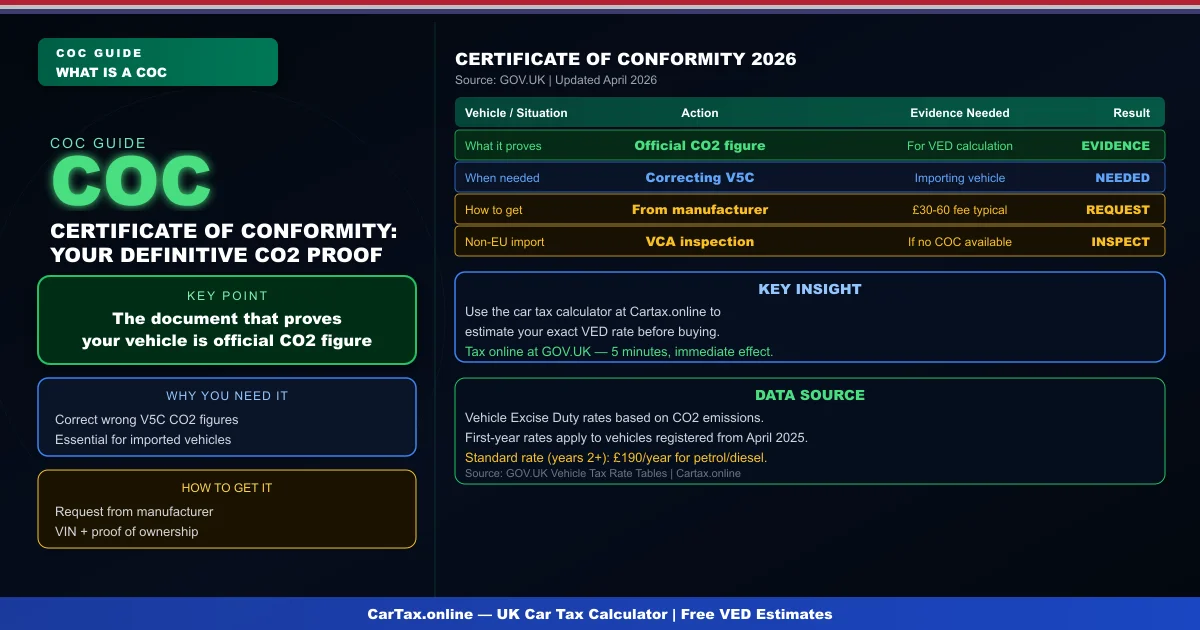
The Certificate of Conformity (COC) is an official document issued by the vehicle manufacturer that confirms the vehicle meets EU type approval requirements. It contains the official CO2 emission figure, fuel type, engine size, and other technical specifications used to determine your VED band.
Why the COC Matters for Road Tax
The CO2 figure on your COC is the definitive emission figure for your vehicle. If your V5C shows a different CO2 figure, the COC is the evidence you use to correct DVLA's records. The COC is also essential when importing a vehicle — it provides the CO2 data needed to calculate UK road tax.
How to Get a Certificate of Conformity
Request a COC from your vehicle's manufacturer. Most manufacturers charge a fee for this service — typically £30-£60. Some offer digital copies via their customer services portal. Provide your vehicle identification number (VIN) and proof of ownership. Related: Car Tax CO2 Certificate UK 2026 | Car Tax and Insurance Certificate UK 2026 | UK Car Tax Bands 2026 | How Much Is My Car Tax UK 2026.
COC for Imported Vehicles
For vehicles imported from the EU, the COC provided at first registration in the origin country is accepted by DVLA. For non-EU imports, a COC or equivalent documentation is required to establish the CO2 figure. If no COC is available, a professional inspection at the VCA determines the CO2 classification.
Conclusion
Car tax CO2 certificate UK: the COC is your authoritative CO2 proof. Request from your manufacturer if your V5C figure is wrong. GOV.UK has import documentation guidance.
Vehicle Excise Duty (VED) rates in the UK are reviewed annually, typically in April with the new financial year. The DVLA administers all vehicle taxation and registration, and you can check your vehicle's current tax status for free at gov.uk/check-vehicle-tax using only your registration number. Rates are determined by the vehicle's CO2 emissions and list price at the time of first registration, with additional premiums applying for high-value vehicles.
Frequently Asked Questions
Q: How much is car tax (VED) in the UK 2026?
Car tax rates in the UK depend on your vehicle's CO2 emissions and list price. Standard rates start from £190 per year for petrol and diesel cars, with zero-rated VED for EVs. First-year rates vary from £0 to £2,605 depending on emissions. Additional premiums apply for vehicles over £40,000.
Q: How do I check if my car is taxed online?
You can check your vehicle's tax status for free on the Gov.uk website at gov.uk/check-vehicle-tax. You'll need your vehicle's registration number (number plate). You can also check via the Motor Insurance Database to verify road tax and insurance status simultaneously.
Q: Can I get a refund on car tax if I sell my vehicle?
Yes — if you sell or scrap your vehicle, you can claim a refund on any full months of remaining road tax. Contact DVLA with the V11 reminder letter or apply online at gov.uk. Refunds are usually processed within 4-6 weeks.
Q: Is road tax refund available when transferring ownership?
No — road tax does not transfer with the vehicle. When you sell your car, the tax is automatically cancelled and any remaining months are refunded to you by DVLA. The new owner must tax the vehicle immediately. As a buyer, always verify the vehicle's tax status before purchasing.
Q: What is the luxury car tax threshold in the UK 2026?
The additional rate for vehicles over £40,000 (list price) adds £410 per year to standard VED rates for years 2-6 of registration. This surcharge brings the annual cost for high-emission vehicles over £40,000 to around £600-690 per year. Pure EVs under £40,000 pay zero VED.