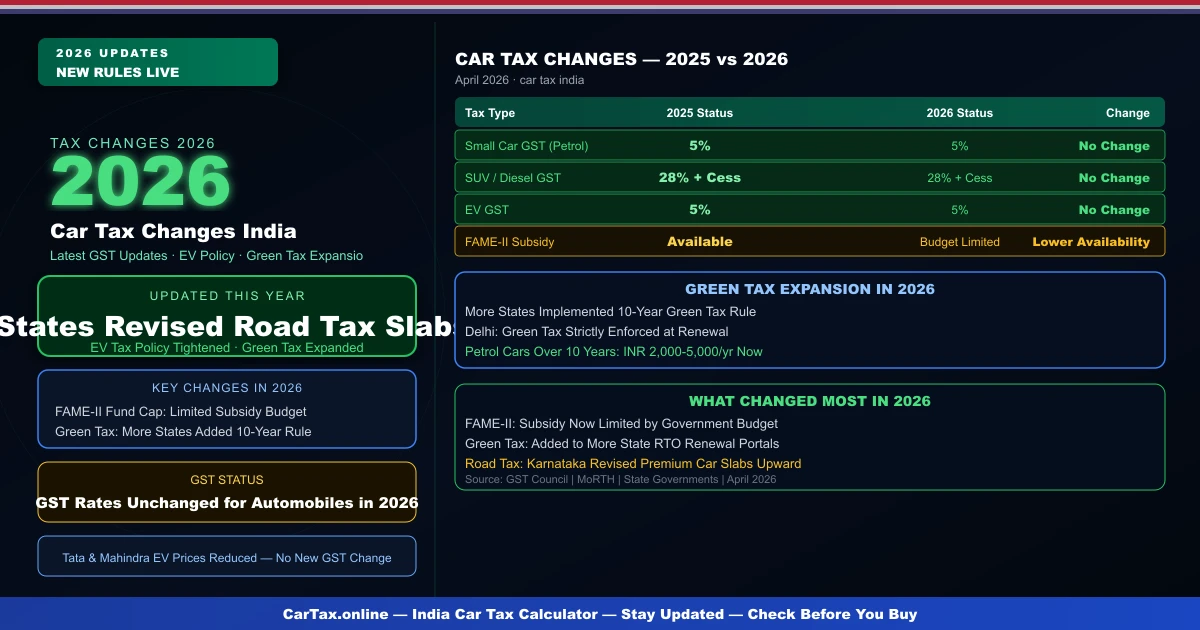
Car tax changes in India for 2026 bring important updates across GST rates, state road tax slabs, EV taxation, and inter-state transfer rules. Staying informed about these changes helps you make better decisions when buying, selling, or transferring vehicles across state lines.
As of April 18, 2026, several significant policy shifts have reshaped the vehicle taxation landscape. The gradual phase-out of FAME-II subsidies, state-level road tax revisions, and tighter inter-state transfer compliance have all created a more complex but in some cases more favourable environment for car buyers and sellers.
GST Council Updates for 2026
The GST Council maintained the existing car tax structure through 2026 with no major revisions to the GST rates on vehicles. Small cars with engine sizes under 1200cc petrol or 1500cc diesel continue at 18% GST, mid-size vehicles at 28% GST, and larger SUVs and luxury vehicles at 28% plus additional cess. Electric vehicles retain the concessional 5% GST rate under the FAME-II framework.
The absence of GST revisions is itself notable, as earlier speculation suggested potential harmonisation of rates. Maintaining current rates provides stability for car buyers and manufacturers planning long-term investments in vehicle production and purchase decisions.
State Road Tax Revisions in 2026
Several states have revised their road tax structures for 2026. Karnataka increased road tax for vehicles above INR 10 lakh from 18% to 20%, a significant change for buyers of premium vehicles in the state. Maharashtra continues to offer lower road tax for small cars but applies higher cess on larger vehicles. Delhi maintained its relatively low road tax rates, keeping the capital among the more affordable cities for vehicle ownership.
Other states including Gujarat, Tamil Nadu, and Punjab made minor adjustments to their road tax brackets to account for vehicle price inflation. These changes mean that the same vehicle priced at INR 10 lakh in 2024 may now fall into a higher tax bracket in 2026 as price thresholds remain static while vehicle prices have risen.
Electric Vehicle Taxation Changes
The most significant EV taxation change in 2026 is the continued reduction of FAME-II subsidies. The per-vehicle subsidy cap has been reduced by approximately 25% compared to 2024 levels, meaning buyers receive less government support at the point of purchase. However, the 5% GST rate, state road tax exemptions, and lower running costs still make EVs financially attractive compared to equivalent petrol vehicles.
State EV policies have also evolved, with more states extending road tax exemption periods for electric vehicles and some adding additional registration fee waivers. The convergence of state-level incentives creates significant regional variation in effective EV costs, making location-specific analysis essential before purchase.
Inter-State Transfer Rule Changes
Post-April 2025, inter-state vehicle transfer rules have tightened across most states. Physical vehicle inspection is now required before NOC issuance in Maharashtra, Karnataka, and Delhi. The Vahan portal integration means that vehicles with pending challans, tax arrears, or legal disputes are flagged automatically, preventing seamless transfers until all issues are resolved.
Processing timelines for inter-state transfers have extended from the previous 3 to 4 weeks to 6 to 10 weeks in most states. Buyers and sellers should factor this extended timeline into their transaction planning, particularly when purchasing pre-owned vehicles from different states.
Impact on Car Buyers in 2026
The combined effect of these changes means that car buyers should budget more carefully than in previous years. The reduced FAME-II subsidy increases effective EV purchase costs, while higher road tax in states like Karnataka adds to overall ownership costs for non-EV vehicles. Inter-state transfer complexity makes buying used cars from different states more cumbersome.
For the best outcomes, use our India car tax calculator to compare total costs across states before committing to a purchase, and always factor in the full tax liability including registration fees, road tax, and GST when calculating the true on-road cost of any vehicle.
Frequently Asked Questions
What are the major car tax changes in India for 2026?
Key changes in 2026 include continued FAME-II subsidy phase-out for EVs, state-level road tax revisions in Karnataka, Maharashtra, and Delhi, clarification on hybrid vehicle GST treatment, and expanded input tax credit provisions for commercial vehicles under GST.
Has GST on cars changed in 2026?
The GST rates on cars have remained largely unchanged in 2026. Small cars continue at 18%, mid-size at 28%, large SUVs at 28% with additional cess, and electric vehicles retain the concessional 5% rate under FAME-II. No major GST council revisions were announced for 2026.
What road tax changes happened in Karnataka in 2026?
Karnataka revised road tax slabs in 2026, increasing rates for vehicles above INR 10 lakh to 20% from the previous 18%. The sub-4 metre car category continues to receive a lower cess of 4% compared to larger vehicles. Electric vehicles in Karnataka continue to enjoy road tax exemption for the first 5 years.
How do EV tax changes affect car buyers in 2026?
The FAME-II subsidy for EVs has been gradually reducing, with the per-vehicle subsidy cap decreased by 25% compared to 2024 levels. This increases the effective cost of EVs, though the 5% GST rate and state road tax exemptions still make EVs significantly cheaper than equivalent petrol vehicles over their lifetime.
Are there new rules for inter-state car transfers in 2026?
Several states implemented tighter inter-state transfer rules in 2025 and 2026, requiring physical vehicle inspection for NOC issuance, enhanced digital verification through the Vahan portal, and stricter timelines for re-registration in the destination state. Buyers transferring cars across state borders should budget for 6 to 10 weeks of processing time.
Official Resources: Parivahan Portal | Vahan Road Tax | India GST Portal | FAME-III Scheme
Frequently Asked Questions
Q: What is the current road tax rate for cars in India 2026?
Road tax rates in India vary by state and vehicle category. For new cars, GST is charged at 5% for EVs, 18% for hybrids under 1,200cc, and up to 28% for petrol/diesel SUVs. State road tax is charged separately and varies from Rs3,000-15,000 annually depending on the state's slab system. Check your specific state's RTO website for current rates.
Q: How do I calculate my car road tax online in India?
You can calculate your car road tax using online calculators available on state RTO portals and CarTax.online. The calculation considers your vehicle's ex-showroom price, fuel type, engine capacity, and state of registration. Road tax is payable annually or for the vehicle's lifetime depending on your state's rules.
Q: Is GST included in the road tax for new cars in India?
No — GST and road tax are separate charges. GST is a central tax charged by the vehicle manufacturer at the time of purchase. State road tax is a separate annual or one-time charge levied by your state's transport department. Both apply at the time of first registration, and annual road tax continues for subsequent years.
Q: Do electric vehicles get tax benefits in India 2026?
Yes — electric vehicles in India qualify for a reduced GST rate of 5% (down from 28% for petrol cars). Under FAME-III subsidies, EVs may also qualify for additional state-level incentives, reduced road tax, and free registration in many states. The exact benefits vary by state.
Q: What happens if I don't pay my car road tax on time?
If you don't pay road tax, your vehicle's registration can be flagged in the Vahan database, preventing renewal of fitness certificates and creating legal liability during police checks. Penalties range from Rs200-500 per day of default in most states. Road tax is a legal requirement under the Motor Vehicles Act.