Using a car for business purposes creates a separate set of tax considerations on top of standard road tax. Whether you are a company car driver, a sole trader using your personal vehicle for work, or a business owner with a fleet, understanding how car tax interacts with business use is essential for staying compliant and minimising costs.
Company Car Benefit in Kind Tax
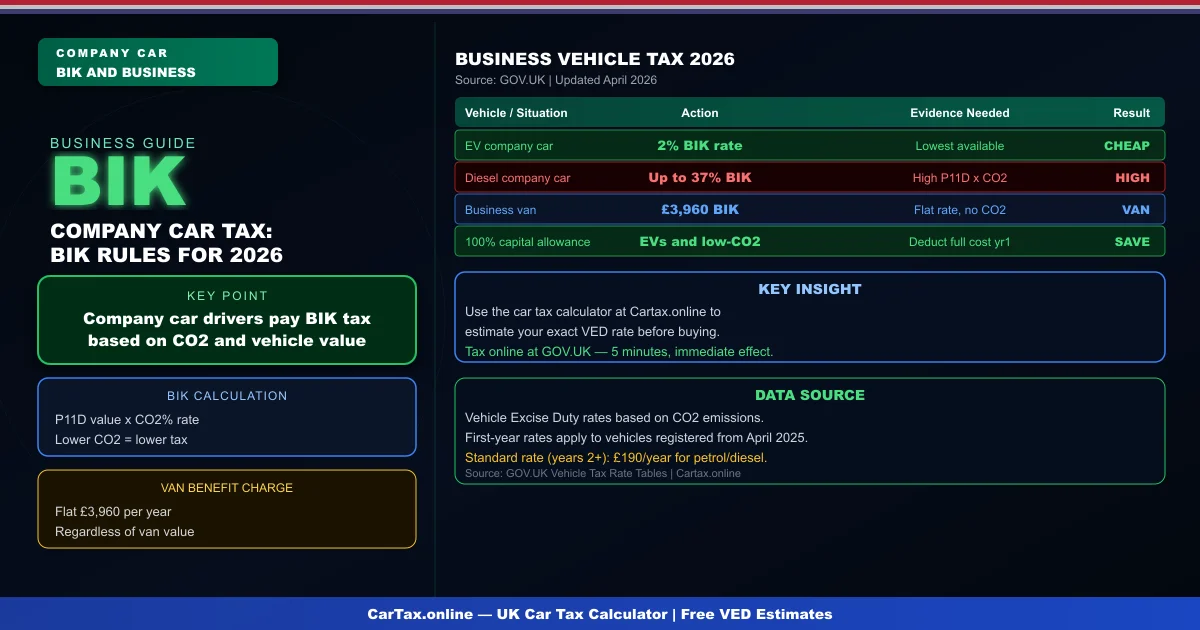
If your employer provides you with a car for personal use, you pay Benefit in Kind (BIK) tax. BIK is calculated as a percentage of the vehicle's P11D value — the list price including VAT and delivery charges. The percentage is based on the vehicle's CO2 emissions: zero-emission company cars attract a 2% BIK rate in 2026-27, rising to 5% by 2027-28. A high-emission diesel company car can attract 37% BIK. Your employer reports BIK via PAYE and you pay it through your tax code.
Van Excise Duty for Business Vans
Vans used for business purposes pay a different VED rate than cars. The standard annual rate for a van is currently £290 per year. Electric vans attract a reduced rate of £0 for the first year and £0 standard rate. Businesses can claim capital allowances on van purchases and deduct running costs including road tax from their taxable profits. If a van is used privately, a van benefit charge may also apply.
Sole Trader Allowable Vehicle Expenses
Sole traders using their own car for business can claim vehicle expenses against tax. This includes a portion of road tax proportional to business use.HMRC allows you to claim either the standard mileage rate (45p per business mile for cars) or actual expenses including road tax, insurance, fuel and maintenance. Choose whichever gives the higher deduction. Keep detailed mileage logs to support your claim. Related: Car Tax and Business Use UK 2026 | Car Tax | Company Car vs Private Car Tax UK 2026 | Company Car vs Private Car Tax UK 2026.
VAT on Road Tax
Road tax (VED) itself is not VAT-able, but if you are VAT-registered and use your vehicle exclusively for business, you may be able to reclaim 100% of the VAT on vehicle costs. If the vehicle is used for a mix of business and personal use, you can only reclaim a proportion. Consult an accountant to calculate the correct business use percentage. VAT on fuel (whether you use a fuel card or pay personally) has its own simplified scheme — the VAT fuel scale charge — which HMRC sets annually.
Fleet Operators and Multiple Vehicles
Businesses with five or more vehicles should consider fleet management systems that track VED status, MOT dates and fuel efficiency. Managing road tax centrally prevents vehicles accidentally running without tax. Many fleet operators use the DVLA fleet licensing service to manage multiple vehicles under one account. This simplifies renewals and reduces administrative overhead. Fleet operators can also access bulk discount rates on some vehicle services.
Electric Vehicle Tax Incentives for Businesses
Businesses receive enhanced capital allowances on zero-emission vehicles: 100% first-year allowance for cars with CO2 emissions up to 50g/km, and 100% for electric vans. This means the full cost can be deducted from taxable profits in the year of purchase. Company car BIK rates for EVs remain the lowest of any fuel type. These incentives make electric company cars significantly cheaper for businesses to provide and for employees to accept.
Frequently Asked Questions
Q: How much is car tax (VED) in the UK 2026?
Car tax rates in the UK depend on your vehicle's CO2 emissions and list price. Standard rates start from £190 per year for petrol and diesel cars, with zero-rated VED for EVs. First-year rates vary from £0 to £2,605 depending on emissions. Additional premiums apply for vehicles over £40,000.
Q: How do I check if my car is taxed online?
You can check your vehicle's tax status for free on the Gov.uk website at gov.uk/check-vehicle-tax. You'll need your vehicle's registration number (number plate). You can also check via the Motor Insurance Database to verify road tax and insurance status simultaneously.
Q: Can I get a refund on car tax if I sell my vehicle?
Yes — if you sell or scrap your vehicle, you can claim a refund on any full months of remaining road tax. Contact DVLA with the V11 reminder letter or apply online at gov.uk. Refunds are usually processed within 4-6 weeks.
Q: Is road tax refund available when transferring ownership?
No — road tax does not transfer with the vehicle. When you sell your car, the tax is automatically cancelled and any remaining months are refunded to you by DVLA. The new owner must tax the vehicle immediately. As a buyer, always verify the vehicle's tax status before purchasing.
Q: What is the luxury car tax threshold in the UK 2026?
The additional rate for vehicles over £40,000 (list price) adds £410 per year to standard VED rates for years 2-6 of registration. This surcharge brings the annual cost for high-emission vehicles over £40,000 to around £600-690 per year. Pure EVs under £40,000 pay zero VED.