April 13, 2026 in United Kingdom — When it comes to paying road tax, UK drivers can choose between 12-month and 6-month terms. But which option is actually better? This guide breaks down the cost differences, refund rules, and practical considerations for choosing the right payment term in 2026.
12-Month vs 6-Month Road Tax: The Cost Difference
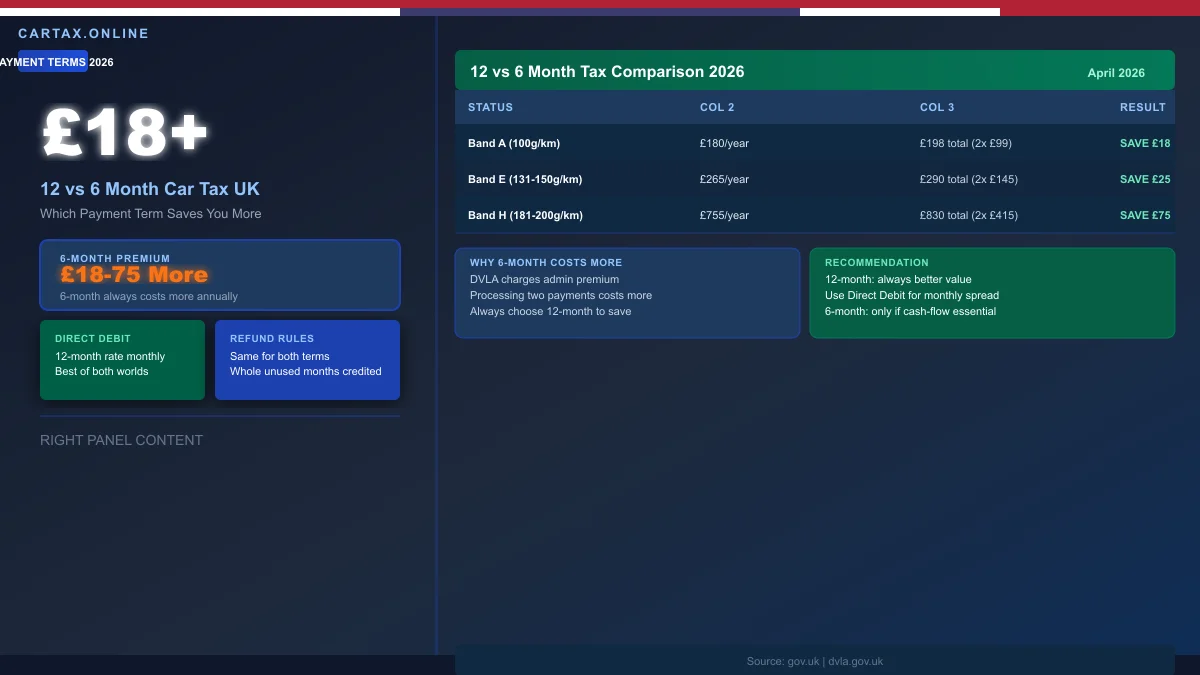
Road tax can be paid in either 12-month or 6-month instalments. However, the 6-month rate is not simply half of the annual rate — it is slightly higher. The DVLA charges a premium for 6-month tax to cover administrative costs of processing twice-yearly payments. Here is the typical cost comparison:
| VED Band | 12-Month Rate | 6-Month Rate (each) | 6-Month Total | Premium Cost |
|---|---|---|---|---|
| Band A (0-100g/km) | £180 | £99 | £198 | £18 extra |
| Band C (101-110g/km) | £195 | £107 | £214 | £19 extra |
| Band E (131-150g/km) | £265 | £145 | £290 | £25 extra |
| Band F (151-165g/km) | £445 | £244 | £488 | £43 extra |
| Band G (166-180g/km) | £600 | £330 | £660 | £60 extra |
| Band H (181-200g/km) | £755 | £415 | £830 | £75 extra |
As shown above, paying 6-monthly always costs more overall. For a Band E vehicle, the 6-month option costs £25 extra per year compared to the 12-month rate.
Why Would Anyone Choose 6-Month Tax?
Despite the higher cost, some drivers prefer 6-month tax for practical reasons: Related: 12-Month vs 6-Month Car Tax UK 2026 | Can You Pay Car Tax 6 Months in the UK? Current Options | How to Tax a Car UK 2026 | Car Tax Refund UK 2026.
- Cash flow management: Smaller payments every 6 months are easier to budget for some drivers
- Timing flexibility: If your vehicle is seasonal (e.g., a convertible used only in summer), 6-month tax lets you align payments with usage
- Unused refund window: If you sell the vehicle mid-period, you get a proportional refund on both 12-month and 6-month tax — but 6-month means you have already paid for a shorter maximum period
Direct Debit: The Best of Both Worlds?
The DVLA's Direct Debit option pays for 12 months but spreads the cost across monthly payments from your bank account. This gives you the lower 12-month rate while breaking the payment into manageable monthly amounts. The Direct Debit runs annually and automatically renews — so you never forget to tax your vehicle. Set it up once and forget it.
Refund Rules: 12-Month vs 6-Month
Both 12-month and 6-month road tax are refunded proportionally for unused whole months when you notify the DVLA of a sale, scrapping, or export. The calculation is the same for both terms. However, because the 6-month rate is higher per month, the per-month cost of the refund is also proportionally higher.
Can You Switch from 12-Month to 6-Month?
Yes — when your current tax period expires, you can choose to pay 6-monthly instead. You cannot switch mid-period. When the tax renewal is due, simply select the 6-month option at GOV.UK or the post office. Note that the next 6-month payment will come due again in 6 months, so you are committing to twice-yearly renewals.
Is 6-Month Tax Worth It?
For most drivers, 12-month tax is better value — the saving of £18-75 per year is real money that adds up. The only compelling reason to choose 6-month tax is if you genuinely need to manage cash flow in smaller amounts. The Direct Debit monthly option (if available to you) solves the cash flow problem while keeping the cheaper 12-month rate.
What About 6-Month Tax for Classic Cars?
Historic vehicles (over 40 years old) that qualify for the £0 road tax exemption do not have a 6-month option — there is nothing to pay. Pre-2017 low-emission vehicles on the £0 annual rate also have no payment term options since no tax is owed.
Conclusion
12-month road tax is always cheaper than two 6-month payments — saving £18-75 per year depending on your VED band. Use Direct Debit monthly if you need to spread the cost. Choose 6-month only if you have a specific reason (seasonal vehicle, cash flow management). Use GOV.UK vehicle tax to select your payment term when renewing.
Frequently Asked Questions
Q: How much is car tax (VED) in the UK 2026?
Car tax rates in the UK depend on your vehicle's CO2 emissions and list price. Standard rates start from £190 per year for petrol and diesel cars, with zero-rated VED for EVs. First-year rates vary from £0 to £2,605 depending on emissions. Additional premiums apply for vehicles over £40,000.
Q: How do I check if my car is taxed online?
You can check your vehicle's tax status for free on the Gov.uk website at gov.uk/check-vehicle-tax. You'll need your vehicle's registration number (number plate). You can also check via the Motor Insurance Database to verify road tax and insurance status simultaneously.
Q: Can I get a refund on car tax if I sell my vehicle?
Yes — if you sell or scrap your vehicle, you can claim a refund on any full months of remaining road tax. Contact DVLA with the V11 reminder letter or apply online at gov.uk. Refunds are usually processed within 4-6 weeks.
Q: Is road tax refund available when transferring ownership?
No — road tax does not transfer with the vehicle. When you sell your car, the tax is automatically cancelled and any remaining months are refunded to you by DVLA. The new owner must tax the vehicle immediately. As a buyer, always verify the vehicle's tax status before purchasing.
Q: What is the luxury car tax threshold in the UK 2026?
The additional rate for vehicles over £40,000 (list price) adds £410 per year to standard VED rates for years 2-6 of registration. This surcharge brings the annual cost for high-emission vehicles over £40,000 to around £600-690 per year. Pure EVs under £40,000 pay zero VED.