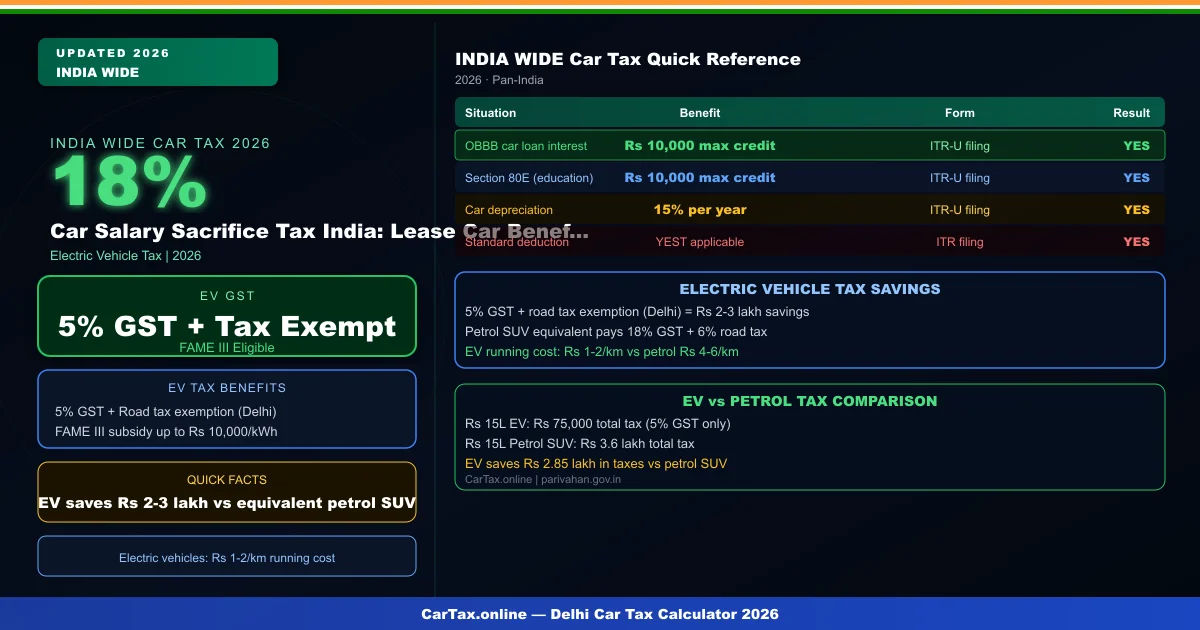
April 12, 2026 in India — Car salary sacrifice arrangements allow employees to exchange a portion of their salary for a company-provided car. Understanding tax implications of salary sacrifice helps employees optimize their take-home pay while getting a car benefit.
This guide covers salary sacrifice car schemes in India and their tax treatment.
Understanding Salary Sacrifice
Salary sacrifice (or salary packaging) is an arrangement where:
- Employee opts: Foregoes part of salary
- Employer provides: Car and related benefits
- Net effect: Lower taxable income
- Both parties: May benefit
Tax Treatment of Salary Sacrifice
Under Indian tax law, salary sacrifice affects perquisite valuation:
| Arrangement | Tax Implication |
|---|---|
| Company provides car | Perquisite value taxable |
| Employee leases car | Lease cost may be deductible |
| Salary sacrifice (lease) | Benefit reduced/eliminated |
Car Lease vs Company Car
| Aspect | Company Car | Lease Car |
|---|---|---|
| Ownership | Company | Lease company |
| Tax (employee) | Perquisite value | Nil if business use |
| Flexibility | Limited | Better choices |
| Maintenance | Company handles | Lease company handles |
GST on Car Leasing
Car lease services attract GST at 18%:
- Lease rent: Subject to 18% GST
- Input tax credit: Company can claim ITC
- Employee benefit: GST included in lease cost
Section 37 Business Deductions
For self-employed with lease arrangements:
- Lease payments: Fully deductible
- GST on lease: Input credit available
- Documentation: Lease agreement essential
Employer Benefits from Salary Sacrifice
Companies offering salary sacrifice benefit from:
- Simplified administration: Fixed monthly deduction
- ITC recovery: GST credit on lease payments
- Employee retention: Attractive benefit package
Salary Sacrifice Calculation
Example: Rs 30,000/month lease in salary sacrifice:
- Base salary: Rs 1,50,000/month
- Salary sacrifice: Rs 30,000
- Taxable salary: Rs 1,20,000
- Tax saving (30% bracket): Rs 9,000/month
Limitations of Salary Sacrifice
- Perquisite rules: Still apply in some cases
- Employer participation: Company must offer scheme
- Fixed tenure: Lock-in periods apply
Frequently Asked Questions
Is salary sacrifice car tax-efficient in India?
Salary sacrifice can be tax-efficient if the car is used exclusively for business purposes. Perquisite value is nil if certified for business use only.
What GST applies to car lease payments?
Car lease services attract 18% GST on the lease rent. Companies can claim input tax credit for GST paid on lease payments.
Can employees claim lease cost as tax deduction?
Employees cannot claim lease costs as personal deductions. However, if self-employed, lease payments are fully deductible as business expenses.
What's better: company car or salary sacrifice lease?
Salary sacrifice lease offers more flexibility in vehicle choice and may have lower tax impact. But it depends on individual usage and employer scheme availability.
Conclusion
Salary sacrifice can optimize tax position for both employer and employee. Evaluate based on your tax bracket. Use our salary sacrifice calculator for estimates.
Disclaimer: This article is for informational purposes only. Tax rules for salary sacrifice are complex. Consult a tax professional.
अस्वीकरण: यह लेख केवल सूचनात्मक उद्देश्यों के लिए है। कर नियम जटिल हैं।
Official Resources: Parivahan Portal | Vahan Road Tax | India GST Portal | FAME-III Scheme
Frequently Asked Questions
Q: What is the current road tax rate for cars in India 2026?
Road tax rates in India vary by state and vehicle category. For new cars, GST is charged at 5% for EVs, 18% for hybrids under 1,200cc, and up to 28% for petrol/diesel SUVs. State road tax is charged separately and varies from Rs3,000-15,000 annually depending on the state's slab system. Check your specific state's RTO website for current rates.
Q: How do I calculate my car road tax online in India?
You can calculate your car road tax using online calculators available on state RTO portals and CarTax.online. The calculation considers your vehicle's ex-showroom price, fuel type, engine capacity, and state of registration. Road tax is payable annually or for the vehicle's lifetime depending on your state's rules.
Q: Is GST included in the road tax for new cars in India?
No — GST and road tax are separate charges. GST is a central tax charged by the vehicle manufacturer at the time of purchase. State road tax is a separate annual or one-time charge levied by your state's transport department. Both apply at the time of first registration, and annual road tax continues for subsequent years.
Q: Do electric vehicles get tax benefits in India 2026?
Yes — electric vehicles in India qualify for a reduced GST rate of 5% (down from 28% for petrol cars). Under FAME-III subsidies, EVs may also qualify for additional state-level incentives, reduced road tax, and free registration in many states. The exact benefits vary by state.
Q: What happens if I don't pay my car road tax on time?
If you don't pay road tax, your vehicle's registration can be flagged in the Vahan database, preventing renewal of fitness certificates and creating legal liability during police checks. Penalties range from Rs200-500 per day of default in most states. Road tax is a legal requirement under the Motor Vehicles Act.