Pay Car Road Tax Online India 2026
Paying car road tax online in India has become significantly more accessible in 2026, with national and state government portals offering streamlined digital payment options. Gone are the days of making multiple trips to the RTO for road tax payments. The Parivahan portal, state transport department websites, and integrated digital payment systems now enable most car owners to pay road tax from the comfort of their home using UPI, net banking, or debit/credit cards.
This guide covers all the methods available for paying car road tax online in India in April 2026, from the national Parivahan portal to state-specific transport portals, with step-by-step instructions for the most common payment scenarios including new car registration tax, annual road tax renewal, and lifetime tax payment.
Pay Road Tax via Parivahan Portal — National RTO Gateway
The Parivahan portal (parivahan.gov.in) is the national gateway for RTO services across India and handles road tax payments for most states. The portal is operated by the Ministry of Road Transport and Highways (MoRTH) and provides a unified interface for vehicle-related services regardless of your state. The portal processes new car registration tax, annual road tax renewals, and lifetime tax payments through a standardised online process.
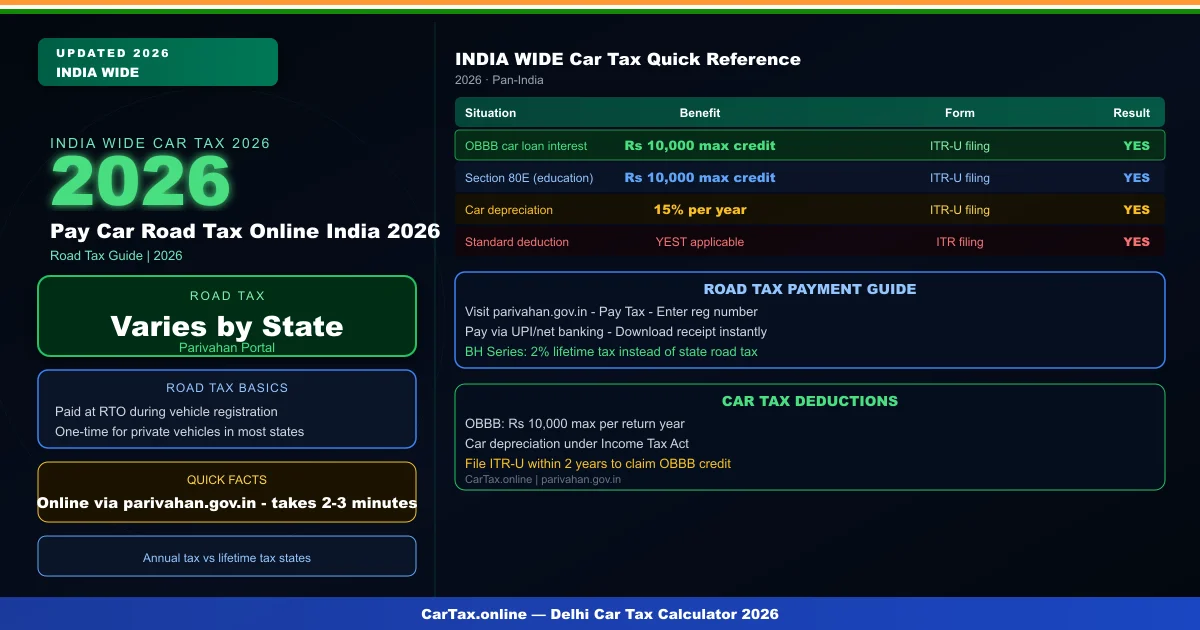
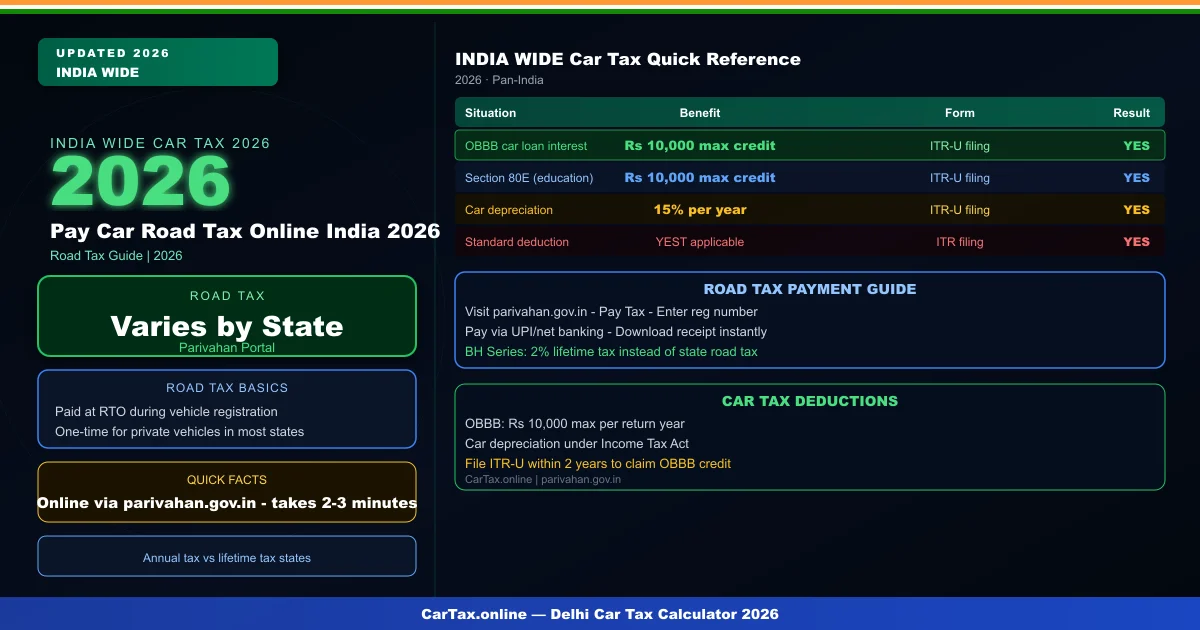
To pay road tax via Parivahan: first, visit parivahan.gov.in and select the "Tax Calculator" or "Pay Tax" service from the home page; second, select your state from the dropdown menu as road tax rules vary by state; third, enter your vehicle's registration number and confirm the vehicle details displayed; fourth, the portal will calculate the applicable road tax based on your vehicle's details and your state's schedule; fifth, select your preferred payment method (UPI, net banking, or card); sixth, complete the payment and download or print the receipt.
The Parivahan portal processes payments in real-time and generates an immediate digital receipt. The payment confirmation is automatically updated in the Vahan database (the national vehicle registration database), meaning your registration records reflect the payment without requiring a separate RTO visit. However, for new car registration, you may still need to visit the RTO for physical document verification and number plate issuance.
State Transport Portals — Direct State Payment
Most Indian states now operate their own dedicated transport department portals that handle road tax payments specific to that state. These state portals often provide more state-specific features and may offer lower processing times than Parivahan for certain transactions. Key state portals include: Delhi Transport Department (delhitransport.gov.in) for Delhi road tax; Karnataka Transport Department (transport.karnataka.gov.in) for Karnataka road tax; Maharashtra Transport Department (maharashtra.gov.in/transport) for Maharashtra road tax; Tamil Nadu Transport Department (tn.gov.in/transport) for Tamil Nadu road tax; and Gujarat Transport Department (guj.gov.in/transport) for Gujarat road tax.
State portals are particularly useful for complex transactions like road tax refunds (when transferring a vehicle out of state), correction of tax records, and annual tax renewals where the state-specific calculation may differ from the generic Parivahan calculator. The portals also provide state-specific penalty calculators if road tax has lapsed and need to be recovered with penalty charges.
The advantage of state portals over Parivahan is that they are designed specifically for that state's tax schedule, reducing the risk of calculation errors. They also often provide faster receipt generation and are more integrated with the state's vehicle records. However, for owners who have relocated or are registering a vehicle in a new state, Parivahan provides a more accessible starting point across all states.
UPI Payment for Road Tax — Fastest Method
UPI (Unified Payments Interface) has become the preferred payment method for road tax online payments in India in 2026. All government portals now accept UPI payments through the GovPay gateway and directly through UPI ID transfers. Major UPI apps including Google Pay, PhonePe, Paytm, and native bank UPI apps are supported, making it the most convenient option for most car owners.
To pay road tax via UPI: add the UPI ID provided by the portal (typically a government ID like [state]rtax@SBI or similar), confirm the amount on your UPI app, and authorise the payment with your UPI PIN. The payment is processed within seconds, and the portal immediately generates a payment receipt. UPI is the fastest method with no processing delays and no additional convenience fees in most cases.
For higher-value road tax payments (lifetime tax on premium vehicles can exceed INR 1 lakh), UPI remains the most seamless option. The absence of convenience fees on UPI transactions — which can add 1-2% for credit/debit card payments — makes UPI significantly more cost-effective for large payments. Most government portals now prominently feature UPI as the first payment option.
New Car Registration Tax — Online Payment Before RTO Visit
For new car purchases, the road tax must typically be paid before the vehicle can be registered. The dealer usually facilitates this process, but car owners can also pay road tax independently before visiting the RTO for registration. The process for paying new car road tax online involves: first, obtaining the chassis number ( VIN) and engine number from the dealer; second, calculating the applicable road tax using the state transport portal or Parivahan tax calculator; third, initiating payment and noting the receipt reference number; fourth, taking the payment receipt to the RTO along with other documents for vehicle registration.
Some states like Karnataka and Delhi allow dealers to pay road tax on behalf of buyers as part of the vehicle delivery process, bundling the road tax into the total on-road price. In such cases, the dealer handles the online payment process and passes the receipt to the buyer. However, even when the dealer handles payment, the buyer should verify that the road tax has been correctly calculated and paid, as errors can create issues during vehicle transfers later.
Annual Road Tax Renewal — Staying Compliant
For owners in annual tax states like Maharashtra and West Bengal, road tax must be renewed every year before the registration renewal date. The annual road tax payment can be made online through the state transport portal or Parivahan, typically 30 days before the annual renewal date to allow time for processing and record update. Failure to pay road tax before the renewal date can result in penalties and complications during the fitness certificate renewal process.
The online annual renewal process involves logging into the state portal with your vehicle registration number, confirming the vehicle details, calculating the annual road tax for the upcoming year, making the payment, and downloading the receipt. The payment confirmation is automatically updated in the Vahan database within 1-2 business days, enabling the annual fitness certificate renewal to proceed without a physical RTO visit.
Owners who have missed annual road tax payments should pay the lapsed tax as soon as possible along with the applicable penalty. The penalty rates for delayed road tax payment vary by state — typically ranging from 2% to 5% per month of delay — but the government has been offering periodic relief schemes where reduced penalties apply for bulk settlement of arrears. Checking the state transport portal for any active relief schemes is worthwhile before paying large penalty amounts.
Frequently Asked Questions
How do I pay car road tax online through Parivahan?
To pay road tax online via the Parivahan portal, visit parivahan.gov.in and select the tax payment service. Choose your state, enter your vehicle registration number, and the portal will retrieve your vehicle details and calculate the applicable road tax. Select UPI, net banking, or card as your payment method and complete the transaction. The payment receipt is generated immediately and automatically updated in the Vahan vehicle registration database. For new car registration tax, the receipt should be taken to the RTO along with other documents. For annual tax renewals, the online receipt is typically sufficient without a physical RTO visit.
Can I pay road tax using UPI in India 2026?
Yes. UPI is the preferred payment method for road tax online payments in India in 2026. All national and state government portals accept UPI payments through apps like Google Pay, PhonePe, Paytm, and native bank UPI apps. UPI payments are processed instantly with no additional convenience fees, making them the most cost-effective option for large road tax payments. Simply select the UPI option at checkout on the Parivahan or state transport portal and authorise the payment with your UPI PIN.
Can I pay road tax online for a new car before RTO registration?
Yes. You can pay road tax online before visiting the RTO for your new car's first registration. Obtain the chassis number (VIN) and engine number from your dealer, use the Parivahan or state transport portal to calculate the applicable road tax, make the payment online, and note the receipt reference number. Take this receipt to the RTO along with your other registration documents. Some dealers handle road tax payment as part of the delivery process, but you can also manage it independently if preferred.
What happens if I don't pay my annual road tax on time?
If annual road tax is not paid before the registration renewal date, the vehicle is flagged as non-compliant in the Vahan database. This can prevent the renewal of the fitness certificate, create issues during police checks, and may result in penalties. The penalty for delayed road tax payment varies by state but is typically 2-5% per month of delay. Some states have periodic relief schemes offering reduced penalties for bulk settlement of arrears. Paying road tax as soon as possible — along with any applicable penalty — is the recommended course of action to restore compliance.
Which states allow online road tax payment through their own portals?
Most Indian states now allow online road tax payment through their dedicated transport department portals. Key state portals include Delhi Transport Department (delhitransport.gov.in), Karnataka Transport Department (transport.karnataka.gov.in), Maharashtra Transport Department, Tamil Nadu Transport Department, and Gujarat Transport Department. These state-specific portals often process payments faster and with greater accuracy for state-specific calculations than the national Parivahan portal. For complex transactions like road tax refunds on interstate transfers or correction of tax records, the state portals are particularly useful.