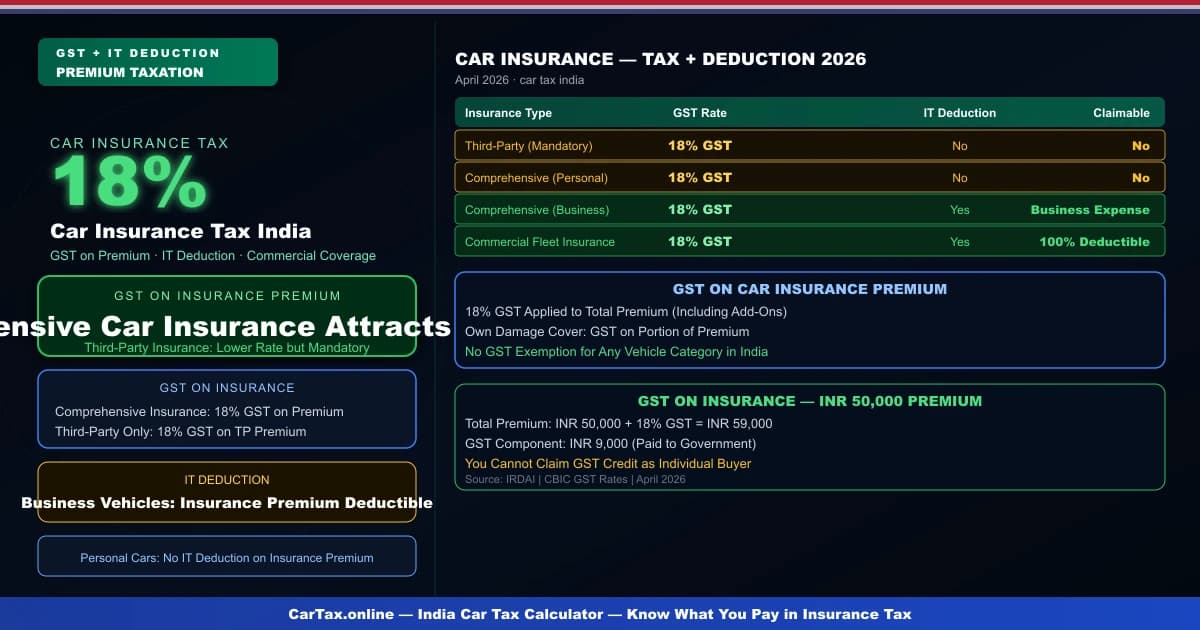
Car insurance tax in India for 2026 covers both GST implications on insurance premiums and income tax deductions available to businesses and individuals. Understanding how car insurance interacts with the tax framework helps you optimise your vehicle ownership costs and claim legitimate deductions where applicable.
As of April 18, 2026, comprehensive car insurance in India attracts 18% GST, and businesses can claim meaningful deductions on commercial vehicle premiums. Whether you're a salaried employee with a personal car or a business running a fleet, the tax treatment of your car insurance has real financial implications worth understanding.
GST on Car Insurance Premiums in India
All motor insurance policies in India, including comprehensive car insurance, attract an 18% GST rate applied to the premium amount. This GST is borne by the policyholder at the time of purchasing or renewing the insurance policy. The GST applies uniformly across all registered insurers operating in India, whether public sector companies like New India Assurance or private insurers like HDFC Ergo and ICICI Lombard.
When you receive a car insurance quote, the premium shown typically excludes GST. The 18% GST is added separately, and the total amount including GST is what you pay. For a comprehensive car insurance premium of INR 20,000, GST at 18% adds INR 3,600, making the total premium INR 23,600.
Income Tax Deductions on Car Insurance
For businesses, car insurance premiums qualify as a deductible business expense under Section 37(1) of the Income Tax Act. This means the GST paid on commercial vehicle insurance can be claimed as a business expense, reducing your taxable income. If your business operates on an accrual basis, the insurance premium paid for the financial year is deducted in that year's tax calculation.
Input tax credit for GST on car insurance is available to businesses with GST registration. Under the GST framework, registered businesses can claim input tax credit on GST paid for commercial vehicles used in the course of business. For passenger cars used partially for personal purposes, the input tax credit claimable is limited to 50% of the GST amount paid on the premium.
For individuals with personal cars, car insurance premiums are not tax deductible. Unlike health insurance under Section 80D or life insurance premiums, car insurance for personal vehicles does not qualify for any income tax deduction for individual taxpayers. The tax benefit framework for personal vehicles is limited to the Road Tax paid at the time of registration, which may be claimed as part of the vehicle's cost for depreciation calculations in certain circumstances.
Tax Implications for Fleet Owners
Businesses operating car fleets can structure their insurance arrangements to maximise tax efficiency. Fleet insurance policies often attract volume discounts, and the GST paid across all vehicles in the fleet remains fully claimable as input tax credit for commercial use. Maintaining detailed records of each vehicle's usage pattern is essential to defend input tax credit claims during GST audits.
For commercial vehicles including taxis, transport vehicles, and company cars used entirely for business, the full GST on insurance premiums can be claimed as input tax credit. The distinction between fully commercial use and partial personal use determines how much credit can be claimed. Fleet managers should maintain trip logs and usage records to support their tax credit claims.
Car Insurance and Road Tax Relationship
While car insurance and road tax are separate charges, both are mandatory for legal vehicle operation in India. Valid insurance must be presented when paying road tax and registering a vehicle at the RTO. Insurance does not affect the road tax calculation itself, but the compulsory third-party insurance component is enforced through the registration renewal process where the RTO verifies insurance status before allowing registration renewal.
Senior citizens and certain categories of vehicle owners may benefit from modified insurance pricing, though the tax treatment remains the same regardless of the policyholder's age or category. Using our India car tax calculator helps you understand the total tax burden when purchasing a vehicle, separate from your ongoing insurance costs.
Frequently Asked Questions
Is car insurance premium tax deductible in India?
Personal car insurance premiums are not tax deductible for individuals in India. However, commercial vehicle insurance premiums can be claimed as a business expense under Section 37(1) of the Income Tax Act, reducing taxable income.
What GST rate applies to car insurance in India?
Comprehensive car insurance in India attracts an 18% GST rate. This applies to the premium amount for both personal and commercial vehicle insurance policies purchased from registered insurers.
Can businesses claim GST input tax credit on car insurance?
Businesses can claim input tax credit on commercial vehicle insurance GST paid. For passenger cars used for business purposes, input tax credit is limited to 50% of the GST amount if the vehicle is partially used for personal purposes.
Does car insurance affect road tax in India?
Car insurance itself does not affect road tax calculations. However, a valid insurance certificate is mandatory for vehicle registration and road tax payment at the RTO. An uninsured vehicle cannot be legally registered or taxed.
Are there any tax benefits on car insurance for senior citizens?
Senior citizens can claim deduction under Section 80D for health insurance which may include vehicle-related personal accident cover. Standard car insurance premiums themselves do not have specific senior citizen tax benefits beyond the general 80D framework.
Official Resources: Parivahan Portal | Vahan Road Tax | India GST Portal | FAME-III Scheme
Frequently Asked Questions
Q: What is the current road tax rate for cars in India 2026?
Road tax rates in India vary by state and vehicle category. For new cars, GST is charged at 5% for EVs, 18% for hybrids under 1,200cc, and up to 28% for petrol/diesel SUVs. State road tax is charged separately and varies from Rs3,000-15,000 annually depending on the state's slab system. Check your specific state's RTO website for current rates.
Q: How do I calculate my car road tax online in India?
You can calculate your car road tax using online calculators available on state RTO portals and CarTax.online. The calculation considers your vehicle's ex-showroom price, fuel type, engine capacity, and state of registration. Road tax is payable annually or for the vehicle's lifetime depending on your state's rules.
Q: Is GST included in the road tax for new cars in India?
No — GST and road tax are separate charges. GST is a central tax charged by the vehicle manufacturer at the time of purchase. State road tax is a separate annual or one-time charge levied by your state's transport department. Both apply at the time of first registration, and annual road tax continues for subsequent years.
Q: Do electric vehicles get tax benefits in India 2026?
Yes — electric vehicles in India qualify for a reduced GST rate of 5% (down from 28% for petrol cars). Under FAME-III subsidies, EVs may also qualify for additional state-level incentives, reduced road tax, and free registration in many states. The exact benefits vary by state.
Q: What happens if I don't pay my car road tax on time?
If you don't pay road tax, your vehicle's registration can be flagged in the Vahan database, preventing renewal of fitness certificates and creating legal liability during police checks. Penalties range from Rs200-500 per day of default in most states. Road tax is a legal requirement under the Motor Vehicles Act.