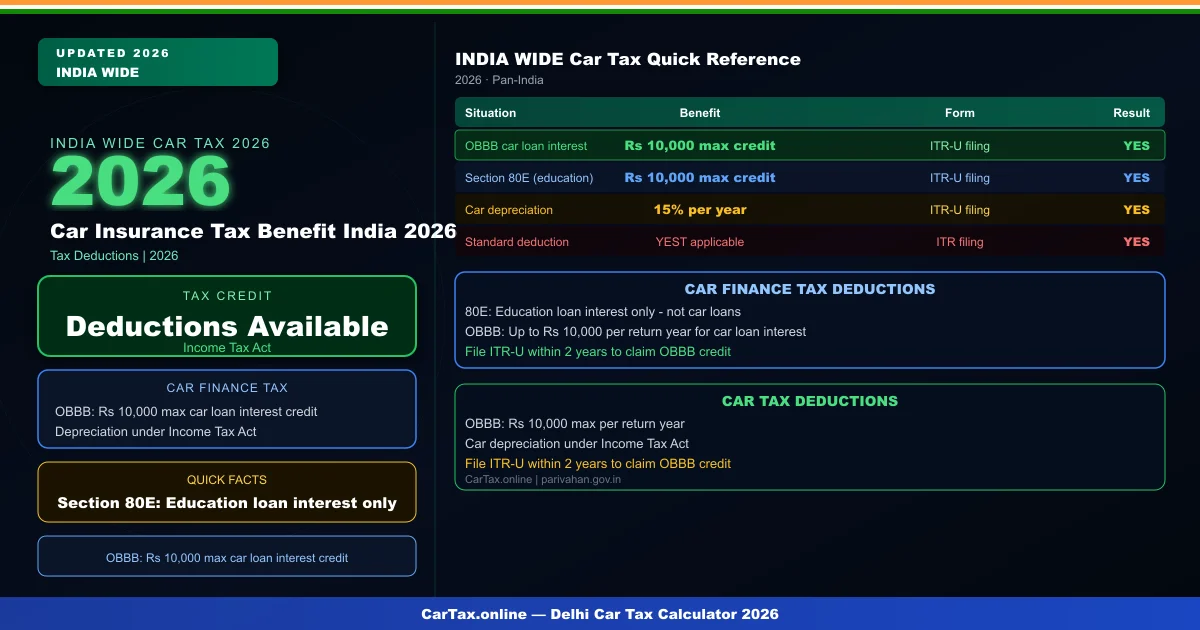
Car insurance tax benefit in India in 2026 is a nuanced area that many vehicle owners miss entirely. While there is no standalone car insurance deduction under Section 80D (which covers health insurance), the own damage portion of a car insurance premium for a business-use vehicle qualifies as a deductible business expense. Additionally, GST input tax credit on motor insurance is available to GST-registered businesses under specific conditions. This guide covers the complete framework of car insurance tax benefits and how to claim them correctly.
The most common misconception is that Section 80D covers car insurance. It does not — Section 80D is exclusively for health insurance premiums and preventive health check-up costs. Car insurance deductions fall under the business expense provisions of the Income Tax Act for business-use vehicles, and under the GST input tax credit rules for GST-registered entities. CarTax.online tracks these rules as they evolve across financial years.
Own Damage Premium as a Business Expense Under Section 30
Section 30 of the Income Tax Act allows deduction of expenses on repairs, insurance, and maintenance of business assets. For a business-use car, the own damage premium component of the comprehensive motor insurance policy is deductible under Section 30 as a business expense. The deduction is available in the financial year the premium is paid.
The key condition is that the car must be used for business purposes — not personal use. If the car is partly personal and partly business, the deductible portion of the insurance premium is limited to the business-use percentage, supported by the same logbook evidence required for depreciation and interest deductions. The third-party liability insurance component is a statutory requirement and is separately deductible under the same provision.
GST Input Tax Credit on Car Insurance for Businesses
GST input tax credit on car insurance is a complex area governed by the CGST Act's restrictions on input tax credit for motor vehicles. Generally, input tax credit is NOT available on cars used for personal purposes or for commuting to and from a place of work. However, input tax credit IS available when the car is used for making taxable supplies (for example, a car used by a car rental business to provide taxable services) or when the car is a commercial vehicle.
For GST-registered businesses that genuinely use the car for business operations, the input tax credit on the insurance premium (subject to the overall input tax credit restrictions) can be claimed. For example, a GST-registered tour operator who insures a tourist vehicle can claim input tax credit on that insurance. A regular business owner commuting to office cannot.
Insurance Claim Taxation Rules
Insurance claims received for car damage are not taxable income in most circumstances. When your car is damaged and the insurance company pays for repairs or writes off the vehicle, the payment compensates for the loss — it is not income. You are merely being restored to the position before the loss occurred, which is not a taxable event under the Income Tax Act.
The exception is a business asset scenario where the insurance claim exceeds the written-down value of the vehicle, creating a deemed gain on disposal. In this case, the excess over written-down value is treated as a business income or capital gain and is taxable. This typically arises when a business vehicle with significant remaining book value is totalled and the insurance payout exceeds that value.
Frequently Asked Questions
Can I claim tax deduction for car insurance premium in India 2026?
Car insurance premium in India 2026 can generate a tax deduction under Section 80D of the Income Tax Act, but only for the own damage portion of the premium — not for third-party liability insurance. Section 80D allows deduction for health insurance premiums, preventive health check-up costs, and critical illness premiums. For car insurance, the own damage premium paid for a vehicle used for business purposes may qualify as a business expense under Section 30 or Section 37, not Section 80D.
Is Section 80D applicable to motor vehicle insurance?
Section 80D specifically covers health and preventive health insurance — it does not directly cover motor vehicle insurance premiums. The own damage premium for a car is deductible as a business expense under Section 30 of the Income Tax Act if the car is used for business, rather than under Section 80D. However, some tax advisors have argued that comprehensive motor insurance with a health-related personal accident rider could have a portion eligible under 80D — this remains a grey area and requires professional advice.
Can I claim GST input tax credit on car insurance?
GST input tax credit on car insurance is available only to GST-registered businesses that use the car for business purposes. Under the CGST Act, input tax credit for motor vehicles is restricted — businesses cannot claim input tax credit on cars unless the vehicle is used for making taxable supplies, is a commercial vehicle, or is a vehicle for transportation of goods or passengers. Input tax credit on personal-use car insurance is not available even for GST-registered individuals.
Are insurance claims on cars taxable income?
Insurance claims received for damage to a car are generally not taxable income. When a car is damaged and you receive an insurance claim, the reimbursement is for the loss of the asset or repair costs — it does not constitute income under the Income Tax Act. However, if the insurance claim exceeds the written-down value of a business asset (creating a gain on disposal), or if the claim is for loss of profits from a business interruption, different rules may apply.
What are the Section 80D deduction limits for AY 2026-27?
Section 80D deduction limits for AY 2026-27 are: INR 25,000 per year for self and family (INR 50,000 for senior citizens), with an additional INR 25,000 for parents (INR 50,000 if parents are senior citizens). An extra INR 5,000 is available for preventive health check-ups within these limits. These limits apply to health insurance premiums, not motor insurance. Car insurance own damage premiums are claimed as business expenses under Sections 30 or 37, outside the Section 80D framework.
Official Resources
For authoritative Section 80D provisions and current deduction limits, refer to the Income Tax Department portal. For GST input tax credit rules and restrictions on motor vehicle credit, refer to the GST portal and CGST Rules. IRDAI (Insurance Regulatory and Development Authority of India) provides guidelines on motor insurance policy structures at irda.gov.in.