car import tax india
Car import tax India 2026 — customs duty, GST, and cess on imported vehicles.

Understanding Car Import Tax in India — April 2026

Car import tax in India is one of the highest in the world, and for good reason — the government actively protects domestic automobile manufacturing under the Make in India initiative. In April 2026, anyone importing a car into India faces a multi-layered tax structure that can push the total cost of an imported vehicle to nearly double its international price.

The import tax system distinguishes between Completely Built Up (CBU) vehicles imported as finished cars, Semi-Knocked Down (SKD) kits assembled in India, and Completely Knocked Down (CKD) units that arrive in parts for domestic assembly. Each category attracts different duty rates.

Customs Duty Rates for Imported Cars in 2026

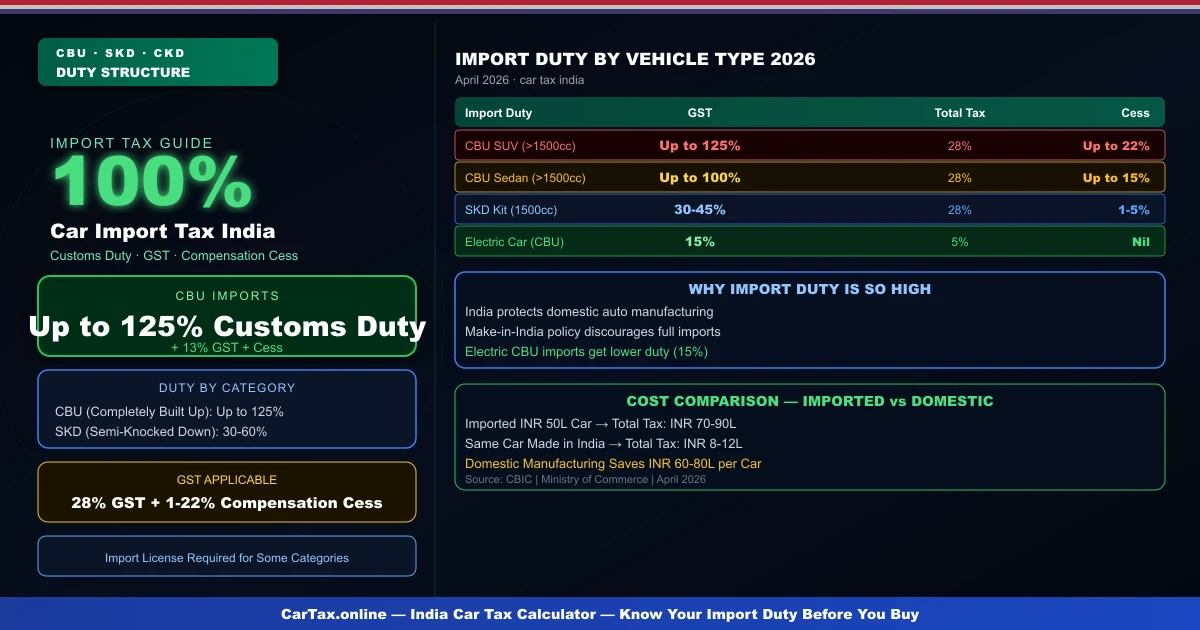
For CBU (Completely Built Up) imports, customs duty can reach up to 125% of the assessable value for large SUVs and luxury sedans. Mid-size imported cars typically attract customs duty of 60-100% depending on engine capacity and vehicle category. These high duties are designed to protect Indian manufacturers like Maruti, Hyundai, Tata, and Mahindra from foreign competition.

For SKD (Semi-Knocked Down) kits where basic assembly happens in India, customs duty drops to 30-45%. For CKD (Completely Knocked Down) units assembled domestically, duty rates are the lowest, making it more viable for manufacturers to bring in vehicles for local assembly.

GST and Compensation Cess on Imported Cars

Beyond customs duty, imported cars attract 28% GST on the customs-cleared value. Additionally, a Compensation Cess applies to certain vehicle categories — SUVs and luxury sedans with engine capacity above 1500cc can attract cess of up to 22% on top of the GST. The total tax on a large imported SUV can therefore reach 50-175% of the original vehicle cost.

Electric cars enjoy significantly lower import duties — CBU electric vehicles are taxed at just 15% customs duty plus 5% GST with no compensation cess, making them the most viable category for imported EVs.

Total Cost Example — Imported vs Domestic Car

Consider a luxury SUV priced at INR 50 lakh (INR 5 million) in its country of origin. The import tax calculation works as follows: customs duty at 100-125% adds INR 50-62.5 lakh, GST at 28% on the cleared value adds another INR 20-30 lakh, and compensation cess of 10-20% adds INR 10-15 lakh. The total tax alone reaches INR 80-1.07 crore, meaning the car costs INR 1.3-1.57 crore before it even reaches a showroom.

The same vehicle manufactured domestically in India would cost INR 50 lakh plus GST (18-28%) and state road tax (3-10%), bringing the total to approximately INR 60-70 lakh — less than half the imported equivalent.

Who Actually Imports Cars into India?

Despite the high duties, certain categories of car buyers still import vehicles. NRIs returning to India can import one car duty-free under personal baggage rules if they have lived abroad for more than two years. Diplomats and certain international organisations receive duty concessions under bilateral agreements. Antique and classic car enthusiasts sometimes import vehicles that are no longer manufactured in India.

High-net-worth individuals importing supercars and luxury vehicles also exist, though the economics are challenging — a INR 2 crore Ferrari in Europe can cost INR 6-8 crore by the time it lands in an Indian showroom after all import duties.

Frequently Asked Questions

What is the current customs duty on imported cars in India?

For the most accurate information about car import tax india, visit the official Parivahan portal or your nearest Regional Transport Office. Tax rules, rates, and exemptions are updated periodically by government authorities, so always verify current information before making financial decisions.

How is car import tax calculated in India for CBU vehicles?

For the most accurate information about car import tax india, visit the official Parivahan portal or your nearest Regional Transport Office. Tax rules, rates, and exemptions are updated periodically by government authorities, so always verify current information before making financial decisions.

Is it worth importing a car to India given the high duties?

For the most accurate information about car import tax india, visit the official Parivahan portal or your nearest Regional Transport Office. Tax rules, rates, and exemptions are updated periodically by government authorities, so always verify current information before making financial decisions.

Do electric cars have lower import duties in India?

For the most accurate information about car import tax india, visit the official Parivahan portal or your nearest Regional Transport Office. Tax rules, rates, and exemptions are updated periodically by government authorities, so always verify current information before making financial decisions.

Can NRIs import a car to India duty-free?

For the most accurate information about car import tax india, visit the official Parivahan portal or your nearest Regional Transport Office. Tax rules, rates, and exemptions are updated periodically by government authorities, so always verify current information before making financial decisions.

Conclusion

Car import tax in India is deliberately high to protect domestic manufacturing. For most buyers, purchasing a car manufactured in India makes far more financial sense than importing — the savings on tax alone can be INR 50 lakh or more on a premium vehicle. If you are considering an import, always calculate the total cost including customs duty, GST, cess, shipping, and compliance costs before committing.

Frequently Asked Questions

Q: What is the current road tax rate for cars in India 2026?
Road tax rates in India vary by state and vehicle category. For new cars, GST is charged at 5% for EVs, 18% for hybrids under 1,200cc, and up to 28% for petrol/diesel SUVs. State road tax is charged separately and varies from Rs3,000-15,000 annually depending on the state's slab system. Check your specific state's RTO website for current rates.

Q: How do I calculate my car road tax online in India?
You can calculate your car road tax using online calculators available on state RTO portals and CarTax.online. The calculation considers your vehicle's ex-showroom price, fuel type, engine capacity, and state of registration. Road tax is payable annually or for the vehicle's lifetime depending on your state's rules.

Q: Is GST included in the road tax for new cars in India?
No — GST and road tax are separate charges. GST is a central tax charged by the vehicle manufacturer at the time of purchase. State road tax is a separate annual or one-time charge levied by your state's transport department. Both apply at the time of first registration, and annual road tax continues for subsequent years.

Q: Do electric vehicles get tax benefits in India 2026?
Yes — electric vehicles in India qualify for a reduced GST rate of 5% (down from 28% for petrol cars). Under FAME-III subsidies, EVs may also qualify for additional state-level incentives, reduced road tax, and free registration in many states. The exact benefits vary by state.

Q: What happens if I don't pay my car road tax on time?
If you don't pay road tax, your vehicle's registration can be flagged in the Vahan database, preventing renewal of fitness certificates and creating legal liability during police checks. Penalties range from Rs200-500 per day of default in most states. Road tax is a legal requirement under the Motor Vehicles Act.