Car Depreciation Under Income Tax Act — Who Can Claim
If you use a car for business purposes in India, you can claim depreciation as a deduction against your business income under Section 32 of the Income Tax Act, 1961. In April 2026, this remains one of the most significant tax benefits available to self-employed individuals and businesses that own cars for commercial purposes.
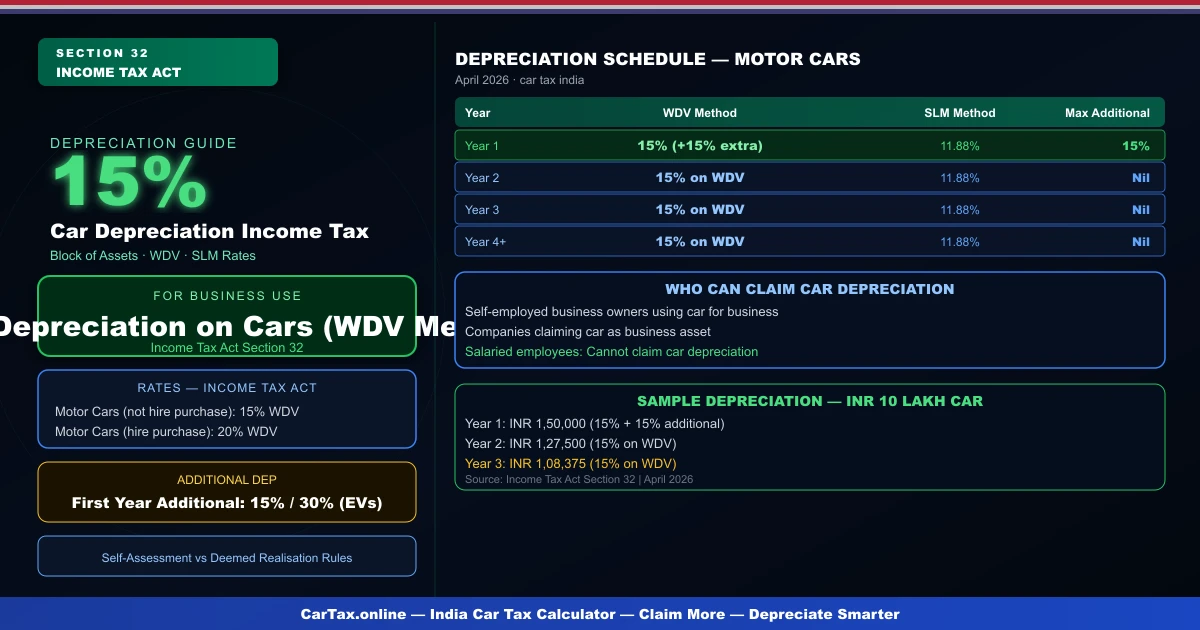
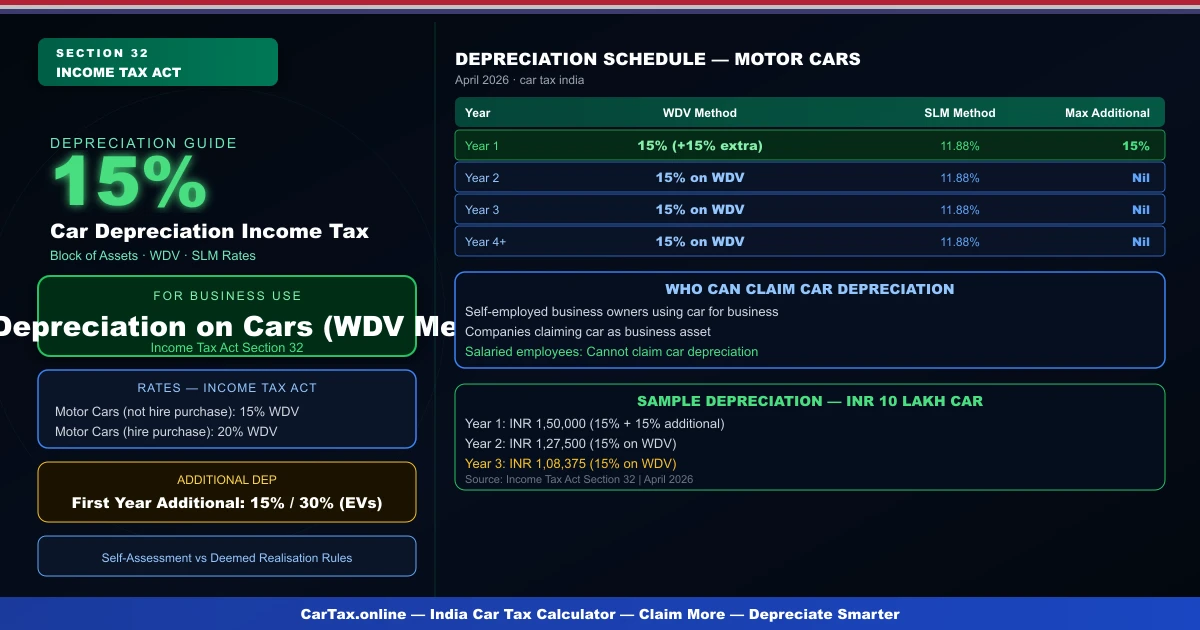
Salaried employees cannot claim car depreciation on their personal tax returns — depreciation is a business expense deduction, not a personal tax benefit. If you are a self-employed professional, a business owner, or a company, you can claim car depreciation on vehicles used for business operations.
Depreciation Rates for Motor Cars Under Section 32
Under the Income Tax Act, motor cars (not acquired on hire purchase) attract depreciation at 15% per year under the Written Down Value (WDV) method. This is the most commonly used method. Motor cars acquired on hire purchase attract a slightly higher rate of 20% per year under WDV, reflecting the financing cost component.
Under the Straight Line Method (SLM), the depreciation rate for motor cars is 11.88% per year (equivalent to 15% WDV over the presumed 15-year block life). Most businesses prefer WDV as it front-loads the deduction, providing larger tax savings in the early years of vehicle ownership.
Additional Depreciation — First Year Boost
Beyond the standard rate, businesses can claim additional depreciation of 15% of the cost of the car in the first year of acquisition. This additional deduction was introduced to incentivise capital expenditure. For electric vehicles, the additional depreciation is even higher at 30% in the first year, reflecting the government's push toward electric mobility.
Total first-year depreciation on a car purchased for business use can therefore reach 30% under WDV (15% standard + 15% additional) for petrol/diesel cars and 45% for electric vehicles (15% standard + 30% additional). This significantly accelerates the tax deduction in the year of purchase.
Block of Assets Concept — Important for Multiple Cars
Income tax depreciation operates on a "block of assets" basis. All motor cars fall into a single block taxed at 15% WDV. If you own multiple cars for business, they are all depreciated within the same block. If the total depreciation in a year exceeds the written down value of the entire block, only up to the WDV can be claimed — the excess is lost.
If you sell a car from the block, the sale proceeds reduce the block's WDV. If the block's WDV becomes zero, no further depreciation can be claimed on any remaining cars in that block until a new acquisition is made.
Sample Depreciation Calculation — INR 10 Lakh Business Car
For a car used for business purchased at INR 10 lakh: Year 1 — 15% standard depreciation (INR 1,50,000) + 15% additional depreciation (INR 1,50,000) = INR 3,00,000 total deduction; Year 2 — 15% on WDV of INR 7,00,000 = INR 1,05,000; Year 3 — 15% on WDV of INR 5,95,000 = INR 89,250; Year 4 — 15% on WDV of INR 5,05,750 = INR 75,863.
By the end of Year 4, you have claimed approximately INR 5.7 lakh in total depreciation against an original cost of INR 10 lakh.
Deemed Realisation and Tax Implications
When a car is sold, the proceeds are compared to the block's WDV. If proceeds exceed WDV, the excess is treated as income under "income from other sources." If the block has nil WDV and you sell a car, the entire proceeds may be taxable. For businesses regularly renewing their fleet, understanding deemed realiation rules prevents unexpected tax bills at the time of vehicle disposal.
Frequently Asked Questions
Can salaried employees claim car depreciation under income tax?
For the most accurate information about car depreciation income tax, visit the official Parivahan portal or your nearest Regional Transport Office. Tax rules, rates, and exemptions are updated periodically by government authorities, so always verify current information before making financial decisions.
What is the depreciation rate for motor cars under Section 32?
For the most accurate information about car depreciation income tax, visit the official Parivahan portal or your nearest Regional Transport Office. Tax rules, rates, and exemptions are updated periodically by government authorities, so always verify current information before making financial decisions.
How is additional depreciation on cars claimed in the first year?
For the most accurate information about car depreciation income tax, visit the official Parivahan portal or your nearest Regional Transport Office. Tax rules, rates, and exemptions are updated periodically by government authorities, so always verify current information before making financial decisions.
What is the Written Down Value (WDV) method for car depreciation?
For the most accurate information about car depreciation income tax, visit the official Parivahan portal or your nearest Regional Transport Office. Tax rules, rates, and exemptions are updated periodically by government authorities, so always verify current information before making financial decisions.
How does car depreciation work when I sell the vehicle?
For the most accurate information about car depreciation income tax, visit the official Parivahan portal or your nearest Regional Transport Office. Tax rules, rates, and exemptions are updated periodically by government authorities, so always verify current information before making financial decisions.
Conclusion
Car depreciation income tax under Section 32 provides significant deductions for businesses that use vehicles for commercial purposes. Understanding the 15% WDV rate, the additional first-year depreciation, and the block of assets concept helps you maximise your legitimate tax deductions while staying compliant with Income Tax Act provisions.
Frequently Asked Questions
Q: What is the current road tax rate for cars in India 2026?
Road tax rates in India vary by state and vehicle category. For new cars, GST is charged at 5% for EVs, 18% for hybrids under 1,200cc, and up to 28% for petrol/diesel SUVs. State road tax is charged separately and varies from Rs3,000-15,000 annually depending on the state's slab system. Check your specific state's RTO website for current rates.
Q: How do I calculate my car road tax online in India?
You can calculate your car road tax using online calculators available on state RTO portals and CarTax.online. The calculation considers your vehicle's ex-showroom price, fuel type, engine capacity, and state of registration. Road tax is payable annually or for the vehicle's lifetime depending on your state's rules.
Q: Is GST included in the road tax for new cars in India?
No — GST and road tax are separate charges. GST is a central tax charged by the vehicle manufacturer at the time of purchase. State road tax is a separate annual or one-time charge levied by your state's transport department. Both apply at the time of first registration, and annual road tax continues for subsequent years.
Q: Do electric vehicles get tax benefits in India 2026?
Yes — electric vehicles in India qualify for a reduced GST rate of 5% (down from 28% for petrol cars). Under FAME-III subsidies, EVs may also qualify for additional state-level incentives, reduced road tax, and free registration in many states. The exact benefits vary by state.
Q: What happens if I don't pay my car road tax on time?
If you don't pay road tax, your vehicle's registration can be flagged in the Vahan database, preventing renewal of fitness certificates and creating legal liability during police checks. Penalties range from Rs200-500 per day of default in most states. Road tax is a legal requirement under the Motor Vehicles Act.