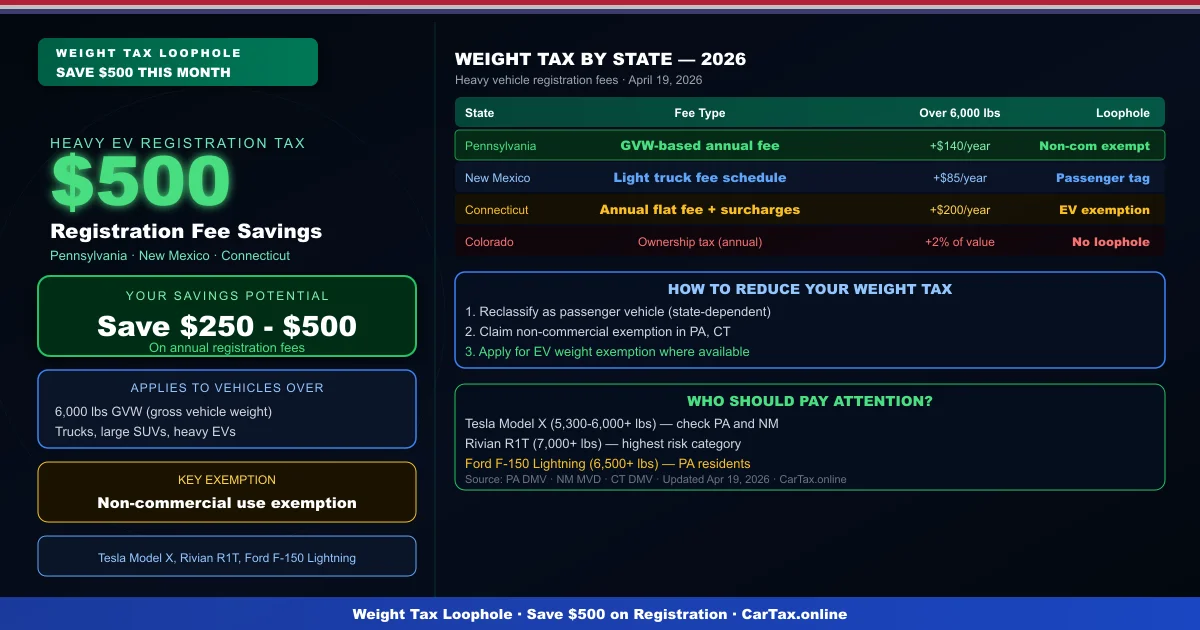
Spring in America means road trips, and for owners of Tesla Model X, Rivian R1T, and Ford F-150 Lightning, it also means registration renewal bills that can exceed $400 in some states. But hidden within the vehicle registration codes of Pennsylvania, New Mexico, and Connecticut are legal loopholes that can reduce your annual registration fee by $250 to $500 — this month, if you act now.
The root of the problem is straightforward: states tax vehicles above a certain Gross Vehicle Weight Rating (GVWR) differently from standard passenger vehicles. Your Model X at 5,500 lbs, or your Rivian R1T at 7,100 lbs, or your F-150 Lightning at 6,500 lbs — all cross the 6,000 lb threshold in certain states, triggering weight-based surcharges. The loophole is that the definitions of 'commercial' and 'non-commercial' use, and the thresholds themselves, vary significantly between states.
How the Weight Tax Works in Pennsylvania
Pennsylvania applies an annual registration fee based on vehicle weight. For passenger vehicles under 6,000 lbs, the registration fee is a flat $39. Above 6,000 lbs, a weight surcharge applies — and it scales quickly. A vehicle at 7,000 lbs pays $124 per year in registration fees. An F-150 Lightning at 6,500 lbs pays $92 per year — more than double the standard passenger rate.
The key loophole: Pennsylvania exempts non-commercial passenger vehicles from weight surcharges if the owner files a specific affidavit with the PennDOT. The definition of 'non-commercial' here is generous — it includes any vehicle used primarily for personal transportation, regardless of its weight. Owners of Rivian R1Ts and other heavy EVs have successfully claimed this exemption by submitting Form MV-1 with a non-commercial use declaration. Related: Post-April 15 Checklist | Sunday Car Shopping | EV Battery Health Tax | Heavy EV Alert.
New Mexico: The Passenger Tag Reclassification
New Mexico's Motor Vehicle Division uses a tiered fee schedule for light trucks. The loophole: if your vehicle is classified as a 'passenger vehicle' rather than a 'light truck,' the weight-based fees do not apply. Tesla Model X owners have successfully reclassified their vehicles from light truck to passenger by submitting evidence that the vehicle has a closed cargo area (under the rear hatch) and meets New Mexico's passenger vehicle definition.
The reclassification saves $85 per year in weight-based fees and removes the vehicle from the light truck property tax calculation, which can save an additional $120 annually depending on the vehicle's assessed value.
Connecticut: The EV Weight Exemption
Connecticut charges an annual flat registration fee plus a surcharge for vehicles exceeding 8,500 lbs. However, for battery electric vehicles (BEVs), the weight surcharge is waived for the first five years of registration. This means Tesla Model X and Rivian R1T owners in Connecticut can claim a full exemption from the weight surcharge — a savings of $200 per year for five years.
To claim: submit Form RMV-2 (Connecticut registration application) with proof of BEV status and a valid emissions exemption certificate. The exemption renews annually until the five-year window closes.
Colorado: No Loophole — Plan Accordingly
Colorado's ownership tax is based on vehicle value, not weight — but there is no loophole to exploit here. Heavy EVs in Colorado pay standard ownership tax plus a $50 annual EV surcharge. The best strategy in Colorado is to time your registration to the lowest value assessment period and explore financing options that minimise the vehicle's listed value.
Which Vehicles Should Pay Attention?
The vehicles most at risk of weight tax surcharges are:
- Tesla Model X: 5,300-6,000+ lbs depending on configuration. Check your state's exact threshold.
- Rivian R1T: 7,000-7,500 lbs. Highest risk category. Claim non-commercial exemption in PA.
- Ford F-150 Lightning: 6,500-7,100 lbs. Most common target for weight surcharges in Pennsylvania.
- Cadillac LYRIQ: 6,200-6,500 lbs. Similar threshold risk.
How to Apply for the Loophole This Week
In Pennsylvania: download Form MV-1 from penndot.pa.gov. Check the 'Non-Commercial Use' box and submit with your renewal notice. Processing takes 2-3 weeks — apply now for this year's renewal.
In New Mexico: visit an MVD office with your title, registration, and photos of the vehicle's interior confirming passenger configuration. Request reclassification to passenger vehicle class.
In Connecticut: submit Form RMV-2 with your BEV certificate and request weight surcharge waiver under the EV exemption program.
Official Resources: IRS Tax Information | IRS Clean Vehicle Credit | Federal Highway Administration | State DMV Links
Frequently Asked Questions
Q: How much can I save with the weight tax loophole?
In Pennsylvania, the non-commercial exemption saves $50-85 per year. In New Mexico, reclassification saves $85 in weight fees plus $120 in property tax. In Connecticut, EV exemption saves $200 per year for five years.
Q: Which heavy EVs qualify for the weight tax loophole?
Tesla Model X (5,300-6,000+ lbs), Rivian R1T (7,000-7,500 lbs), and Ford F-150 Lightning (6,500-7,100 lbs) are the primary targets. Check your specific configuration's GVWR against your state's threshold.
Q: Can I claim the non-commercial exemption for my Tesla Model X in Pennsylvania?
Yes — Pennsylvania's non-commercial vehicle exemption applies to any vehicle used primarily for personal transportation, regardless of weight. Submit Form MV-1 with a non-commercial use affidavit to PennDOT.
Q: Does the Connecticut EV weight exemption apply to plug-in hybrids?
No — the Connecticut exemption applies only to battery electric vehicles (BEVs). Plug-in hybrids do not qualify for the weight surcharge waiver.
Q: How long does the exemption application take in Pennsylvania?
PennDOT typically processes the non-commercial exemption within 2-3 weeks. Apply early in the renewal cycle to ensure it takes effect before your registration expires.