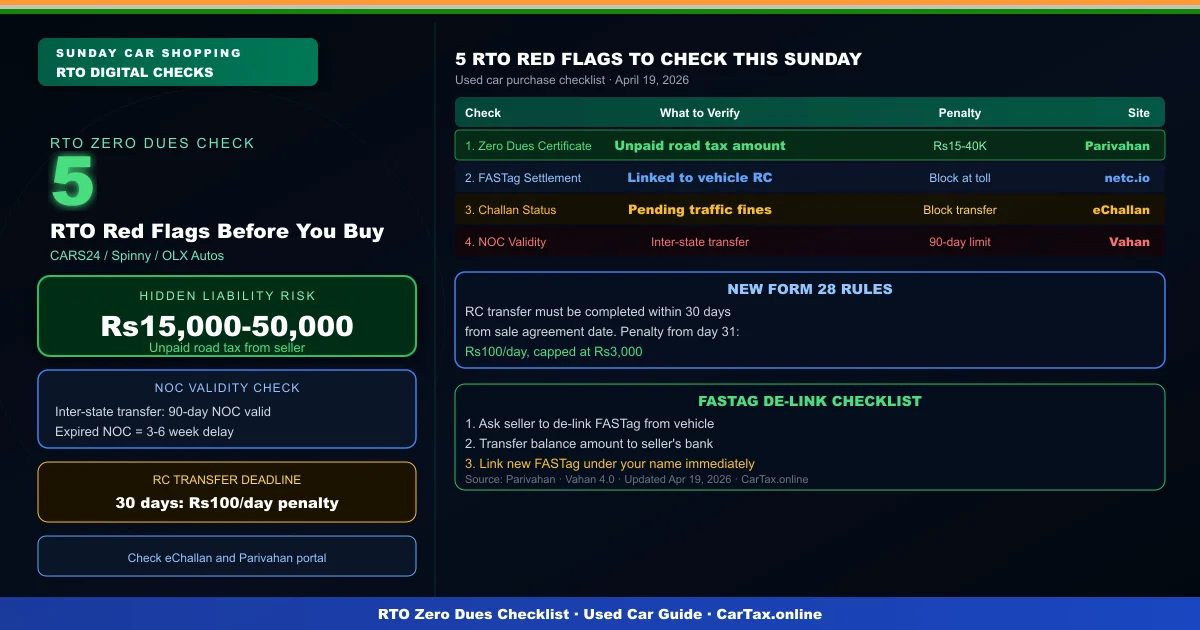
If you are planning to buy a used car this weekend in India, the most important document you can ask the seller for is not the insurance certificate or the service history — it is the Zero Dues Certificate (ZDC). Without this, you inherit every unpaid road tax liability from the previous owner. In Delhi, Maharashtra, and Karnataka particularly, road tax for a 5-year-old car can accumulate to Rs15,000-40,000 depending on the vehicle's age and category. And unlike other fees, road tax cannot be negotiated away after the sale. It becomes your problem the moment the RC is transferred to your name.
On this Sunday afternoon in April 2026, with the used car market buzzing after the weekend, the Ministry of Road Transport's Vahan 4.0 and Parivahan portals have made checking these risks easier than ever. This guide walks you through every digital check you should run before signing any deal — whether you are buying from CARS24, Spinny, or an individual seller on OLX Autos.
Check 1: Zero Dues Certificate on Parivahan
The Zero Dues Certificate is the seller's proof that all road tax has been paid up to the date of sale. Without it, the buyer's RTO will not complete the transfer — and the buyer becomes legally responsible for the previous owner's unpaid road tax. In Delhi, the road tax for a petrol car above 1,000cc but under 1,200cc is Rs3,545 per year. For a car registered in 2019, that is approximately Rs21,270 in unpaid tax if the previous owner neglected payments. In Maharashtra, the road tax structure is different but equally significant.
How to check: Visit parivahan.gov.in, enter the vehicle registration number, and navigate to 'Tax Details'. If the tax status shows 'Paid' with a recent date, the ZDC should be available. If it shows 'Unpaid' or a date older than 12 months, ask the seller to produce the ZDC from their state RTO before proceeding. Related: Sunday Used Car Guide | 8th Pay Commission Sunday Analysis | 8th Pay Commission Analysis | BH-Series Registration.
Check 2: FASTag Settlement on netc.io
FASTag is now mandatory for all vehicles in India, and every FASTag is linked to the vehicle's RC number. If the previous owner did not de-link their FASTag from the vehicle before selling, the buyer inherits all toll charges — and potential negative balance — from the previous owner's highway usage. More critically, if the NHAI flags the tag for a disputed toll, it can block your vehicle at a toll plaza.
How to check: Visit netc.io, enter your vehicle registration number, and verify if a FASTag is active and its current balance. Ask the seller to show their FASTag app, confirm the balance transfer to their bank account, and request a screenshot of the de-linking confirmation from their bank. Do not accept 'I will do it later' — the FASTag should be de-linked at the time of sale, not after.
Check 3: Traffic Challan Status on eChallan
Traffic challans accumulated by the previous owner do not disappear with a sale. If a car has unpaid challans, the transfer process in most states will reveal them — and RTO offices will not complete the transfer until fines are cleared. The most common trap: a seller who accumulated challans in a different state from where you are registering. These are the hardest to resolve and can delay the transfer by weeks.
How to check: Use the eChallan portal (echallan.parivahan.gov.in), enter the vehicle registration number, and scan for any challans from the past 6 months. Also search by state — some state traffic police issue challans that don't immediately appear in the central database. If you find any, negotiate the amount as a price reduction before the sale, or insist the seller pays and clears them before the transfer appointment.
Check 4: NOC Validity for Inter-State Transfers
If you are buying a car registered in a different state — common with CARS24 and Spinny inventory from other cities — you need a No Objection Certificate (NOC) from the original RTO. As of April 2026, NOCs are issued digitally through the Vahan portal and are valid for 90 days from the date of issue. An expired NOC blocks inter-state transfer completely. A fresh NOC requires the vehicle to be physically submitted to the original RTO, which can take 3-6 weeks.
How to check: Ask the seller for the NOC document number and date of issue. Cross-reference it on the Vahan portal to verify its validity. If the NOC was issued more than 75 days ago, insist on a fresh one before the sale. If the NOC has already expired, walk away from the deal — or negotiate a minimum Rs10,000 discount to cover the hassle and delay of re-applying.
Check 5: RC Transfer Deadline — 30 Days After Sale
Under the amended Motor Vehicles Act rules effective January 2026, the buyer must complete RC transfer within 30 days of the sale agreement date. After day 31, a penalty of Rs100 per day applies — capped at Rs3,000 maximum. Many sellers 'park' cars under their company or dealer name to avoid this penalty, which changes the transfer tax rate and creates additional documentation requirements for the buyer.
How to check: Request the original sale agreement date and calculate the days elapsed. If more than 25 days have passed, insist on completing the transfer immediately. If the car is registered under a company name, you are buying from a business entity, not an individual — the transfer tax and documentation requirements are different. Negotiate accordingly.
Official Resources: Parivahan Portal | Vahan Road Tax | India GST Portal | FAME-III Scheme
Frequently Asked Questions
Q: How do I check if a used car has unpaid road tax?
Visit parivahan.gov.in, enter your vehicle registration number, and check the Tax Details section. If it shows 'Paid' with a recent date, the zero dues certificate should be available from the seller.
Q: What happens if I buy a car without a Zero Dues Certificate?
You inherit the previous owner's unpaid road tax liability. In Delhi and Maharashtra, this can be Rs15,000-40,000 depending on vehicle age and category.
Q: How do I de-link a FASTag when buying a used car?
Ask the seller to de-link their FASTag from the vehicle via their bank or the netc.io portal. Transfer any balance to the seller's bank account, and link a new FASTag under your name immediately.
Q: How long is a NOC for inter-state car transfer valid?
90 days from the date of issue. If expired, you need a fresh NOC from the original RTO, which can take 3-6 weeks.
Q: What is the RC transfer penalty for delayed transfer?
Rs100 per day from day 31 after the sale date, capped at Rs3,000 maximum.